
Frameworks are useful for naming the competences that matter. The European Commission’s LifeComp framework describes nine of those competences across Personal, Social, and Learning to Learn areas; to help us to navigate complexity, become responsible members of society, and grow as reflective lifelong learners. We develop these competences in different ways and in different settings and sport and physical activity is one of the environments in which they are built, often without anyone naming them as such.
The benefits of physical activity for physical and mental health are well known, but sport can also enrich personal and social experience. EAEA’s Manifesto (2024) notes that well-being and resilience have a very positive impact on social life and professional development, and that actively promoting well-being in and outside the workplace helps prevent long-term inactivity caused by burnout and other stress-related health problems. European policy increasingly reflects this. The European Sport Model frames sport around social and cultural values, highlighting inclusion, diversity and equality, and the Commission is due to publish a Communication by the end of 2026 setting out a strategic vision for sport in Europe that builds on it. While progress is being made, physical activity and sports need to be better connected to education and competence development.
Judo as interdisciplinary practice
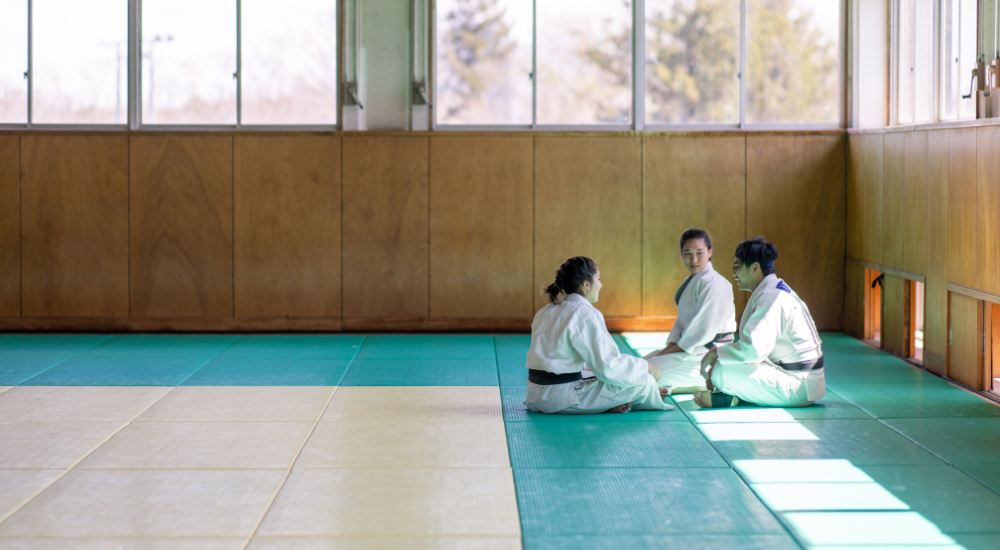
Judo is a great example of how sports encompass a wide range of competences. When Jigorō Kanō, an educator from Japan, founded judo in the late 19th century, he did not merely refine martial arts; he developed an interdisciplinary activity based on two principles: Seiryoku Zenyo (maximum efficient use of energy) and Jita Kyoei (mutual prosperity for self and others). Practising judo requires interconnected coordination of the body, mind, and spirit at the individual and collective levels, encouraging more than physical strength, but also developing personal, social and learning competences.
Using LifeComp as a reference, several skills can be highlighted across these three areas. These skills are increasingly important in a constantly changing world, and judo provides an environment in which they can be developed. Why? Because judo is an integrated practice that goes beyond combat or a single training session, fostering continuous practice and interaction with others in respectful and meaningful ways.
Personal competences
Judo develops all three of LifeComp’s personal competences. The first is self-regulation. Judo’s principles imply a deep knowledge of oneself and one’s own limits, which extends into the ability to recognise and respect the limits of others. The second is flexibility. Judo supports learners in adapting, managing unexpected situations, and looking for multiple solutions. The third competence is well-being. In judo, this is understood on a physical level, through movement and coordination; mental, through concentration and the management of stress and emotions; and on a social level, through relationships based on respect, trust, and collaboration.
Social competences
Judo also develops empathy, communication, and collaboration. Empathy grows because judo supports the capacity to feel, understand, and respect another person. All these translate positively in social relations. Communication in judo comes through the body, where judokas learn to perceive the energy, intentions, and emotions of the other person. Collaboration is key in randori (cooperative practice) when two judokas challenge each other’s ability to solve problems in real time. It is a space of listening, respect, mutual responsibility, and the ability to create something meaningful together.
Learning to learn competences
Acquiring personal and social competences depends on a willingness to reflect and to learn. Judo continuously invites judokas to re-evaluate and try new techniques and strategies; improvements are only possible with consistent training. Continuous learning in judo draws on awareness, reflection, critical thinking, and a sense of responsibility at the individual level, as much as within the group. Judo requires a moment for dialogue and discussion (mondō) where one develops critical thinking and self-reflection. This way, judo can be seen as a learning journey in which people learn to make decisions actively and responsibly.
How can all of this translate in practice? Judo for Lifelong Learning Communities project
Recognising all this potential, EAEA is working on the Judo for Lifelong Learning Communities project that aims to support Judo trainers and practitioners to recognise, articulate, and intentionally develop a diverse range of competences embedded in Judo. In order to facilitate this learning process, an upcoming platform for Judo communities across Europe will be made available. For more information and updates, visit the project’s web page.
EU-funding acknowledgement
JUDO4LLL is an Erasmus+ Sport project.

Funded by the European Union. Views and opinions expressed are however those of the author(s) only and do not necessarily reflect those of the European Union or the European Education and Culture Executive Agency (EACEA). Neither the European Union nor EACEA can be held responsible for them.
Text: Amaya Gomezgil Gabriel, Maria Gonçalves RibeiroPhotos: Satoshi K – Getty Images