
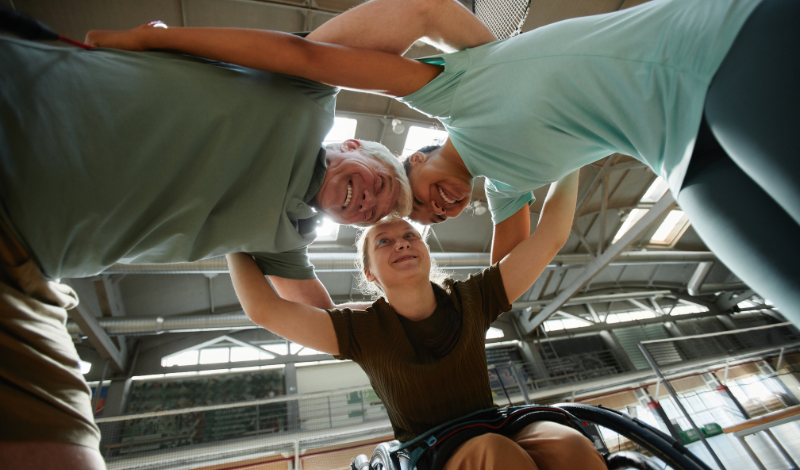
The role of sports in learning and its role as a learning environment in itself is also often overlooked. Beyond developing physical skills that benefit health, sport requires active engagement, which can contribute to building stronger groups and communities. To learn more about the European dimension of sports and EAEA’s position on the importance of sports in adult learning, read our previous article: Learning through sports and physical activity.
Projects supporting non-formal adult education through sports
Despite the potential of sports to foster capacity- and community-building, only a limited number of initiatives have recognised and fully realised this potential for lifelong learning through sports.
One of these was the Erasmus+ funded project Sustainable Development Through Sport, which operated in Turkey, North Macedonia, Slovenia, and France and aimed at supporting low-skilled adults in acquiring basic skills and competences through sports. A special focus was empowering women by raising awareness of their rights through physical activities. The theoretical frameworks and practical tools that the projects provided were not only intended to assist adult educators and sports trainers in integrating sports into adult education, but also to train them in three main topics: Innovation and Entrepreneurship, Learning to Learn, and Social, Cultural and Active Citizenship.
Similarly, the Erasmus+ funded project Physical Literacy for Life promoted the idea of “learning through movement”. It suggests that sport goes beyond physical abilities as it also involves the development of basic competences, which can contribute to mental and social well-being. In order to fulfil their mission of improving every generation’s lifestyle across Europe and Australia, several theoretical and practical resources were provided, such as self-assessment tools to assist individuals, teachers, and trainers to pursue a more active physical lifestyle.
Another was aETS – adult Education Through Sport (Erasmus+ project), which combined formal and non-formal education through innovative methods. The activities were organised by Bulgaria, Great Britain, Italy, and Poland. With the help of virtual-reality tools, the project provided digital tutorials to improve sports practices in an accessible and collaborative manner. Its materials encouraged healthy habits and lifelong learning, especially for adults facing social inequalities.
With support from the EU, the Integration of Refugees Through Sport (IRTS) (by ISCA) highlights the social and emotional benefits of sports that facilitate community-building and social inclusion. The resource hub includes practical guides and online courses to promote integration of migrants through sports.
Zooming in on the case of judo for lifelong learning
A great example of a sport that embeds learning at its core is judo. Jigorō Kanō, the founder of judo, described judo as more than a sport, but as “a physical, intellectual and moral education”. Judokas (judo practitioners) have reported several health benefits of judo, such as improved balance, flexibility, strength, and treatment of some diseases, especially related to ageing (Palumbo et al., 2023). These improvements facilitate tasks in daily life, which can help contribute to a better quality of life while strengthening one’s self-sufficiency and confidence. In fact, judo draws on two philosophical principles: Jita Kyoei and Seiryoku Zenyo, which highlight that judo relies on one’s efficient mental and physical energy use, while also requiring personal well-being and cooperation with others for mutual benefit.
Projects such as the Judo Intellectual Disability Project (JIDP) and BE-JUDO-IN have developed adapted approaches for people with disabilities, demonstrating that judo’s emphasis on cooperation, physical contact, and mutual respect can support social inclusion and personal development regardless of individual ability. The EdJCO project (Educating Judo Coaches for Older Practitioners) specifically addresses the needs of older adults, recognising that the benefits of Judo practice are particularly relevant for ageing populations. Meanwhile, the Intergenerational Judo Project (JudoJoy) creates spaces where different generations learn together, reinforcing Judo’s role as a community-building practice.
Highlighted EAEA project: Judo for Lifelong Learning Communities
Given the interdisciplinary characteristics and benefits of judo, EAEA is currently working on the Judo for Lifelong Learning Communities (JUDO4LLC) project that highlights its role in competence development, particularly for adults. The project strives to foster well-being through the acquisition of basic and transversal skills and to engage in community-building and community-strengthening through active engagement. This mission is in line with our manifesto, where EAEA emphasises the importance of adult learning and the need to support adults in adapting to life experiences such as health-related problems, life transitions, and age-related changes (EAEA Manifesto, 2024).
If you’re curious about the project’s vision and would like to follow along its journey and keep up-to-date on its developments, find more information on the Judo for Lifelong Learning Communities’ project page. We will publish more updates soon!
EU-funding acknowledgement
JUDO4LLL is an Erasmus+ Sport project.

Funded by the European Union. Views and opinions expressed are however those of the author(s) only and do not necessarily reflect those of the European Union or the European Education and Culture Executive Agency (EACEA). Neither the European Union nor EACEA can be held responsible for them.
References
Palumbo, F., Ciaccioni, S., Guidotti, F., Forte, R., Sacripanti, A., Capranica, L., & Tessitore, A. (2023). Risks and Benefits of Judo Training for Middle-Aged and Older People: A Systematic Review. Sports, 11(3), 68. https://doi.org/10.3390/sports11030068.
Text: Lara Stoltz