
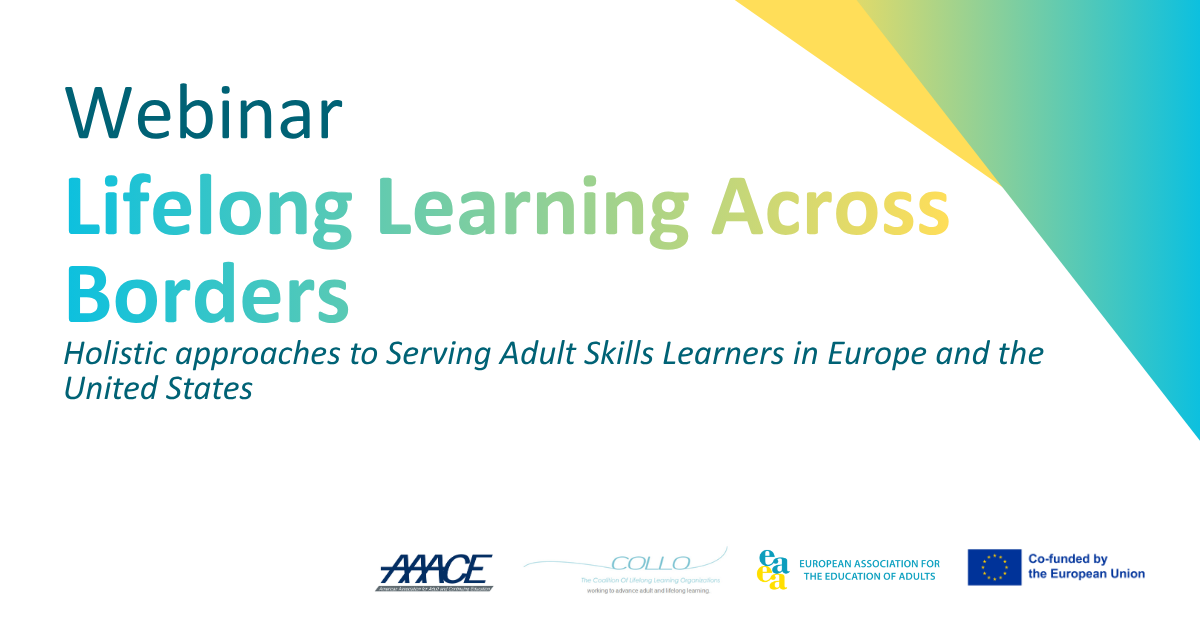
On November 3, 2026, we hosted the second session of the Lifelong Learning Across Borders format: Holistic Approaches to Supporting Adult Skills Learners in Europe and the United States. The event brought together diverse perspectives and experiences, offering an opportunity to explore similarities, differences, and best practices in adult learning across Europe and the United States.
Our first speaker, Anja Kathrin Meierkord, Policy Officer at the OECD, set the scene by providing an overview of the current state of adult education across European countries and the United States. She highlighted the importance of foundational skills and explained how they influence various aspects of adult life, including employment, wages, health and life satisfaction. She also shared that “65% of adults with low foundational skills are employed”
65% of adults with low foundational skills are employed
This highlights the importance of addressing foundational skills and making adult learning a priority.
Following this, Judith Alamprese, board member at COLLO, shared insights into the US experience, highlighting the goal of helping students prepare for their next steps in education, training and employment. She presented lessons learned from the implementation of adult skills programmes, emphasising that coordination and the use of services with partners are fundamental to providing multi-component adult skills services. She also highlighted the importance of offering a range of academic support to help learners succeed, supporting their career pathways and future education and training opportunities, and providing practical incentives such as free tuition and transferable college credits.
Ginny Seltenright, Assistant Vice Chancellor for Adult Education for College & Career (Acting) at Pima Community College, presented another perspective from the United States, focusing on the adult learners’ needs that they need to cover to achieve long-term success. She highlighted three key elements:
- Access: Removing barriers to entry and creating accessible educational opportunities tailored to diverse adult backgrounds.
- Acceleration: Fast-tracking skills acquisition and credential completion to connect learners to further education and workforce opportunities.
- Integrated, holistic support: Providing integrated support services to help learners throughout their educational journey.
Moving from the US perspective to the European context, Maria Gonçalves Ribeiro, Policy and Project Coordinator at EAEA, introduced several European initiatives and instruments, including the European Pillar of Social Rights (2017), the European Education Area (2021–2030), the Union of Skills (2025) and Upskilling Pathways (2016).
Maria highlighted that successful policies often take a holistic approach, bringing together multidisciplinary services to support people, including housing, health, employment services, and parental or carer support. She also shared examples of initiatives and projects, including ETHLAE, illustrating how adult learning can go beyond technical skills and how teaching digital skills is not only about developing technical competencies; it can also involve a broader approach that includes nutrition, personal development, social skills and learning to learn.
Ludwig Willaert, Coordinator at Ligo, also shared a European perspective, introducing six pillars to support Fuge: look, inspire, activate, care, push boundaries and connect. He presented practical examples, including the Parents’ School initiative, which aims to empower parents with limited educational backgrounds and help them understand that they can still play an important role in their children’s education. Through this initiative, parents participate in a learning programme before the school year starts, supporting their involvement in their children’s educational journey.
To conclude the event, Alex Stevenson, Deputy Director at Learning & Work Institute in England, shared some final reflections, highlighting both the US and European perspectives. He brought together the most relevant points from the different presentations, identifying similarities and differences in the approaches to adult learning on both sides of the Atlantic. He closed the session with questions for the audience, encouraging further reflection on holistic approaches to supporting adult learners.
Text: Amaya Gomezgil Gabriel