
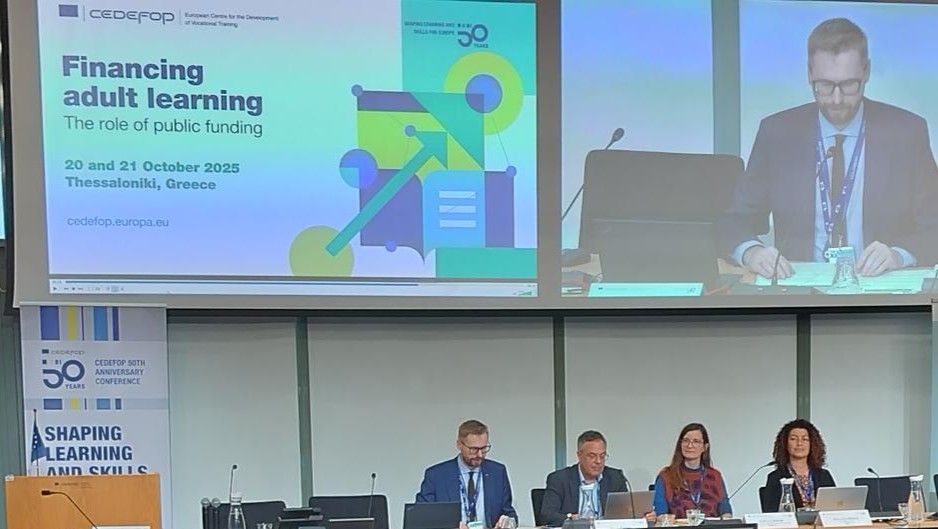
In the final round table of the CEDEFOP conference on ‘’Financing adult learning – Vision for the future’’, Raffaela Kihrer, EAEA Secretary General, highlighted how the challenges for adult education providers across Europe are overall increasing and we are observing also a general tendency of de-funding for the whole sector.
Kihrer remarked how the increased structural fragility, in particular in relation to stable funding, competition over funding and high effort on operational aspects, can become the focus, rather than the learning programme development. This shift has an impact on quality and on the working conditions of adult educators as well as on the capability of the non-formal education sector to research and innovate according to real societal needs. Finally, this clearly affects also the most vulnerable groups, which are the ones with the biggest challenges to access learning and in many cases cannot afford (also financially) the available learning programmes without structural funding.
Kiher continued indicating how we are also observing a shift in the actual definition of what should be funded under adult education in terms of public available instruments, with a movement toward ‘’employment oriented’’ learning programmes only.
We are facing also a time-based challenge about structural funding of adult education, which is linked to this progressive loss of capability of the sector, which may finally result in the lack of available quality programmes once the funding is allocated to adult learners.
Finally, Kihrer pointed out how we should always remind ourselves that lifelong learning is a human right, both along the policy and strategical discussion and in the process of developing any kind of instrument aiming to support adult participation in learning.
Ralexila and the role of digital platforms in ALE
The initial results of the RALExiLA initiative, coordinated by EAEA, were also presented by Viola Pinzi, EAEA Technical advisor, with the collaboration of Stefan Jahnke from Knowledge Innovation Center, during the session ‘’Digital platforms – Scene setting’’.
RALExiLA is an initiative co-funded by the European Union born to develop a model for national registries for adult education to support the implementation of individual learning accounts in European countries.
Pinzi outlined some of the core definition and challenges identified by the initiative research and co-design processes.
ALE registries are systems that organize and make accessible info about learning opportunities for adults. They should not be considered mere technical tools, since they have a potentially systemic role in ALE ecosystem, supporting inclusivity and accessibility (user friendly, multilingual), allowing economic and social alignment and quality assurance. Furthermore, these system, when well governed and maintained, have also the key function supporting data-driven decision making (offering a detailed and continuously updated the ALE ecosystem, offer side).
On the other hand, platforms for individual learning accounts (ILAs) are online platforms to manage funding and credit (allocation and use of individual funding for learning), as well as personal accounts to keep track of programmes and achievements for each learner. The ideal set-up for ILA platform is to configure it as centralized one stop shop for discovering opportunities, allowing transparent and accurate information, and enabling data-driven decision making (with the additional layer of demand-side data on participation and use of funding).
The two main challenges identified by the consortium in this regard were the fragmentation of registries in Europe and often within countries (regional, sectorial, only including one type of education etc.) and the limited interoperability of existing registries among themselves (which is the base for any type of ‘’portability’’, of credentials, qualification and skills/competence).
Finally, the other main challenge seems to be accessibility and user-centricity of such systems, which should aim at simplified user interfaces, integrating direct learners’ feedback, and possibly supporting personalization of guidance to select learning pathways.
Key takeaways and main challenges
Across the two days an all-around view of the state of play of ALE ecosystems and funding across Europe was presented and discussed among international and national experts.
Key takeaways
- Skills are fundamental to improve employability and social fairness.
- Adult learning benefits are widespread across society and economic sectors, while structured and fair access to funding is yet to be achieved, especially for those who are not able to access the main professional training funds.
- Addressing the needs of small and medium-size enterprises and micro-enterprises is also crucial. These employees are often excluded from the main employer-funded opportunities.
- ALE ecosystems should be quicker, easier, and less demanding, to respond to these needs.
- And ILA instruments should not be used for work-place based training (or not only at least).
- Ultimately, we should remind ourselves that education is not an expense, rather the foundation of freedom.
The experts also identified core challenges, especially in the perspective of shaping short- and long-term future work. Governance and stakeholders’ engagement are foundational, not a follow-up actions after developing the main system, as well as capacity building for all stakeholders involved. We also observe still a situation of fragmented governance and fragmented skills intelligence, including fragmented data on ALE spending and use of funds, across Europe and across the wide diversity of funds.
As for key future steps, it was remarked that an in-depth analysis of the current state of play of ALE ecosystems in EU country is a fundamental step to look into developing ILA systems (both as fully fledge programmes or smaller complementary instruments). Furthermore, learners should be more central to this whole conversation, with their specific needs and challenges and a stronger focus of further research and development work. And, ultimately, we should evaluate whether these instruments and these learning pathways are really beneficial and for whom (citizens, employers, etc.).
—————————-
For more information
- The conference materials are available on: https://www.cedefop.europa.eu/en/events/financing-adult-learning-role-public-funding
- For more information on RALExILA: https://ralexila.eu/
- The RALExILA research report ‘’Building national ALE registries in Europe’’ https://ralexila.eu/wp-content/uploads/sites/91/2025/05/Ralexila_Del-2.1_FIN_EN.pd
Text: Viola Pinzi