

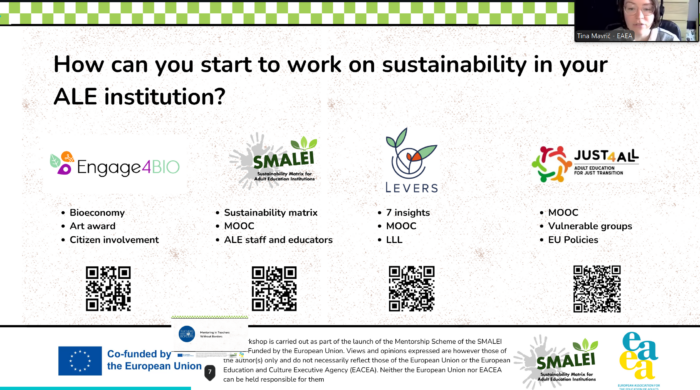
The workshop opened with an introduction from Tina Mavrič, Head of Capacity-Building at EAEA, who introduced the work EAEA is doing in sustainability and ALE. The LEVERs project (Learning Ventures Capacity Building) for example promotes lifelong learning and climate justice. The focus is on the intersection of socio-scientific issues that concern all communities. EAEA is also coordinating JUST4ALL– Adult Education for a Just Transition. It is a project that promotes a just transition through inclusive and innovative lifelong learning and adult education.
The action overall objective is to support an inclusive recovery and digital and green transitions in Europe. These projects, along with SMALEI – Sustainability Matrix for Adult Education Institutions – serve as key learning experiences for EAEA and ALE to navigate the green transition in institutions and communities, with and for the learners. All three projects have online learning courses where ALE educators can learn, meet and connect, hosted on learning.eaea.org.
Teachers Without Borders: Mentoring case study
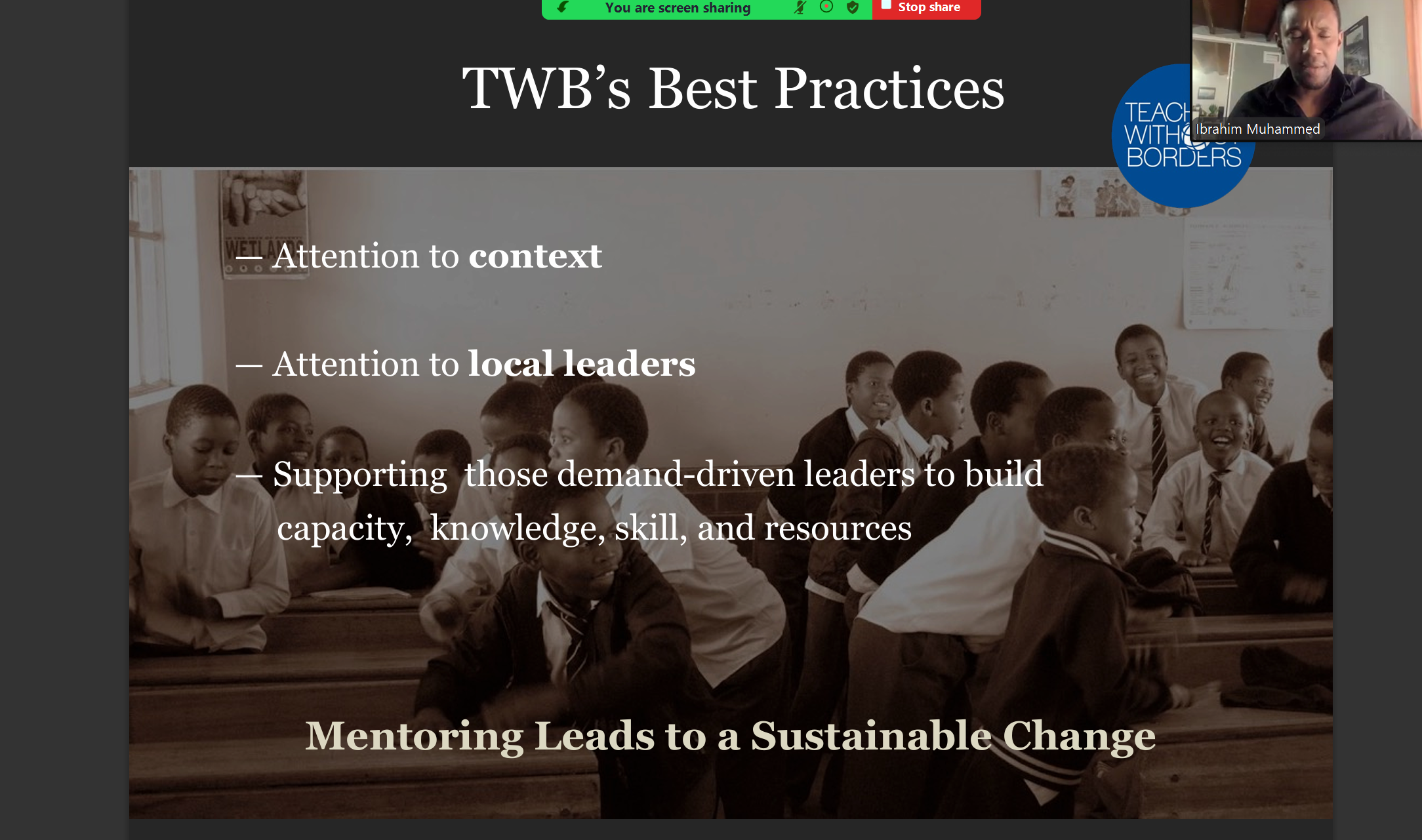
Ibrahim Muhammed from Teachers Without Borders then presented the organization. Since 2000, Teachers Without Borders has attracted educators who show up to serve their communities. The organization uses mentoring as a form of capacity-building for educators, connecting to local leaders and providing them the tools to empower themselves. In fall 2025, Teachers Without Borders is launching an online learning course “Innovations in Mentoring Teaching”, applicable to the SDGs.
SMALEI mentorship and peer-review guidelines launched
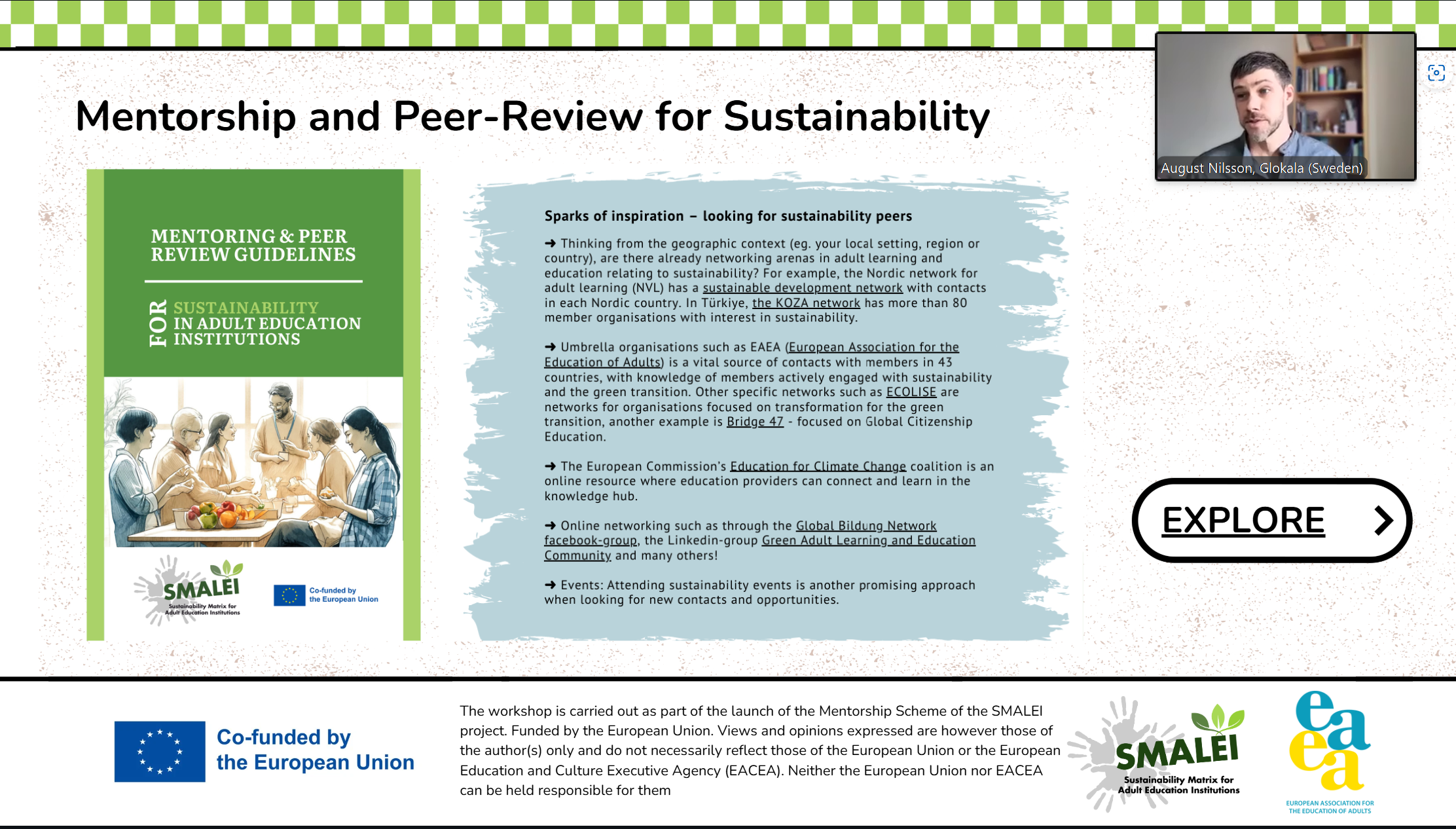
August Nilsson, Glokala Folk High School (Malmö, Sweden), presented the SMALEI Peer-Review and Mentoring Guidelines, as well as the example of peer-reviews across the folk high school network in Sweden. The guidelines are intended as a starting point for 1) personal mentorships, and 2) organisational peer reviews. Establishing a mentoring scheme or building peer relationships in a sustainability network of adult learning organisations can help build motivation, mutual inspiration and learning. The process of developing the sustainability of an organisation is ongoing and can therefore benefit from sharing perspectives and gaining insights from the work of peers in the same field.
Climate Action Sweet Spot
Charlotte Ede, Capacity-Building and Projects Coordinator, introduced Dr. Ayana Elizabeth Johnson’s “Climate Action Sweet Spot” Venn Diagram. Dr Johnson is a marine biologist, policy expert, writer, and teacher working to help create the best possible climate future. Participants worked through the Venn Diagram, using the SMALEI matrix areas for inspiration, to identify their next points of action. Participants exchanged on their climate action sweet spots, their next climate actions, and proposed how connecting with others would help them go further. The workshop encouraged collaboration, networking and making the most of one another’ expertise.
Workshop resources
- Climate Action Sweet Spot Venn Diagram
- SMALEI Matrix: Matrix – SMALEI
- Mentorship and Peer-Review Guidelines: Mentorship for Sustainability – SMALEI
Text: Charlotte Ede