

At EU level, the AI Act lays down harmonised rules on AI, addressing the risks and defining risk-based rules for developers and deployers regarding specific uses of AI. The AI Act defines a risk-approach, with 4 levels: unacceptable, high, limited and minimal risk.
For the sector of education and training, it is important to know that AI solutions used in education institutions may determine the access to education and course of someone’s professional life are considered by the Act as high risk. Examples given by the European Commission are: scoring of exams, evaluating learning outcomes, steering the learning process and monitoring of cheating. This comes with strict regulation before being launched, with obligations such as ensuring appropriate human oversight measures or high-quality of the datasets used to minimise risks of discrimination.
Building AI literacy for all
One of the most forward-looking discussions centered around AI literacy. According to the EU AI Act, providers and deployers of AI systems need to take action starting from 2025 to provide a sufficient level of AI literacy to their staff and anyone using the systems on their behalf.
But how does the EU define AI literacy? ‘AI literacy’ means skills, knowledge and understanding that allow providers, deployers and affected persons, taking into account their respective rights and obligations in the context of the regulation, to make an informed deployment of AI systems, as well as to gain awareness about the opportunities and risks of AI and possible harm it can cause.
The EU AI Office, established within the European Commission as the centre of AI expertise, also has responsibility in promoting AI literacy. This centre will organise capacity-building activities, and gather and share information and best practices. This March, the AI Office already published the first examples of ongoing AI literacy practices and to encourage learning and exchange.
ETHLAE: Emerging Technologies for Holistic Literacy in Adult Education
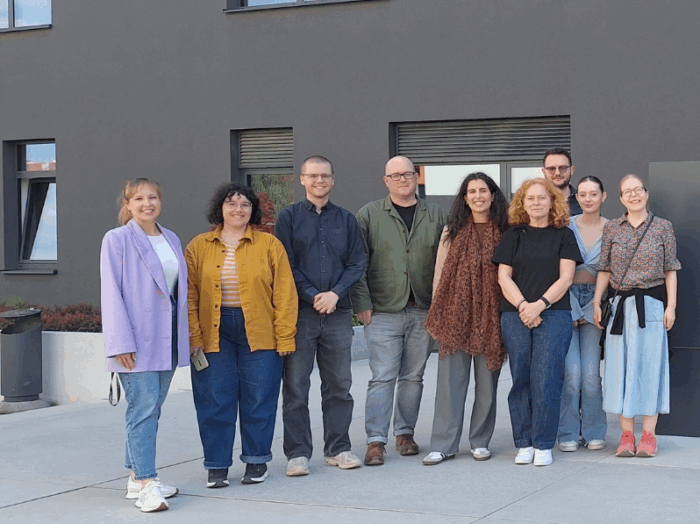
In April 2025, practitioners, legal experts, and EdTech professionals gathered at Algebra Bernays University in Zagreb for a Capacity Building Lab focused on one of the most pressing topics in education today: the legal and ethical challenges of emerging technologies. The event was held under the Erasmus+ ETHLAE project, and addressed both the exciting potential and serious responsibilities tied to the digital transformation of education.
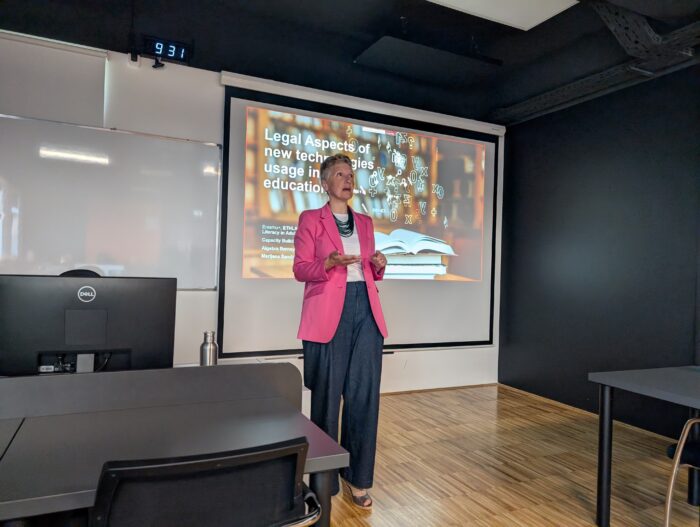
Marijana Šarolić Robić, a legal expert, gave a compelling breakdown of the EU’s groundbreaking regulation. As she explained, “education is not exempt from compliance – it’s at the very heart of it.” As she explained, AI systems must now undergo risk assessments, ensure human oversight, and guarantee transparency in decision-making. And certain uses of AI – like emotion recognition or manipulative systems that exploit students’ vulnerabilities – are flat-out banned.
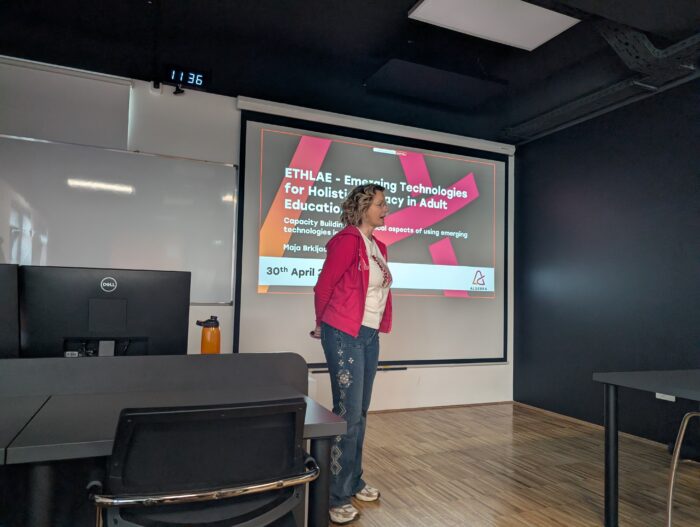
The ethical dimensions of emerging technologies were presented by Maja Brkljačić, Head of the Research Centre at Algebra LAB. Her session highlighted some of the most pressing dilemmas facing education professionals today:
- Can AI truly be unbiased, or does it reinforce hidden inequalities?
- Are learners aware of how their data is being used?
- What does it mean to be “taught” or “evaluated” by an algorithm?
She invited participants to critically reflect on how ethical choices are embedded (or not) into the design of educational technologies. The session stressed that ethics should not be an afterthought – it must be an integral part of how we build, deploy, and use digital tools in learning environments.
The Capacity Building Lab made one thing clear: emerging technologies are reshaping education, but how we choose to use them is still up to the educators.
We are at a moment where institutions, developers, and educators can shape the future, one that embraces the benefits of emerging technologies for learning while protecting human dignity, equity, and the right to learn without discrimination.
To learn more about the ETHLAE project and the current work, visit https://eaea.org/project/ethlae/
Read more on the references of this article at:
- AI Act: European Commission page
- Artificial Intelligence – Questions and Answers
- Regulation (EU) 2024/1689 laying down harmonised rules on artificial intelligence
- Press release: “First rules of the Artificial Intelligence Act are now applicable”
- Library: Living repository to foster learning and exchange on AI literacy
In accordance with GDPR, we have obtained written consent from all participants and speakers for the use of their photos. The main photo is by DKosig from Getty Images Signature.
ETHLAE – Emerging Technologies for Holistic Literacy in Adult Education (Project: 101184061 — ERASMUS-EDU-2024-PCOOP-ENGO). Funded by the European Union. Views and opinions expressed are however those of the author(s) only and do not necessarily reflect those of the European Union or the European Education and Culture Executive Agency (EACEA). Neither the European Union nor EACEA can be held responsible for them.
Text: Maja Šarić (Algebra Bernays University), Maria Gonçalves Ribeiro