10.10.2024

Adult education institutions as key vectors in promoting the green transition: SMALEI takes centre stage during the European Week of Regions and Cities

On October 10 2024, the European Association of Regional and Local Authorities for Lifelong Learning (EARLALL), the Age Platform EU, and EAEA hosted a workshop called “Empowering Societies through Education and Skills for the Twin Transition” at the European Week of Regions and Cities.

The session was an opportunity to present the Erasmus+ SMALEI – Sustainability Matrix for Adult Education Institutions – to over 80 policymakers, regional and local authority representatives and stakeholders. The event opened with a presentation from Andrea Bernert-Bürkle, Head of EU Projects, Volkshochschulverband Baden-Württemberg e.V., who discussed how and why adult education institutions can boost the green transition. One of the main points discussed was about the sphere of influence of adult education institutions and the networks these institutions have.

We as adult education institutions are known in our local communities and are seen. If we act, people see it. – Andrea Bernert-Bürkle, Head of EU Projects, Volkshochschulverband Baden-Württemberg e.V.
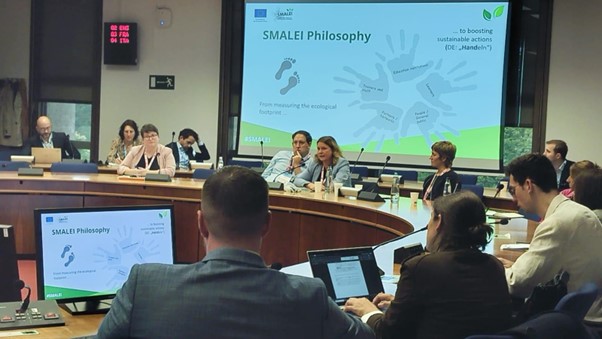
Speakers at the SMALEI event sitting around a table with presentation behind them.

The SMALEI matrix was then presented as a tool that adult education institutions can use to assess and improve on their sustainability. From the Volkshochschulverband Baden-Württemberg’s perspective, “having tested it, the matrix sub-areas are really useful to help us identify specifically our areas of improvement”.

Following this presentation, Susanne Dobner, queraum, Coordinator of SEE U project, took the floor to describe the project results of the Erasmus+ project. During the project, elderly citizens were empowered to use digital skills through walking tours.

Finally, Kieran McCarthy, Cork City Council and CoR Member, presented Cork City as a Learning City and as an inspiration for intergenerational learning. He drew on successful elements in both the SEE U and SMALEI projects, outlining how Cork focused on skills development across all levels and the celebration of learning.

Text: Charlotte Ede

22.05.2026 skills

Farmers are ready to adapt to the twin transition — but training systems must be adjusted too

Europe’s farmers are often portrayed as resistant to change. Yet across the continent, farmers are already navigating climate pressures, sustainability requirements, rising costs, labour shortages and rapid technological change. The challenge may not be a lack of willingness to learn, but whether education and training systems are designed for the realities of agricultural life.

12.05.2026 digitalisation

Strengthening adult education through emerging technologies

While new technologies, such as Artificial Intelligence (AI) have become more and more integrated in formal education settings, adult education has yet to profit properly from these technological advancements.

11.05.2026 Democracy

Democratic resilience starts with the protection of civil society

As civic space narrows across Europe, civil society organisations play an increasingly vital role in defending democracy and participation. EAEA urges European institutions and Member States to take action to protect civil society as a crucial democratic actor.