
What does neurodiversity mean?
Neurodiversity is the natural variation in how human brains process information, learn, and experience the world. It is a fact about the whole population, similar to biodiversity. It is not a condition that any one person “has.”
Neurodivergent describes a person whose brain works differently from what is considered typical. This includes people with dyslexia, dyspraxia, dyscalculia, dysgraphia, ADHD, autism, Tourette’s syndrome, and other differences. Neurodivergence is not a medical diagnosis or an illness.
Neurotypical describes a person whose brain development and functioning align with what society currently considers standard.
Neurodiversity-affirming treats neurological differences as natural variation to be respected and valued, rather than only as problems to be corrected.
The CAN approach for neuroinclusive work and education environments
Different ways of thinking, learning and problem-solving are to be recognised and supported — not barriers that people must overcome. Yet too often, diversity is not valued and many learners and workers are expected to adapt to systems that were not designed with their specific needs and interests in mind.
Neuroinclusive workplaces and educational environments aren’t just fairer – they’re stronger and more resilient.
CAN aims to change this by developing guidance and learning approaches that focus on strengths, personalised support, wellbeing and meaningful participation in learning and work through developing and piloting a counselling and career guidance model that enables all adults to access tailored support for access to training, employment and learning transitions and building capacity of HR professionals, career counsellors and ALE educators.
Read more on our website: https://www.valuingneurodiversity.eu/
We invite adult education organisations to join our work
CAN brings together stakeholders from adult learning, career guidance, employment, research, public authorities, employers and civil society, to co-design practical solutions that respond to the real needs of a diverse and neuroinclusive society.
Valuing neurodiversity is sound policy. It widens participation, strengthens the workforce and lowers the cost of exclusion.
Within the CAN initiative – Counselling and Career Guidance for Adults to Value Neurodiversity stakeholders’ engagement is the mechanism that connects experience, knowledge and action.
Why to engage in CAN?
- Improve quality by incorporating diverse forms of knowledge throughout development
- Enhance relevance by ensuring that activities respond to real needs
- Strengthen legitimacy by developing outputs through transparent and participatory processes
- Increase likelihood of uptake and adopt for co-designed approaches
- Contribute to cultural change by modelling inclusive participation
How to contribute directly?
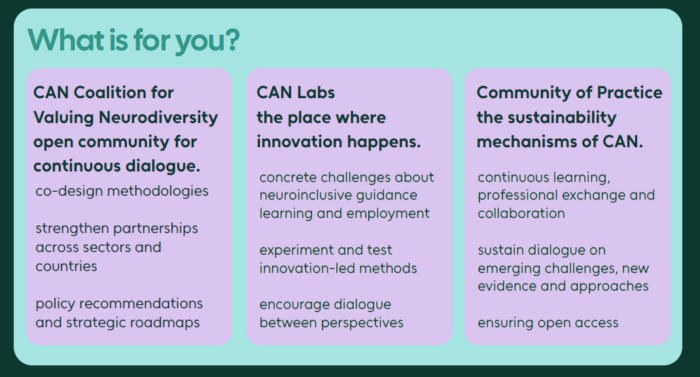
Join the CAN Coalition for Valuing Neurodiversity
The CAN Coalition for Valuing Neurodiversity is a European community of organisations and professionals committed to improving education, career guidance and employability services that recognises and values neurodiversity.
- Read the CAN value proposition for stakeholders
- Express your interest for the CAN Coalition for Valuing Neurodiversity
Participate in the CAN Labs – the place where innovation happens
In the Labs stakeholders work together on concrete challenges related to neuroinclusive guidance, adult learning and employment, through collaborative experimentation, testing and refinement of project outputs
Contribute to The Community of Practice (CoP) – the sustainability mechanisms of CAN
The CoP supports continuous learning, professional exchange and collaboration among the stakeholders involved
Text: Viola PinziPhotos: CAN project