
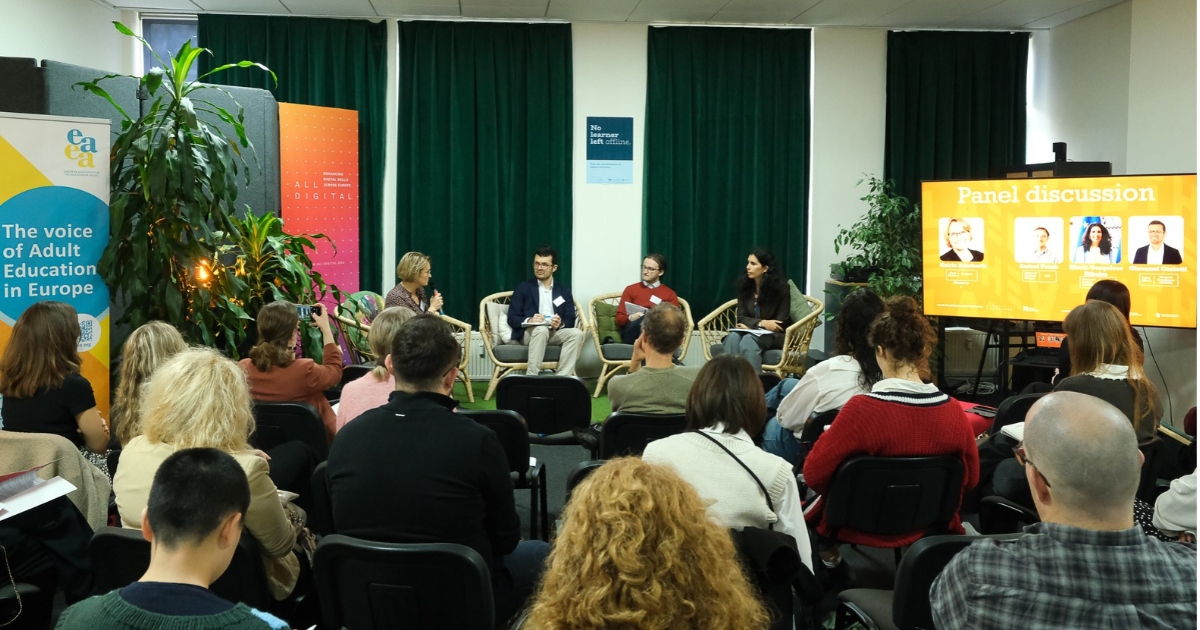
On 18 November, ETHLAE marked the end of two years of work with a policy breakfast at Commons Hub in Brussels, hosted by All Digital in collaboration with EAEA and the Lifelong Learning Platform. The event drew 62 registrations from 38 organisations across 18 countries, and 39 people attended on the day. Policymakers, adult educators and civil society came together around one question: as AI becomes part of everyday life, who gets left behind, and what should Europe do about it?
Ludo Moyersoen of MAKS vzw set the scene with stories from MAKS’s digital inclusion work with adults in Brussels. Katrin Schubert (All Digital) then moderated a panel with Maria Gonçalves Ribeiro (EAEA), Andrei Frank (Lifelong Learning Platform) and Giovanni Carletti (European Commission, DG EMPL). The discussion was built around ETHLAE’s main findings:
- Holistic literacy. Are we preparing adults for the technology they meet as citizens, or only at work? Maria shared ETHLAE’s finding that adults learn digital skills best as part of broader literacy and life skills, linked to real situations.
- Inclusion beyond access. On reaching adults who rarely take part in learning, Andrei highlighted that adults find their way to learning through many doors, from adult education centres and libraries to community organisations and employers. ETHLAE found that trust, confidence and safe learning spaces matter as much as access.
- What the EU can do. Giovanni pointed to Individual Learning Accounts, which give adults a personal budget for training. The panel also called for lasting support for adult educators, who ETHLAE found often feel unprepared and are held back by short-term funding.
The morning closed with Riina Vuorikari interviewing Francesca Maltauro, Deputy Head of Unit for Digital Education, STEM and AI Literacy at the European Commission.
Thank you to All Digital and EAEA for co-hosting, to our speakers, and to everyone who joined us, at the event and throughout the project.
ETHLAE – Emerging Technologies for Holistic Literacy in Adult Education (Project: 101184061 — ERASMUS-EDU-2024-PCOOP-ENGO). Funded by the European Union. Views and opinions expressed are however, those of the author(s) only and do not necessarily reflect those of the European Union or the European Education and Culture Executive Agency (EACEA). Neither the European Union nor EACEA can be held responsible for them.
Text: Gabriela Mucientes Lambert (All Digital)