
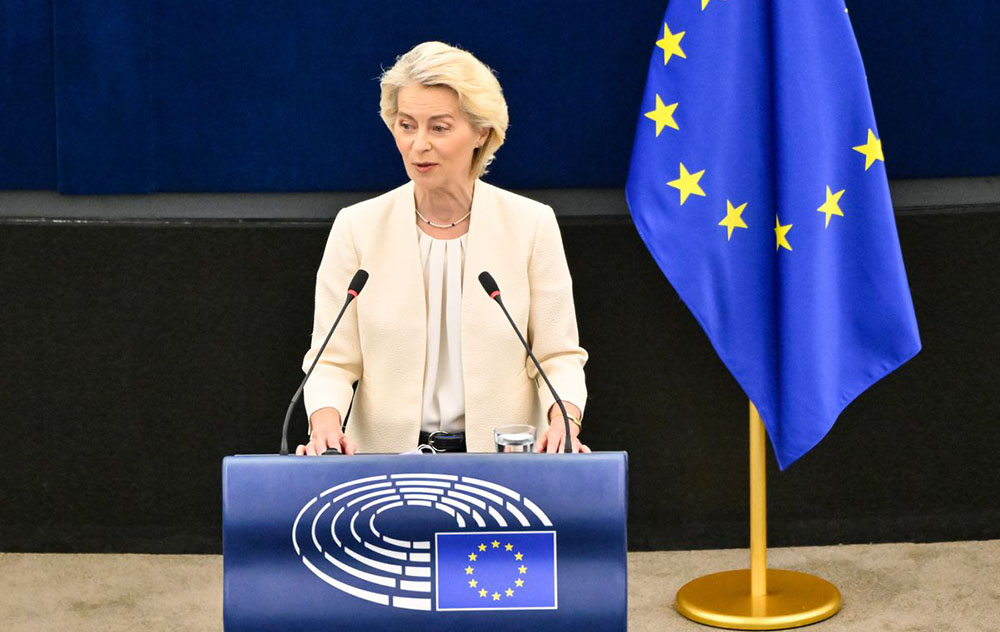
Following European Commission President Ursula von der Leyen’s State of the Union address, EAEA reflects on what Europe’s current priorities mean for adult learning and education. While the SOTEU speech focuses strongly on security, competitiveness and Europe’s resilience, adult learning and education also have a key role to play in building resilient communities and addressing the root causes of many societal challenges.
>> Read the full EAEA op-ed: State of the Union 2026 Europe needs to learn to be together, not only to respond to crises (pdf)
EAEA’s five key recommendations are:
1. Europe needs to invest upstream
Instead of only responding to crises, Europe needs to invest in people, communities and learning infrastructures. This helps prevent exclusion, polarisation and democratic disengagement, and promote collective action for a sustainable and just Twin Transition. Adult learning and education create safe spaces for learners from all walks of life. Here, respectful debates can take place, ideas can be exchanged and grassroots innovation can flourish.
2. People are more than workers
Adult learning and education is about more than matching skills to labour-market needs. Literacy, creativity, critical thinking, citizenship and life skills help people navigate change in every part of their lives. What we need now more than ever are transversal competences that remain relevant even in times of rapid technological change and AI – both at work and in our personal, family and community lives.
3. Resilience starts in communities
Adult learning and education create spaces where people meet, build confidence and networks, and gain the knowledge and competences to act together. Together, we can work on climate-resilient communities, communities of women who support each other in their personal and professional pathways, and spaces where diversity is a lived reality rather than an abstract European value.
4. AI needs empowered citizens, not only skilled workers
Europe needs investment in AI literacy, critical thinking, creativity and social action so that AI serves people and society – not the other way around. Adult learning and education can provide spaces where critical questions can be explored collectively rather than leaving individuals to navigate fundamental technological and societal changes alone.
5. Investing in adult learning and education means investing in our capacity to shape change
From democracy and social cohesion to the green and digital transitions, sustainable financing for adult learning and education is essential for a resilient Europe. We need a strong increase in investment in Erasmus+ and the European Social Fund in the EU’s next Multiannual Financial Framework to reach the millions of adults across Europe who are still excluded from learning opportunities.