
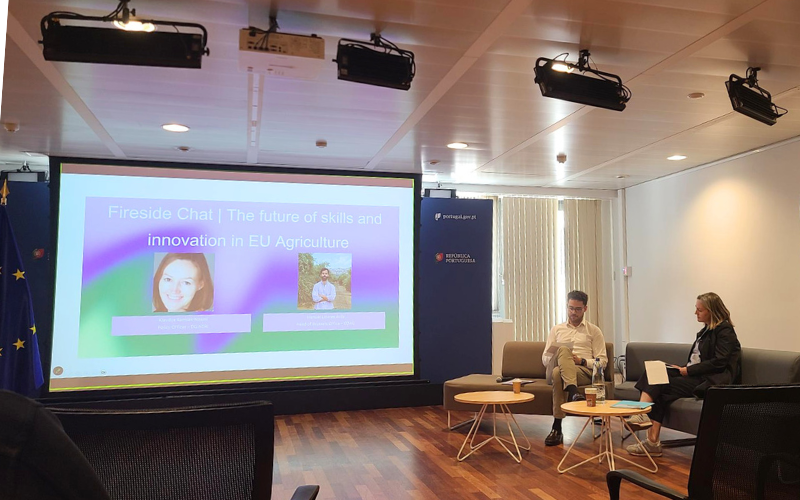
In the European Union, around 70% of farmers rely mainly on practical experience rather than formal agricultural training, according to the European Parliament[1]. While generational transfer and experiential knowledge remain central to farming communities, the twin green and digital transitions are creating new situations where farmers increasingly need access to flexible and relevant learning opportunities.
“The land comes first,” explains Manuel Linares from the Spanish farmers’ organisation COAG[2]. “For farmers, there are three main barriers to taking part in learning programmes. The first is a lack of time. There is no time to take part in 40+ hour in-person courses. The second is relevance. Farmers need to know that training is directly relevant to their specific contexts. Finally, trust and peer-to-peer knowledge exchange are important. Farmers trust other farmers and their advisors and are not easily convinced by so-called ‘experts’.”
According to Linares, farmers do not lack willingness to learn. Rather, many have not yet been presented with learning opportunities that are flexible enough, practical enough, or trusted enough to fit their daily realities.
Personalised and flexible learning models
This challenge is increasingly driving innovation in agricultural education across Europe. New initiatives are experimenting with approaches that combine personalised digital learning, peer exchange and multi-actor collaboration.
One example is the EU-funded PERSONA project[3], in which COAG participated alongside EAEA member CARDET (Center for the Advancement of Research & Development in Educational Technology). The project developed a hybrid human-AI personalised learning pathway for vocational education and training (VET) in innovation and agriculture.
The PERSONA platform uses self-assessment tools based on the European DigiComp, EntreComp and GreenComp frameworks to help learners identify their skills needs and build personalised learning pathways. The project also developed stackable micro-credentials covering topics such as agricultural financial management, agricultural software tools, sustainability, farm entrepreneurship and robotics in agriculture.
Importantly, the project did not focus solely on digital tools themselves, but on how technology can support more accessible and relevant forms of learning. By combining online flexibility with peer exchange and practical relevance, the initiative aimed to better reflect how farmers actually learn and work.
Why multi-actor approaches matter
This emphasis on collaboration and knowledge-sharing is also increasingly reflected in EU policy. Klavdija Ramsak-Noemi, Policy Officer in DG AGRI Unit D.1, highlighted that peer-to-peer and multi-actor approaches are “very essential” for the future of agricultural learning and innovation.[4]
The EU CAP Network promotes the Agricultural Knowledge and Innovation Systems (AKIS) model across Europe. Regulation (EU) 2021/2115 defines AKIS as “the combined organisation and knowledge flows between individuals, organisations and institutions who use and produce knowledge for agriculture and interrelated fields”.
In practice, a well-functioning AKIS model strengthens cooperation between farmers, researchers, advisors, educators, institutions and regional authorities[5]. Under the 2023 to 2027 Common Agricultural Policy (CAP), each Member State must now outline an AKIS strategy within its national CAP Strategic Plan, including how advisors, researchers and national CAP networks will work together to promote knowledge exchange and innovation. Projects that create these connections in practice are therefore becoming increasingly important.
Supporting the agrifood sector from an ALE perspective
EAEA, representing its network and ALE, is involved in the EU-funded TWIN-IN project: Promoting responsible TWIN transitions in European agrifood systems through INnovation and learning alliances. TWIN-IN seeks to develop an innovative education and training model that combines multidisciplinary and multi-actor approaches to support sustainable agrifood transitions.
The project brings together higher education institutions, VET providers, adult learning organisations, researchers, educators, learners, startups, farmers and farm advisors. In four pilot countries, Italy, Greece, Spain and Romania, local ecosystems will test innovative educational models based on active and participatory pedagogical approaches developed together with EAEA and project partners.
Rethinking how learning takes place
As Europe’s agri-food systems undergo profound transformation, the challenge is no longer simply to provide more training opportunities. The real challenge is building learning ecosystems that are flexible, trusted and rooted in the realities of rural life.
Projects such as PERSONA and TWIN-IN suggest that the future of agricultural education may depend less on top-down expertise and more on collaboration: between farmers and educators, between digital tools and peer learning, and between sectors that have not traditionally worked together.
_____________________________________________________________________
[1] Agricultural education and lifelong training in the EU | Think Tank | European Parliament
[2] Manuel Linares, Head of Brussels office COAG, during the ‘Fireside chat on the future of skills and innovation in EU Agriculture’, Persona Final Conference, Brussels, May 21 2026.
[4] Klavdija Ramsak-Noemi, Policy Officer of Unit D.1 DG AGRI during the ‘Fireside chat on the future of skills and innovation in EU Agriculture’, Persona Final Conference, Brussels, May 21 2026.
[5] https://eu-cap-network.ec.europa.eu/support/innovation-knowledge-exchange-eip-agri/akis_en
testing
Text: Charlotte EdePhotos: Charlotte Ede