
The Feminist Futures Festival
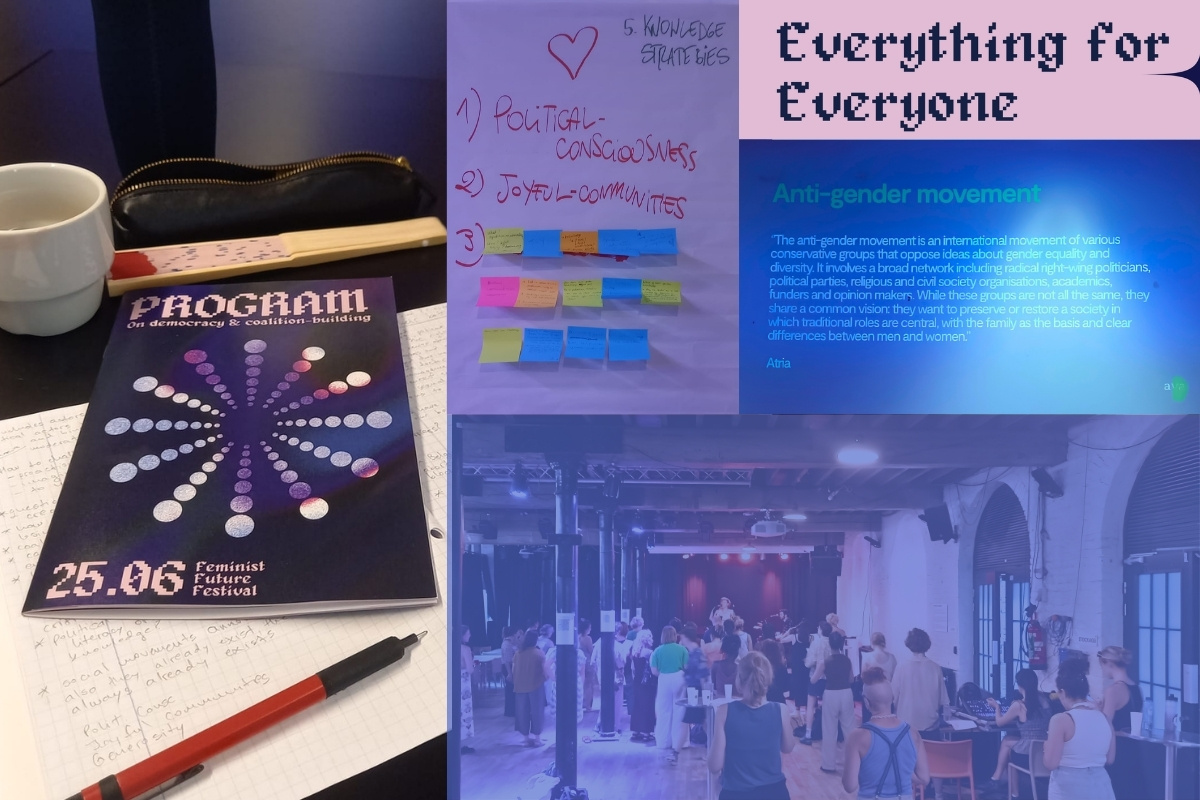
During one of the hottest days in Belgium in June, participants gathered at Pianofabriek for the Feminist Futures Festival. Organised by Sophia, the Belgian Gender Studies Network, the CCINDLE project (Co-Creating Inclusive Intersectional Democratic Spaces Across Europe) this festival was funded by the European Union.
The introduction drew from an intersectional perspective and approach to inclusiveness, safe spaces and radical self-care, inspiring participants to consider the space in terms of awareness, not fear, a space which is anti-racist, anti-sexist, anti-colonial, and anti-imperial – the basic feminist values. The audience was greeted by: Imane Benchaou, Coordinator at Sophia; Billie Wyns, Coordinator at Sophia; Sigrid Vertommen, a Postdoctoral Research Fellow at Cambridge and Ghent Universities; Rylan Verlooy, PhD Researcher at the University of Antwerp; and Mieke Verloo, Professor at Randboud University in Nijmegen.
This festival is a testament to how, despite the heatwave and the realities of the climate crisis we are living through, we continue to come together in large numbers, engage in meaningful discussions, and reflect on how to build a future that is more resilient, healthier, and more supportive for everyone. At a time when democratic values are increasingly being challenged around the world by various actors in power, creating spaces for dialogue and collective learning has become more important than ever. This commitment lies at the heart of EAEA’s annual theme, Resilience and Community Building, and is reflected in EAEA’s manifesto, The Power and Joy of Learning, which recognises adult learning and education as essential for fostering critical thinking and a vibrant civil society. For EAEA, democracy is not only something to be protected through institutions, but also something that must be learned, practised, and continuously strengthened through education, participation, and dialogue.
As one of the participants noted:
Democracy has come to be understood as the rule of the majority or the strongest one in power, and not the plurality of discussions that is supposed to bring quality of life to everyone
One of the most visible challenges to democratic pluralism today is the rise of the anti-gender movement. Framing gender equality, LGBTQ+ rights, and reproductive rights as threats to the traditional family, national identity, and social order, the movement has become a powerful transnational force. By appealing to fear and uncertainty, it promotes restrictive policies and reinforces exclusionary narratives that can weaken democratic participation, pluralism, and social inclusion. During the festival, we explored these challenges in two workshops. The first focused on strategies for challenging anti-gender narratives, while the second examined the transnational forms of solidarity and mobilisation needed to respond to this growing movement.
A key insight from the workshop “Knowledge strategies in anti-gender politics” was the challenge posed by anti-intellectualism and the active discrediting of scientific knowledge, affecting both the hard sciences and social sciences and humanities, particularly disciplines related to feminism, gender, disability, class, and race. Participants emphasised the importance of political consciousness as a way forward, encouraging critical engagement with issues of knowledge and literacy that are often perceived as top-down – whose knowledge is it? The workshop was organised by elena pavan, Associate Professor at Università di Trento; Zuzanna Rokita, PhD candidate at the University of Warsaw; and Aurora Perego, Post-Doc Researcher at Radboud University Nijmegen.
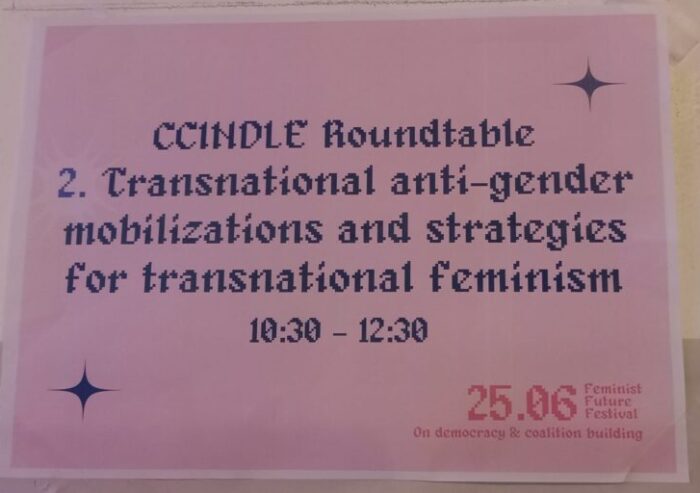
Last but not least, the “Transnational anti-gender mobilisations” workshop drew on knowledge from the Ccindle project. What participants most appreciated was the production of knowledge, which, rather than being locked within academic institutions, was widely shared with everyone. The workshop participants were asked to reflect on possible mobilisations from a transnational perspective and what they would entail – knowledge sharing (to avoid reinventing the wheel), learning, the need for infrastructural support, civil society actors bringing the values and relevance of a transnational feminist network to the forefront, lobbying, and the use of digital tools to maintain a presence in virtual spaces as much as possible. The workshop was organised by Emanuela Lombardo, Professor at Scuola Normale Superiore in Italy, and Anastasia Barone, Postdoctoral Researcher in the CCINDLE Project at Scuola Normale Superiore in Italy.
In conclusion, the Feminist Future Festival comes to us as a timely reminder that even with all the limitations we face, whether infrastructural, financial, or institutional, and despite the heatwave, a large group of people from different backgrounds and areas of interest, all committed to universal human rights and the protection of individuals and communities, managed to come together in Brussels. They built new connections, discussed current and important issues, and inspired knowledge sharing within their own communities and beyond.
EAEA supports initiatives such as the Feminist Future Festivals as important pillars of democracy and of advancing all societies, as explained in our Manifesto, The Power and Joy of Learning. Without community and learning from each other, our world would become nothing more than a collection of individuals gradually losing the ability to engage in meaningful dialogue with one another.
Text: Marina Sakač HadžićPhotos: EAEA