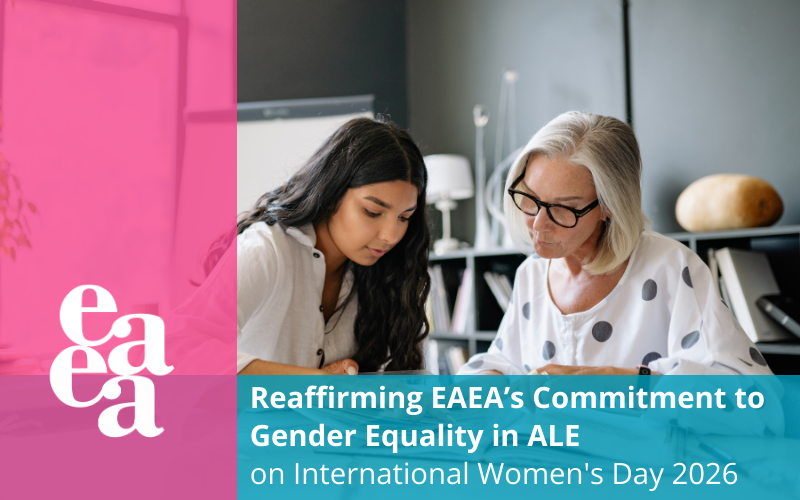
International Women’s Day is a global moment to reflect on progress towards gender equality and the rights and opportunities of women and girls. Celebrating achievements while taking collective action for change provides an important platform to engage communities, reflect on progress, and (re)commit to positive action. EAEA, through its participation in the Gender Equality Task Force for Lifelong Learning, supports this mission by advocating for gender equality and the empowerment of under-represented groups in adult learning and education (ALE) and in wider society.
EAEA is a co-organiser of the Gender Equality Task Force for Lifelong Learning, together with the European Association of Regional and Local Authorities for Lifelong Learning (EARLALL) and the European Forum for Vocational Education and Training (EfVET). The Task Force works to advance a strategic agenda focused on:
Gender equality in digital skills, AI and TVET,
Building capacity in adult education to strengthen women’s participation and opportunities,
Empowering learners and migrant women, giving them a platform to share experiences and projects,
Addressing violence and discrimination in educational and workplace settings,
Monitoring and preparing for the European Gender Equality Strategy 2026–2030, ensuring that policies translate into real impact.
The newly presented EU Gender Equality Strategy 2026–2030 provides a renewed framework to advance gender equality across Europe, building on the 2020–2025 strategy. As part of its 2026 activities, the Task Force will analyse the Strategy to identify synergies and priorities for future actions.
Through Erasmus+ and other EU-funded initiatives supporting gender equality, surveys on access to education and work, and the promotion of good practices, the Task Force fosters an open community for dialogue, exchange and collaboration. These efforts contribute to more inclusive learning environments and equal opportunities for all. EAEA additionally will organise two activities in Spring 2026: A community-breakfast on gender-inclusive language and the Safe Spaces for Adult Learning in-person training in June 2026.
International Women’s Day reminds us that lifelong learning and equitable education systems are essential for achieving gender equality, unlocking human potential, and building more resilient and inclusive societies.
Read more:
Declaration of principles for a gender-equal society (2026): https://commission.europa.eu/strategy-and-policy/policies/justice-and-fundamental-rights/gender-equality/declaration-principles-gender-equal-society_en
The EU Roadmap for Women’s Rights: a renewed push for gender equality (2025): https://commission.europa.eu/news-and-media/news/eu-roadmap-womens-rights-renewed-push-gender-equality-2025-03-07_en
Capacity-Building in ALE for Gender Equality (2025): https://eaea.org/wp-content/uploads/2024/12/Background-Paper-Capacity-Building-in-Adult-Education-for-Gender-Equality-with-illustrations.pdf
Issue paper on gender in and through education (2022): https://op.europa.eu/bg/publication-detail/-/publication/d36b1bdf-adae-11ed-8912-01aa75ed71a1/language-en
Background Paper on ALE and Gender (2020): https://eaea.org/wp-content/uploads/2020/08/ALE-and-Gender-EAEA-background-paper-July-2020_final.pdf