
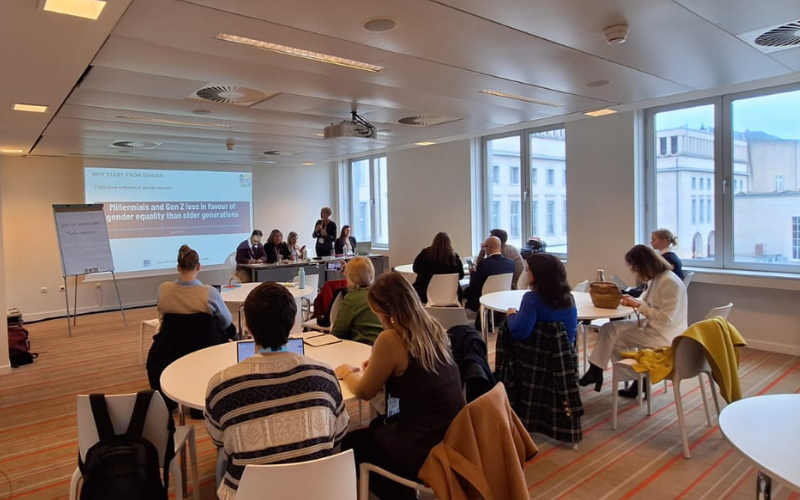
The task force organised jointly by EAEA, EfVET and EARLALL, coordinated the event to bring awareness to the role of a multi-stakeholder approach to create safe online and offline public spaces.
The event opened with Sylvia Liuti, Gender expert at Forma.Azione and Honorary member of the Gender Equality Task Force. Ms Liuti set the stage on gender equality and why it matters in learning and work environments. As Ms Liuti put it, “gender equality is not just about addressing social inequalities; it is about improving the labour market”. From this perspective, Ms Liuti presented the GenderEd coalition project which seeks to empower individuals to challenge gender-based disinformation and misogyny, tackling the concept of safety in public spaces through addressing needed changes in attitudes.
Following this introduction, Simona Meloni, Councillor of Gender Equality and Agriculture at the Umbria Region, presented her region’s priorities with regards to ending sexual and gender-based violence and harassment towards women, including through empowering women into the workplace to encourage greater mixing and inclusion of women in society.
Lorena Ripoll Ferri, Manager of the EdTWomenDays at the Escola del Treball, presented their VET’s project to directly address hesitancy of women to joining traditionally male-dominated careers in VET, such as technical and engineering pathways. The project began in January 2023 and has since recruited female teachers and students interested in the project and launched into a mentoring scheme to change attitudes of younger female students from an early age.
What can we do in ALE to create safe spaces?
Adult Learning and Education (ALE) has a crucial role to play in shaping environments that are not only inclusive but consciously equitable and empowering for all learners. ALE institutions are often the first point of contact for adults seeking to re-engage in learning after negative or exclusionary educational experiences. As such, they carry a special responsibility to foster trust, respect and belonging, which are key elements of what makes a space “safe”.
Ioannis Karoumpalos, Project Manager and Educator at Dafni Kek, an adult education centre and member of EAEA in Greece, led a reflective session with participants about the barriers to safe spaces and the role of gender and power dynamics in these spaces. Participants shared their experiences individually and then in a plenary, and highlighted that attitudes need to change. As one participant pointed out, “Having more diversity in the streets, classrooms, libraries means that people feel more welcome to join.”. Mr Karoumpalos ended by emphasising the words of Paola Freire “If the structure does not permit dialogue, the structure must be changed”, highlighting the need to have continuous discussion around gender imbalances and to actively address what safety means.
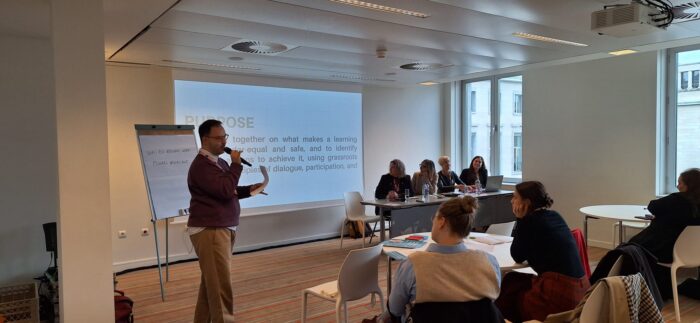
Ioannis Karoumpalos (Dafni Kek) leading the closing session. Photo owned by EAEA.
–
EAEA and Dafni Kek were part of the ‘Safe Spaces for Learning’ project from 2020 – 2023. If you are interested in exploring safe spaces with learners, educators or researchers, you can check out the Safe Board Game and other capacity-building materials from the project.
Text: Charlotte EdePhotos: EAEA