

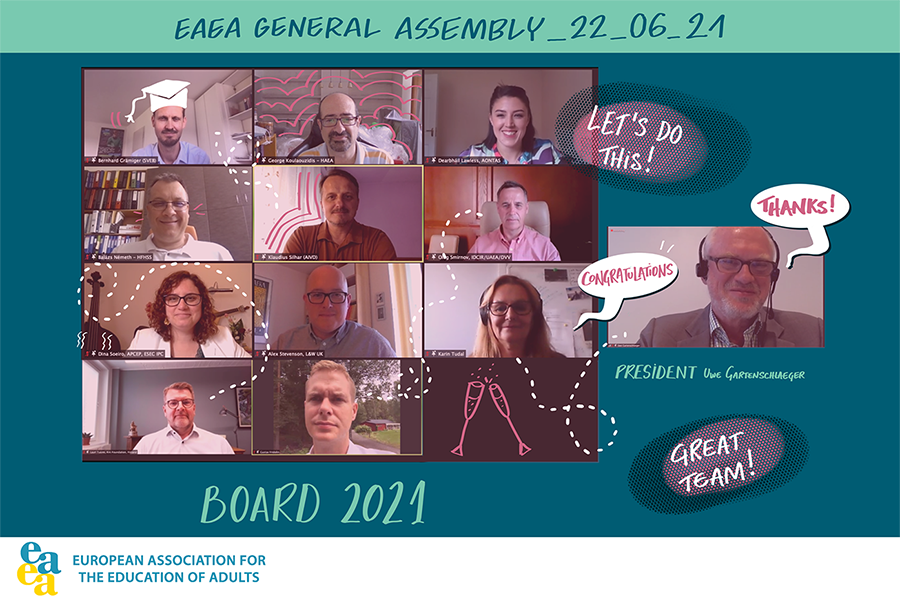
Uwe Gartenschlaeger from German Adult Education Association (DVV) continues his appointment as a President of EAEA. Gartenschlaeger shared his enthusiasm for upcoming tasks of the newly elected Executive Board.
“I look forward to working with the new board and the staff of EAEA on strengthening the recognition for adult learning and education. I strongly believe that it’s the main instrument to equip European citizens to become actively involved in shaping the transformations ahead. Digitalisation, a sustainable lifestyle and economy, just societies and a vibrant democracy need more adult learning,” he commented.
The members of the EAEA Executive Board 2021-2023 are:
- Uwe Gartenschlaeger, nominated by German Adult Education Association (DVV) International, Germany
- Gustav Fridolin, nominated by Swedish Interest Organisation for Popular Movement Folk High Schools (RIO) Sweden
- Bernhard Grämiger, nominated by Swiss Federation for Adult Learning (SVEB-FSEA), Switzerland
- George Koulaouzides (Hellenic Open University), nominated by Hellenic Adult Education Association, Greece
- Dearbháil Lawless, nominated by AONTAS, Ireland
- Balázs Németh (University of Pécs), nominated by Hungarian Folk Highschool Society Hungary
- Klaudius Šilhár, nominated by Association of Adult Education Institutions in the Slovak Republic (AIVD) Slovakia
- Oleg Smirnov, (Integration and Development Center for Information and Research), nominated by Ukrainian Adult Education Association, Ukraine
- Dina Soeiro (Coimbra Higher Education School – Polytechnic Institute of Coimbra), nominated by APCEP – Associação Portuguesa para a Cultura e Educação Permanente, Portugal
- Alex Stevenson, nominated by Learning and Work Institute, UK
- Karin Tudal, nominated by La Ligue L’Enseignement, France
- Lauri Tuomi (The Finnish Lifelong Learning Foundation), nominated by Finnish Adult Education Association, Finland
EAEA is looking forward to working with the new board! We also want to express our warmest thank you for candidates who expressed interest in the board membership, and the outgoing board members.
More information:
Gina Ebner
Secretary General
EAEA
gina.ebner(at)eaea.org
Uwe Gartenschlaeger
President of EAEA
DVV International
gartenschlaeger(at)dvv-international.de
Photo: Visuality