
What was the main purpose of this project?
“The main purpose of the project was to give on the one hand the opportunity to the local students and to the wider community to get to know a part of the culture and the lives of the migrants and refugees that live with them in the same neighbourhoods and take away existing misconceptions. On the other hand, we wanted to give to our migrant and refugee students the opportunity to ‘expose’ themselves, participate, be creative and take action and at the same time to attract more migrants and refugees to our schools.
As the school reflects the society, it is common sometimes that phenomena such as xenophobia, racism, integration problems, lack of communication and understanding appear in the school community, too. This happens because we are skeptical, hesitant and scared of what we don’t know. But in contrast to the society, in our schools we can make a difference and change the situation because we have the tools, the methods, the ideas and above all the willingness to do so. This is what we tried to do by bringing together locals and migrants towards a common goal.”
How did the project foster cooperations and partnerships?
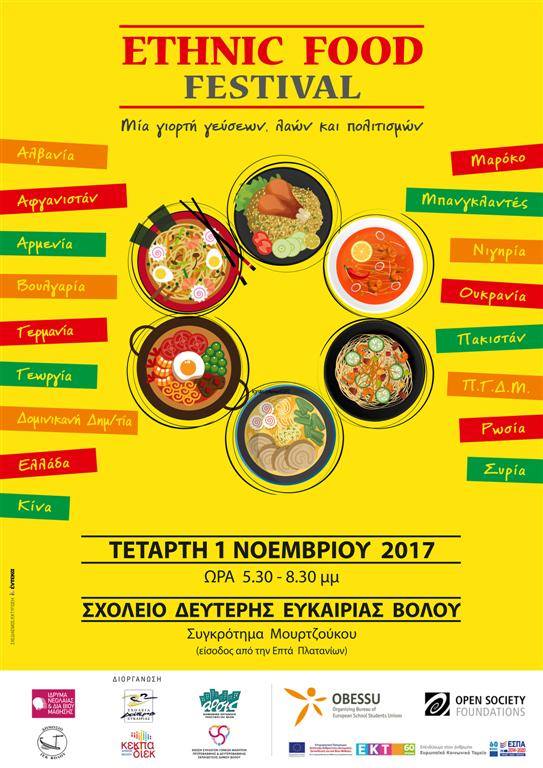
“The Ethnic Food Festival was an intercultural initiative that brought together people from 17 different countries: Albania, Afghanistan, Armenia, Bulgaria, Germany, Georgia, Dominican Republic, Greece, China, Morocco, Bangladesh, Nigeria, Ukraine, Pakistan, Former Yugoslav Republic of Macedonia, Russia, Syria. It was organised by the Second Chance Schools of Volos, Karditsa and Larisa of the region of Thessaly in cooperation with the NGO ARSIS – Association for the Social Support of Youth, the Public Institute of Vocational Training of Volos, the Institute of Vocational Training of the Municipality of Volos, the Parents’ Union of the Municipality of Volos and the Roma Aliveri Support Centre.
So, eight organisations from three different cities of the region of Thessaly had a smooth and very effective cooperation and managed to implement a very successful project. I think that speaks for itself! And most importantly, that was not an occasional and temporary cooperation, but rather a solid and sustainable one that continues since then.”
Our initiative brought together on the one hand several organisations that work on similar areas of interest and on the other hand locals and migrants or refugees.
What was the best practice learnt from this project that you want to share?
“That a simple idea can make the difference. Our initiative brought together on the one hand several organisations that work on similar areas of interest and on the other hand locals and migrants or refugees. And most importantly, it fulfilled its goal: it showed what an inclusive school environment means, it promoted multicultural understanding and tolerance; it created relations and friendships and helped overcome stereotypes and misconceptions.
The Ethnic Food Festival was a celebration of tastes and cultures that gave the opportunity to the students, migrants and locals and to the wider community to work together, discuss all the themes and problems, find alternatives, disseminate the event and get to know each other. The event received a lot of publicity from local and even national media and it will certainly serve as a good practice for the educational inclusion of migrant and refugee students.”
The Ethnic Food Festival
Category: National projects
Coordinator: Second Chance School of Volos
Country: Greece
Focus: Inclusion of migrants
Innovative cooperation: Cooperation that brought together people from 17 different countries
Text: EAEAPhotos: The Ethnic Food Festival