

The Smart Generation project focuses on the smart use of smartphones.
29.11.2016

Smart Generation partners to test media education workshops

Smartphones can be an effective tool in learning – but how do we make sure that students use them safely? The Smart Generation project consortium is finalising the Pedagogical Model, which will help teachers and educators run workshops on media education.

The Pedagogical Model will help educators conduct comprehensive workshops on media education. The pilot implementation of the model will be launched soon by the Smart Generation project consortium.

The Pedagogical Model is supported by results from a survey on the use of a smartphone. The surveys ran in all partner countries and reached almost 500 teachers and educators and 2000 young learners.

The model looks at four intervention areas affected by using a smartphone: identity, relations, safety and knowledge. For each area, the consortium suggests a one-hour workshop to develop the topic in depth. Teachers can, however, use only some activities and incorporate them into their regular class, as each workshop will be broken down into smaller units.
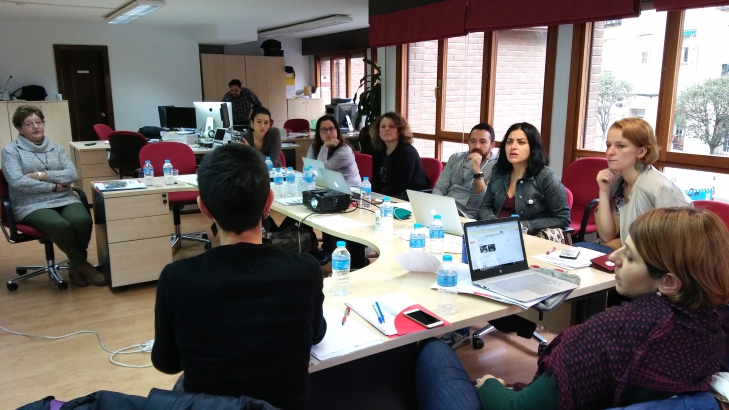
The partners developed the Pedagogical Model at the 3rd meeting of the Steering Committee, which took place on 21–22 November in Madrid.

The model will soon be made available for the public and tested by partners in Italy, Spain, Latvia and Romania.

If you’d like to participate in the pilot implementation or find out more about the project, contact the project coordinator, Centro Culturale Francesco Luigi Ferrari. Don’t forget to follow the project on Facebook.

Text: Aleksandra KozyraPhotos: Aleksandra Kozyra, Unsplash/Clem Onojeghuo

18.06.2026 digitalisation

The transformative power of education in closed environments

Education is a fundamental right. But for people living in prisons, detention centres, and other closed environments, that right often remains out of reach. At the EAEA Annual Conference in Warsaw, a workshop brought together adult education practitioners to explore what it takes to make education (including digital education) a reality behind closed doors and how ALE can contribute actively to systemic change.

18.06.2026 digitalisation

Competence development with the help of technology: practical examples for educators

While the benefits of emerging technologies in adult education have already been recognised, educators still lack support to effectively integrate them in (non-)formal education contexts. Within the ETHLAE project, we have made a toolbox consisting of five learning areas with each two learning scenarios available to help educators in providing learner-centred support to adults in vulnerable situations.

16.06.2026 EAEA General Assembly

Welcome new members!

EAEA welcomed eight new members at the General Assembly on the 9th of June in Warsaw, Poland. The new members come from Kosovo, Ukraine, Malta, Ireland, Portugal, and Bulgaria.