

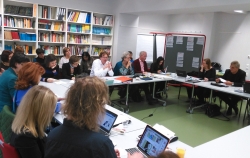
In the framework of the project, an expert conference on validation was held in Vienna on the 13th October 2015. The AVA Jour Fixe was organised by the Association of Austrian Adult Education Centres (VÖV) and gathered Austrian and international participants from more than ten countries. Four experts from the Netherlands, Portugal, Romania and Denmark were invited to share their national experiences on validation.
The Netherlands: transition to a holistic approach
Tijs Pijls, from Dutch Knowledge Centre APL and Partnership Lifelong Learning NL, explained how validation functions in his country and what are the benefits for different target groups. Historically, validation of prior learning was seen as a labour market instrument and thus linked to the concept of a certificate of experience (ervaringscertficaat) in the Netherlands.
“Currently we are in a phase of transition towards a more holistic approach, which could be used for the education sector as well,” stated Mr. Pijls. He also explained how quality standards are being respected in the Netherlands and how important the cooperation among stakeholders – in particular with social partners – is in his country. He stressed the importance of the connection between NLQF, ECVET and APL to stimulate individual mobility on the labour market.
Nordic countries: NVL Quality Tool
Kirsten Aagaard from National Knowledge Centre for Validation of Prior Learning (VPL) illustrated in detail the Nordic quality model for the implementation of validation. The model was designed by the Nordic expert network on validation after comparing models and best practices and takes into consideration three perspectives: organisational, procedural and assessment.
“The NVL Quality Tool was developed to help validation practitioners in their daily work, paying particular attention to avoid adding a burden in such an already complex process,” said Ms. Aagaard.
Portugal: recognising the skills
Dora Redruello presented the standards, processes, impacts of validation for people with disabilities in Portugal. She works for at the Cerebral Palsy Association of Coimbra (APCC) which operates in the area of recognition of skills for people with and without disabilities. It is a service focused on the individual, working in close collaboration with the community.
“The APCC actions not only improved the employability profile of the population with special needs by raising their qualification level, but also promoted self-knowledge and empowerment of the individuals by allowing them to be the key-actors of the process,” elucidated Ms. Redruello.
“Furthermore, being an integrative project that worked with all citizens of the local community, our project increased the awareness on the needs of people with disabilities.”
Romania: National occupational standards
Georgeta Pelcea from the Romanian National Authority for Qualification described how the validation process in her country is linked to the national occupational standards. Defining the competencies needed for a certain occupation and their quality criteria, the standards are key for the assessment and certification of prior learning. They are the reference for development of assessment tools or training programs and therefore they are developed by experts in the field and validated by the sectoral committees.
“The sectoral committees are social dialogue institutions of public utility, with legal personality; organised by economic sectors,” explained Ms. Pelcea.
“Their involvement in the validation of occupational standards creates a strong link between labour market requirements and formal, non-formal and informal learning”.
Next steps of the AVA project
Participants asked the experts to list the strong and weak points of each system and engaged in a discussion around their sustainability and inclusivity. Main challenges at this stage are the lack of permeability (between labour-market and education or within sectors of the latter) and fragmentation (between policy and its implementation, or among practices).
The adult education providers and organisations’ perspective on these issues were investigated through a survey launched by the AVA consortium in the beginning of 2015. An analysis report is currently being finalised and will presented at the net AVA event, the expert seminar in Oslo, Norway, between the 1st and 2nd of February.
Text: Francesca OpertiPhotos: Francesca Operti