
The twin transition assumes that the green and digital transitions are mutually dependent. Digital skills are essential for learning about climate change, participating in solutions or finding climate-friendly alternatives. Green and digital transitions are also connected, as large amounts of data are energy-intensive.
The Adult Learning and Education for the Twin Transition (ALE4TT) project ran from September 2023 to August 2025. The project was co-funded through a grant from Movetia, the Swiss education and exchange agency. ALE4TT aimed to support ALE organisations in better communicating, advocating and developing strategies to convince third parties such as policymakers because ALE has a crucial role to play in a just transition process. It will also support them in building a wider network with diverse allies from the broader digital and green community.
📖 You can discover now the final project outcomes:
- An international training programme on ALE and the twin transition, co-created with participants from ALE organisations. The training programme can be followed by ALE professionals and adapted to your needs.
- An advocacy toolkit bringing together case studies and methods that can support ALE providers in advocating ALE in the twin transition. The toolkit includes best practices for advocacy and the twin transition, as well as pedagogical approaches.
- Policy Recommendations for researchers, policy-makers and ALE professionals. You can use these as food for thought in your local context, and use the training programme tools to learn how to approach policy-makers in your setting.
Hear from the learners
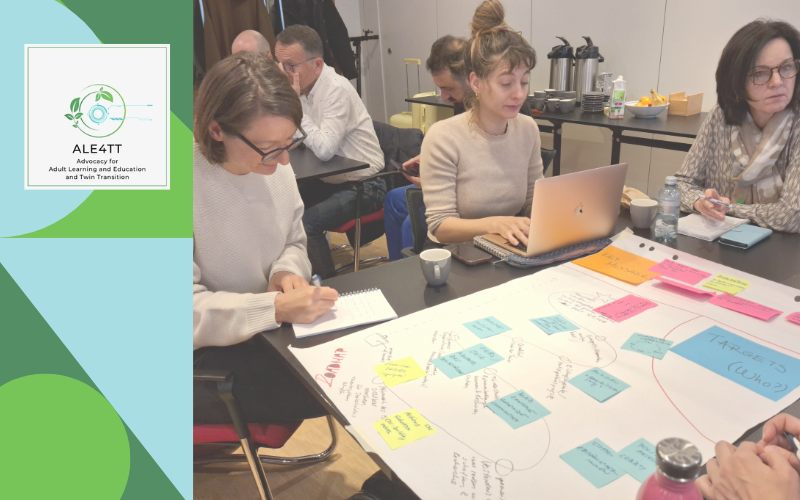
This ALE4TT Training programme results from two rounds of training conducted in Belgrade (May 2024) and Brussels (May 2025), with a total of 34 participants. With highly positive feedback for both trainings, the partners integrated the comments and feedback of participants to provide the following training programme guide. We also ensured to co-create the content during the training with the learners, asking them to set expectations, share their input and regularly guide the direction of the course. Following the training in May 2025 in Brussels, four learners and educators shared their experience of the course and what they learnt: