
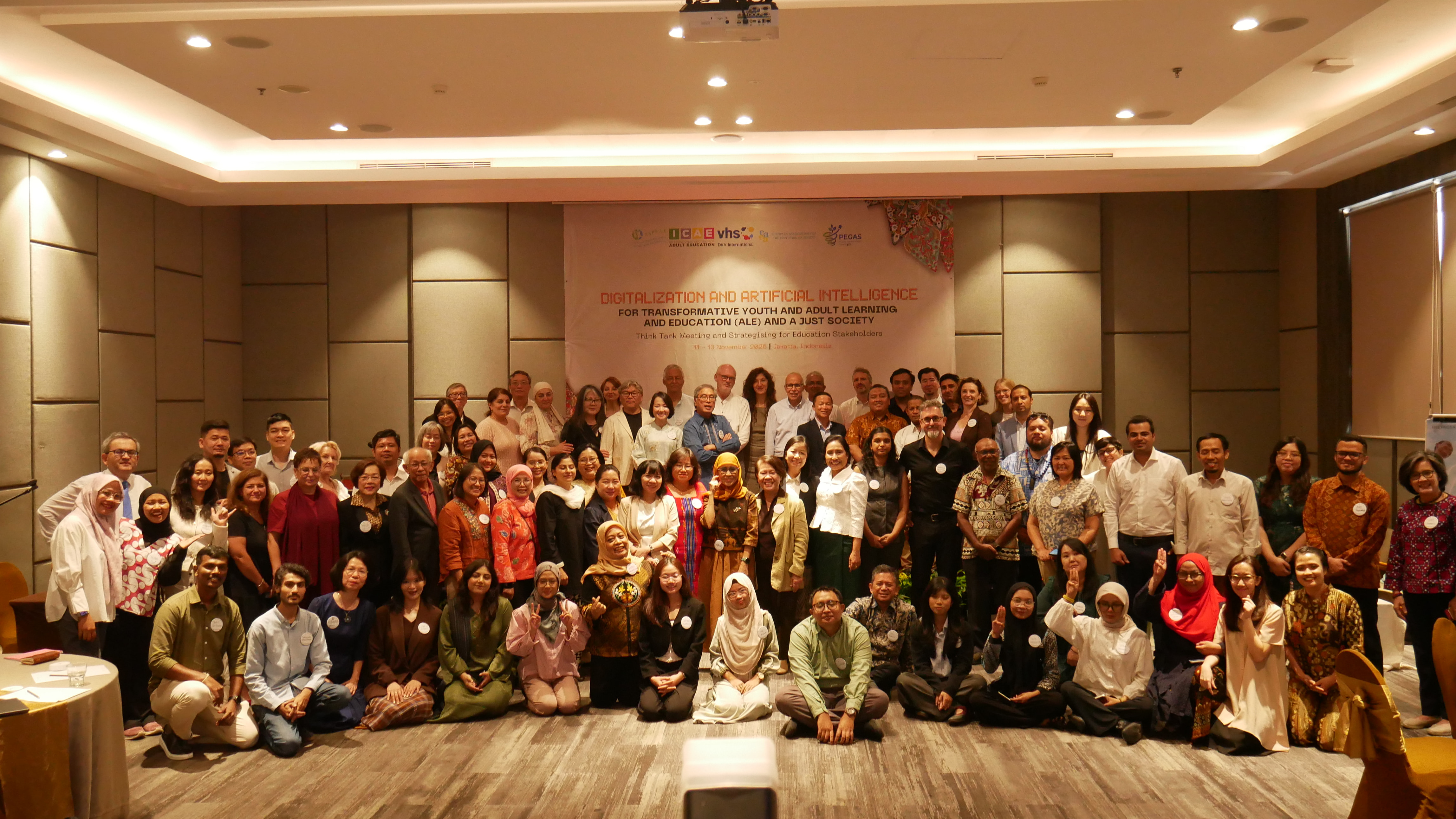
The International Think Tank Meeting and Strategising for Education Stakeholders, titled Digitalisation and AI for Transformative Youth and Adult Learning and Education and a Just Society, met for the second time in Asia. The first, held in Vientiane in November 2025, brought together 65 participants from Asia-Pacific and Europe and produced a Call for Action for rights-based, human- and planet-centred youth and adult learning in the era of digitalisation and AI.
A year after the Call for Action agreed in Vientiane, the conversation had grown, both in numbers and in voices. Alongside colleagues from Asia-Pacific and Europe, participants came from Africa and the Arab region. Young people had dedicated places, and Deaf colleagues from Vietnam and Mongolia took part through a chain of interpreters, from English to Indonesian Sign Language and on to International Sign. That chain was perhaps the best image of what the meeting was about: technology and people working together, so that nobody is left out of the conversation.
The questions on the table were set out in the opening session. Most debates about AI in education, EAEA’s Director of Policy and Public Affairs Greta Pelucco observed, are about tools: which ones to use, how quickly they work, which learners can benefit. The Call for Action goes further: “Whose rights? Whose knowledge? Whose planet? And, perhaps most importantly, who decides?” Robbie Guevara, President of ICAE, put it in an educator’s terms. The challenge is not simply to learn new tools, but to develop the critical understanding to decide which ones to use, which to approach with caution and which to refuse.
Being connected is not the same as being included
Over the two days, speakers from very different contexts kept arriving at the same conclusion. Nurasiah Jamil of Pegas PEKKA described women in Indonesia gathering around a single phone to join online meetings during the pandemic, because almost half of the 91,000 women the organisation works with did not own one. Bayasgalan Nyamdorj, a young lawyer from Mongolia, explained that almost every adult in his country has a smartphone, yet only around one in five can judge whether information is accurate. Farrell Hunter of ICAE spoke of “divides within divides” in Africa, where gender, rural life and age overlap. And from Europe, EAEA showed that the divide does not disappear when connectivity rises. It changes shape: from access, to skills, to agency, the power to question, refuse or influence the systems that shape people’s lives.
Digital and AI policies tend to reach those who are already included, through formal education and the workforce, while the non-formal and community-based learning that reaches people left behind is too often treated as an add-on. Elarbi Imad of the Moroccan Center for Civic Education insisted that civil society organisations should be involved in planning, monitoring and evaluating national strategies, rather than being treated merely as service providers.
Behind the question of access lies a question of power. Rene Raya of ASPBAE showed how the ownership and financing of AI are concentrated in a handful of countries and companies, while there is still no binding global treaty on AI. Georg Pirker, from Adb and member of EAEA, described the imbalance between the hundreds of digital-industry lobbyists in Brussels and civil society organisations that can barely afford one policy officer. Yet alternatives exist. Martin Dougiamas of Open EdTech argued that AI should be treated as public infrastructure, like water or electricity, and a hands-on session on the second day let participants try open-source models for local languages and education. As ASPBAE’s Helen Dabu concluded: “Another world is possible in the digital space.”
Technology may already be at version 5.0, but regulation is still at 1.0, and equity and inclusion, Rene Raya warned, “may even be operating at negative 5.0”.
Digital literacy is more than knowing how to use a tool
What, then, should digital literacy mean for adults? On the second day, a panel moderated by Uwe Gartenschlaeger of DVV International took up the question, and found the usual definitions too narrow, often centred on employability. Christina Bellmann of DVV had already made the case the day before: as AI-generated content becomes harder to tell apart from authentic information, AI literacy becomes a condition for democratic participation. Participants had experienced this first-hand in a “Real or AI?” exercise, where a room full of educators struggled to tell which images were genuine. EAEA linked this to trust: only 37% of EU citizens trust their national government, while exposure to disinformation keeps rising; digital literacy should be perceived as “the ability to use, question, and shape digital technologies, particularly in relation to our participation in society,” and warned that this kind of societal resilience needs public funding as much as defence does.
Guevara, drawing on Paulo Freire, described digital literacy as conscientisation: a lifelong process of becoming aware of how we shape the world and how it shapes us. Dy Samsideth of Cambodia’s National Committee for Lifelong Learning spoke of community learning centres as places where everyone has something to give and something to take. Again and again, speakers came back to the role of non-formal education, libraries and community spaces in reaching people who no longer trust formal institutions.
The generations in the room did not always read the digital world in the same way. Nazihah, a Gen Z lecturer from Jakarta, explained that a crying emoji can mean laughter among her friends and sadness to her mother. Intergenerational learning, which has its own advisory group within the Call for Action, was a thread through both days. The young participants ended their session with a clear request:
“To adults: keep creating spaces for young people. Keep listening to us, involving us, working alongside us, and learning from us.”
None of this will happen without resources. Speakers warned that, for most low- and lower-middle-income countries, AI is simply not affordable, and that some governments are cutting funding for basic education while spending more on educational technology. Proposals ranged from taxing the technology companies that profit from AI to dedicated public budgets for inclusive digital learning. As EAEA had put it at the opening, “a strategy without financing is simply a promise”.
The meeting closed with the in-principle adoption of the collective advocacy messages, refined in working groups on the second day. Organised around policy, governance, financing, participation, equity and inclusion, and quality, they call for learners and educators, especially from marginalised communities, to have a real voice in how AI is designed and regulated; for publicly owned and locally led learning technologies; and for the protection of local and Indigenous languages and of adult educators’ rights. The partners will finalise the document for wider circulation, and EAEA will bring it to its more than 120 members and to European policymakers.
AI may open many doors, but the Think Tank was clear on who should decide where they lead. In the closing words of Elarbi Imad:
“Artificial intelligence may contribute to shaping the future of adult education and lifelong learning. However, it is human intelligence that will ultimately shape the future of humanity.”
Text: Greta Pelucco