
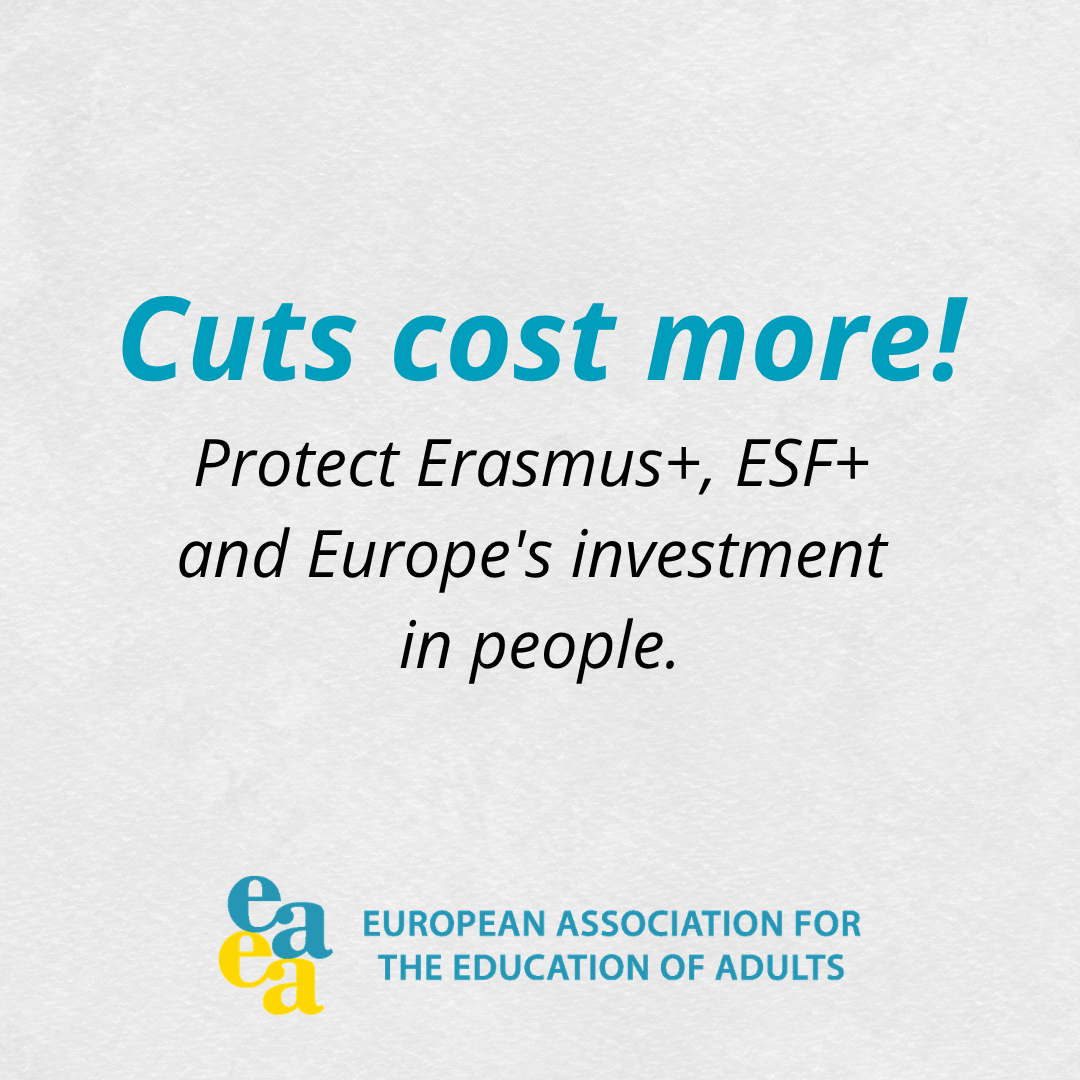
The European Association for the Education of Adults (EAEA) expresses its deep concern and disappointment at the proposed cuts to the EU’s next Multiannual Financial Framework (2028–2034), presented by the Irish Presidency of the Council of the EU on 10 October.
The proposal would reduce the European Commission’s original budget by approximately 8%, with particularly severe reductions to programmes supporting democracy, civil society and international cooperation. The proposed cuts include 30% to AgoraEU, 17% to Global Europe and approximately 4% to Erasmus+. These cuts cannot be explained as budgetary adjustments; they raise fundamental questions about the kind of Europe that we want in the future.
Investment in education, social cohesion, civic participation and international solidarity is more necessary than ever, especially at a time when Europe is facing increasing social inequalities, democratic challenges, geopolitical instability and profound economic and environmental transformations. Yet, the proposal suggests that these are precisely the areas whose funding is now being put under pressure.
Cuts to adult learning and education across the board
Europe cannot claim to prioritise lifelong learning while weakening the instruments that make it possible. The new proposal puts the entire future of the Union of Skills at risk, with the learners having to deal with the consequences.
EAEA is particularly alarmed by the proposed reduction of almost one third of the AgoraEU programme, which is intended to support democracy, culture, media and civil society, and provides funding to programmes such as CERV+. Civil society organisations are essential partners in building democratic resilience, fostering participation, reaching marginalised communities and strengthening trust in democratic institutions. Weakening their financial foundations risks undermining the very European values that the Union has committed itself to defend.
EAEA is equally concerned about the lack of clarity surrounding the future European Social Fund+. While the Irish Presidency proposes to maintain the overall allocations for cohesion policy, there is still no clear financial guarantee for the ESF+ within the new National and Regional Partnership Plans (NRPPs). The proposed minimum allocation for social objectives cannot substitute for a dedicated commitment to education, lifelong learning and social inclusion. Without transparent allocations and safeguards, ALE risks being overshadowed by competing priorities within increasingly broad national funding frameworks. EAEA calls for a clearly identifiable and protected ESF allocation, including a minimum 5% earmark for adult learning, alongside meaningful involvement of civil society and adult education providers in the design and implementation of national and regional plans.
We are equally concerned about the proposed 17% reduction to Global Europe. This raises serious questions about the future of development education and awareness-raising in the context of the EU’s international work. In particular, we are very worried that this might affect a future DEAR programme, which is the EU’s key programme to enable citizens to engage critically with global challenges, sustainable development, human rights and international solidarity.
The proposed reduction to Erasmus+ is another worrying signal. Compared to the European Commission’s original proposal, the cut is “only” 4%; however, compared to the European Parliament’s proposal from 29 September 2026, the decrease is more than 26%. While the programme continues to receive a larger overall allocation than in the current financial framework, the proposed cut risks limiting the programme’s capacity to respond to growing learning needs. Adult education, already one of the smallest sectors within Erasmus+, needs to remain a key pillar of the programme.
Europe’s strongest weapon is educated and empowered citizens
We recognise that the EU faces difficult financial decisions and growing demands for investment in security, defence and competitiveness.
However, Europe’s future depends on both effective security and defence and educated, informed and empowered citizens. These are not competing priorities but complementary elements of a resilient Europe. While defence capabilities are essential to protecting European societies, adult learning and education (ALE) strengthens democratic resilience, critical thinking, informed civic participation and social cohesion. Investment in education and lifelong learning is therefore an integral part of Europe’s long-term security and competitiveness.
ALE empowers people to participate in society, strengthens communities, supports just transitions and provides opportunities for those who are furthest removed from education and training.
Protect funding for lifelong learning, civil society, and global citizenship education
We strongly call for adequate investment in education and lifelong learning, democratic participation, civil society and international cooperation in the next EU budget. In particular, we underline the importance of protecting Erasmus+, ensuring dedicated funding for ALE in ESF+, safeguarding civil society support through AgoraEU and CERV+, and preserving opportunities for global citizenship education through Global Europe and DEAR.
We also reiterate the importance of strong and accessible investment in ALE through the ESF+ and the future NRPPs, with dedicated resources for inclusion, community learning and flexible learning pathways. Cuts to education and civil society risk making Europe’s challenges much more expensive to address in the future.