
30.09.2026

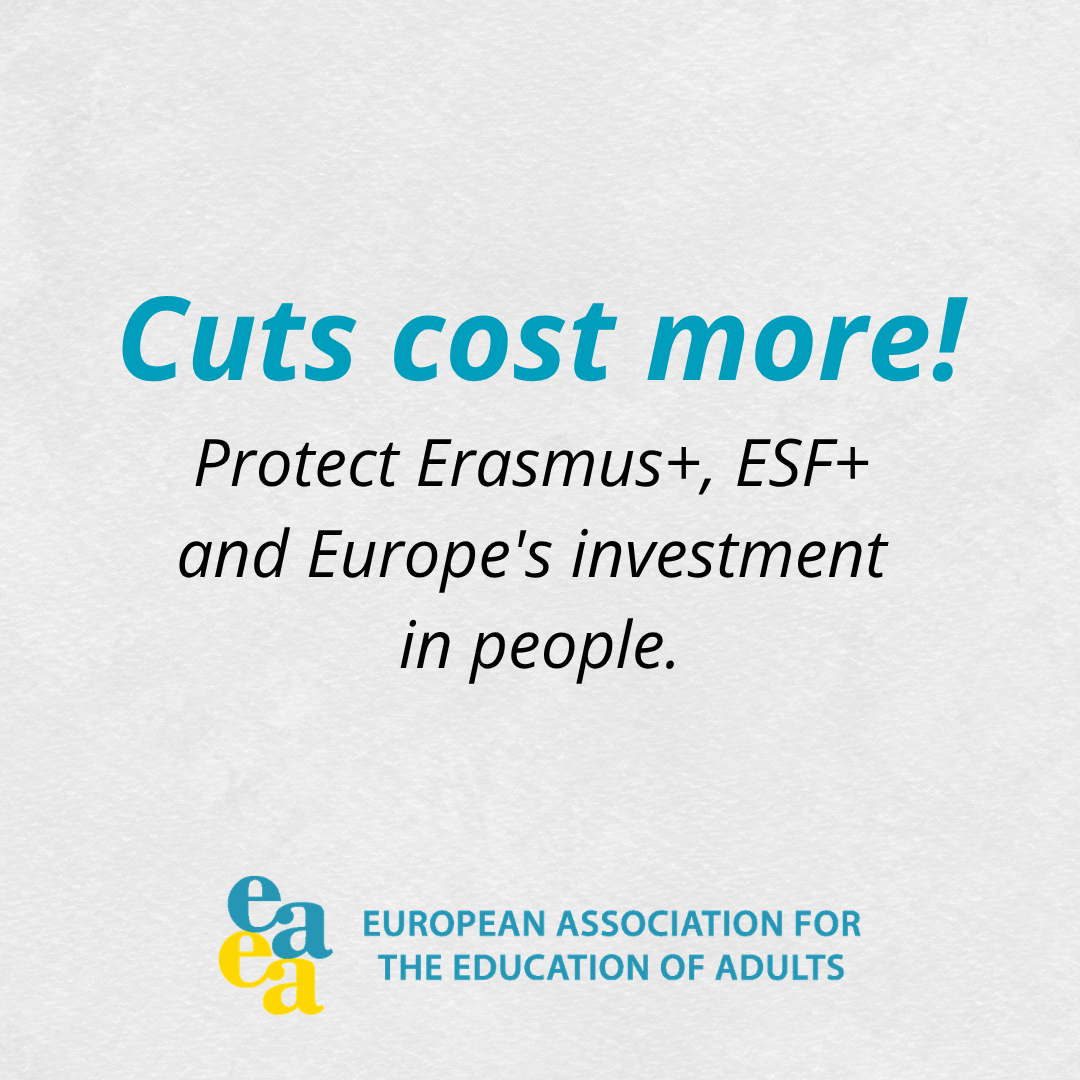
Cuts cost more: EAEA joins European campaign to support future financing of education

EAEA has joined a European campaign to support the future financing of adult education and lifelong learning in the Multiannual Financial Framework (2028-2034) of the European Union. The campaign was launched by the Lifelong Learning Platform and reunites a broad coalition of civil society platforms in education, training, and lifelong learning.

This campaign was launched by the Lifelong Learning Platform and adapted to our sector of adult learning and education. 

The context: The Cyprus Presidency has circulated the first draft of the Multiannual Financial Framework (MFF) Negotiation Box, outlining Member States’ initial position on the next EU budget. While the proposal still requires Member State approval, it currently allocates €39.16 billion to Erasmus+, which is significantly below expectations and accompanies a reduced overall EU budget compared to the European Commission’s proposal. This contrasts with the European Parliament’s draft report on Erasmus+ 2028–2034, which supports a budget of €47.4 billion, based on Parliament’s interim position on the MFF.

The campaign relies on the active involvement of our members and our networks at all levels from the European to national and regional level: join us!

14.10.2026 advocacy

Cuts cost more: EAEA deeply concerned by proposed reductions to the next EU budget

Ahead of the European Council meeting on 15–16 October, EAEA urges European leaders to recognise adult education, lifelong learning, and civil society as essential investments in Europe's future, not as expendable budget lines.

13.10.2026 inclusion

A new European initiative for valuing neurodiversity in work and education

The European Association for the Education of Adults in partnership with FORMA.Azione and other organisations from Italy, Austria, Germany and Bulgaria has launched the European initiative CAN – Valuing Neurodiversity

12.10.2026 access

Closing the digital gap in closed environments

Access to digital education can open new possibilities for people in detention, from developing essential digital skills to supporting personal growth, employability and social reintegration. This article explores how technology and education can help learners in closed environments build confidence, develop new skills and prepare for life beyond detention.