
EAEA has extensive experience in curriculum design and in applying participatory and collaborative learning methodologies for adults. Through the Design Sprint process, EAEA supported project partners in creating practical course outlines that respond to real learner needs and changing labour market demands.
What is a Design Sprint?
The Design Sprint methodology was developed by former Google Ventures partners as a 5-day process for solving challenging problems in entrepreneurial contexts (Knapp, 2016). The process follows six phases: Understand, Define, Sketch, Decide, Prototype, and Validate (Design Sprints, n.d.). One of the most important elements of the first phase, “Understand”, is beginning to empathise with the people for whom you are trying to solve a problem (Institute of Design Stanford, n.d.). As Design Sprint processes are used to address specific challenges, it is essential for designers to view the issue from the perspective of those who face it.
For the Twin-In project, which seeks to create innovative curricula in the agrifood sector, this methodology offered an effective framework to co-create educational solutions that can be transferred across different national and sectoral contexts.
The process was facilitated by Charlotte Ede, Learning and Project Coordinator, and Tina Mavrich, Head of Capacity-Building at the European Association for the Education of Adults (EAEA).
Supporting the future agrifood workforce
The overall goal of the Design Sprint process in Twin-In is to design a pool of sample curricula, which will later be expanded by the Aristotle University of Thessaloniki (AUTH), while also developing a set of internal quality guidelines and checklists to ensure the curricula fully meet learner needs in the future agrifood sector.
The workshops followed the 6 main phases of the Design Sprint approach, split over three workshops:
- Workshop 1: Identifying learner needs for the future agrifood instructor — Understand (1)
- Workshop 2: Validate the checklist criteria and launch the design activities — Define (2) and Sketch (3, conducted independently)
- Workshop 3: Present sketches and developed ideas and validate next steps — Decide (4), Validate (6)
Understanding Learner Needs
The first phase of the Twin-In Design Sprint approach focused on identifying learner needs to be addressed in innovative Twin Transition Schools (TTS). The first workshop was held on 12.03.2026, with 16 participants from the consortium and three external experts. The invited experts were Christos Keramydas, Associate Professor at the Department of Supply Chain Management, School of Economics and Business Administration, International Hellenic University (Greece); Giuseppe (Pino) La Rocca, agricultural worker and educator with a PhD in Economics; and Nina Schweinzger, educational farm owner working with EAEA member Bildungshaus Retzhof GmbH.
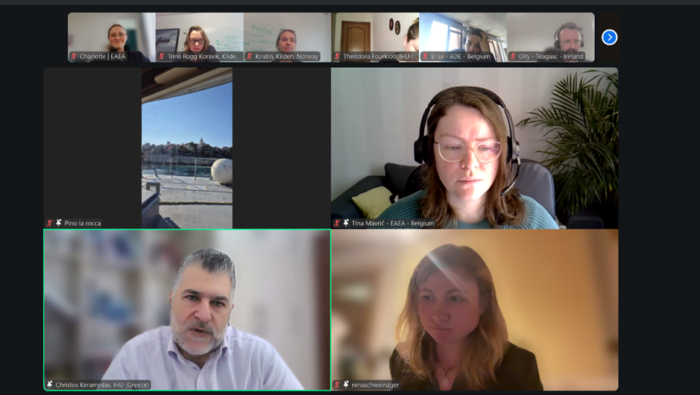
Following the interviews, partners were asked to identify the learner needs highlighted and to add their own perspectives based on their experience as educators or through local workshops conducted under WP4.
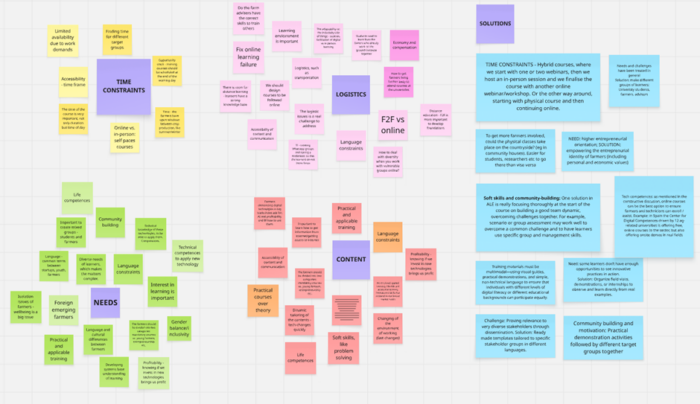
Five main categories of learner needs emerged from the discussions (from both the interviews and partners’ contributions):
- Time-flexible learning formats: Taking into account the specific time constraints of farmers, whether in industrial farms, cooperatives, or university settings.
- Practical and applied training: Interactive, group-based, and project-based learning methods should be prioritised to ensure learners can directly apply their knowledge and educators can quickly identify knowledge gaps.
- Accessibility (location, transport, cost): The location of learning activities (centres, fields, schools) should be carefully considered, along with the availability, organisation, and cost of transport.
- Intercultural, group, and linguistic support: All training materials should be developed in clear and simple language. Where necessary and possible, language support should be provided. Educators should also actively facilitate group dynamics.
- Stronger links between education and real agrifood practice: Training should be directly connected to practical application, whether through cooperation with farmers, industry, or cooperatives, or through study visits and internships.
These findings formed the basis of a learner-centred checklist for Twin Transition Schools.
From ideation to course concepts
During the second workshop on 19 March 2026, partners refined and validated the checklist while launching the curriculum design phase. They also highlighted the importance of intergenerational learning and multi-stakeholder cooperation in future TTS curricula.
Partners were then invited to prepare national course outlines using the checklist together with the competence framework developed by the University of Cassino and Southern Lazio (UNICAS).
In the final workshop, partners presented their draft curriculum ideas, including:
- community-centred marketing
- triple-layer business model canvas
- partnership management
- risk evaluation through storytelling
- digital technologies for agrifood
- prescription maps and ISOBUS systems
Participants reviewed the proposed courses and provided peer feedback based on the jointly developed learner-centred criteria.
Toolkit validation and next steps
As part of the final workshop, EAEA’s T5.1 Toolkit of pedagogical tools and activities was also validated. Partners confirmed that the resources developed will provide valuable support in the next stages of the project.
The next phase of the Design Sprint process will take place during the piloting of Twin Transition Schools under Work Package 6, where ideas and curricula will be tested and improved in real learning environments.
Through this collaborative process, EAEA continues to support innovative adult learning approaches that help learners, educators and communities navigate the twin transition.
___________________________________________
References
Design Sprints. (n.d.). Design Sprint Methodology. Accessed 08.04.2026: https://designsprintkit.withgoogle.com/methodology/overview
Institute of Design Stanford. (n.d.). An Introduction to Design Thinking Process Guide. Hasso Plattner Institute.
Knapp, J., & Zeratsky, J. (2016). Sprint: How to Solve Big Problems and Test New Ideas in Just Five Days. Simon & Schuster.
Text: Charlotte Ede