
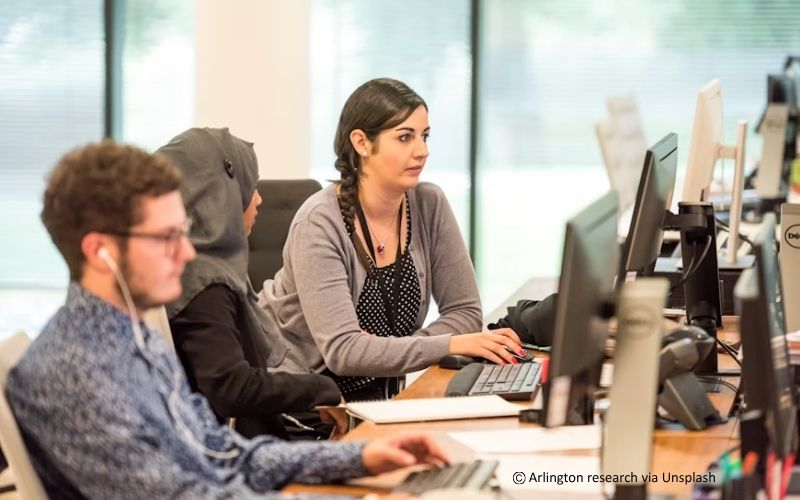
Recent technological developments, namely AI, have pushed society to advance at an even faster pace. But not everybody can keep up. This is leading to inequalities in access to digital learning as these technologies depend on the resources available, access to them, and the capacity of the educational teams.
Everything points towards a technology-heavy future. If we want this future to belong to everyone, especially adults in vulnerable situations, they need to be supported in keeping up with the latest technological innovations. EAEA is working to promote a more inclusive use of digital technologies in non-formal adult education.
Since new technologies are developing rapidly, there is little awareness of the potential and practical uses of emerging technologies in adult education. There is often insufficient support available for educators on how to use them efficiently. However, the implementation of digital tools in adult education can have great benefits as technology facilitates tailored learning pathways which are useful in heterogeneous learner groups. Digital tools can also be used to create immersive environments, which are well-suited in developing life skills relevant for personal and professional development.
Putting digital tools into practice
More than introducing learners to new technologies, EAEA is working on integrating new technologies to enhance learning. These tools can support learners in developing, for example, numerical skills or social and interpersonal skills. With the assistance of an AI tool, learners with basic writing skills can learn new words and get feedback on their texts.
AI and digital tools can also assist in learning to manage personal budgets or calculate the energy consumption of a household. In addition, AI can be used as an empowering tool that fosters active citizenship (always with the proper guidance of an educator), informing learners of their personal rights, such as their right to vote.
Developing these competences is essential for developing self-sufficiency and self-confidence, especially for adults in vulnerable situations. Innovative approaches that use emerging technologies, when used properly and safely, can strengthen accessibility and inclusivity in learning opportunities.
Make use of resources for adult educators
In order to assist educators in adopting emerging technologies, EAEA has created a MOOC (massive open online course) that is specifically designed to support adults in vulnerable situations. It guides ALE educators, trainers, and education stakeholders through emerging technologies in adult education while providing research results, resources, and ten ready-to-use materials on the following areas:
- Literacy and Numeracy
- Personal, Social, and Learning to Learn competence
- Digital spaces and communities
- Environmental sustainability
- Democracy and active engagement
The course is available on EAEA-Learning for free and can be found under the name “Integrating emerging technologies in adult education.” Simply register on the EAEA learning platform and enroll in the MOOC to start learning more about technology in the context of adult education!
***
ETHLAE – Emerging Technologies for Holistic Literacy in Adult Education (Project: 101184061 — ERASMUS-EDU-2024-PCOOP-ENGO). Funded by the European Union. Views and opinions expressed are however those of the author(s) only and do not necessarily reflect those of the European Union or the European Education and Culture Executive Agency (EACEA). Neither the European Union nor EACEA can be held responsible for them.
Text: Lara Stoltz