
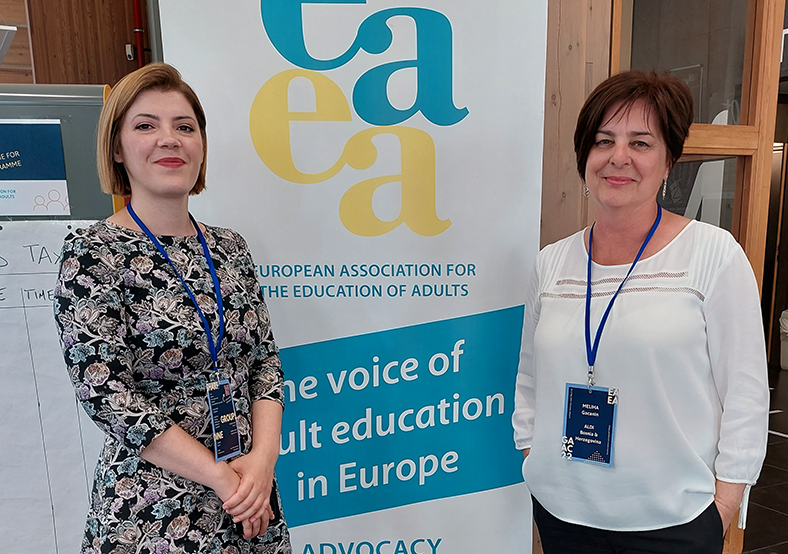
EAEA’s General Assembly has accepted four new associate members and three ordinary members. Representatives from four organisations received their membership certificates at the Assembly in Mechelen Cultural Centre. The event provided an opportunity for beneficial networking among the member organisations.
Catholic Association for the Education of Adults (Katholisches Bildungswerk Kärnten) is one of the new members.
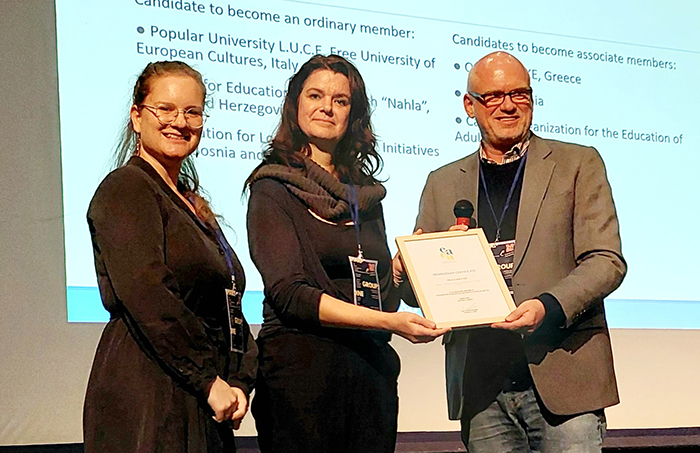
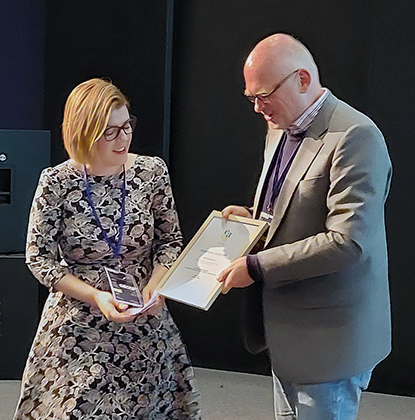
“We are established 75 years ago. We are working in the field of parent education, senior education, migration,integration and political studies. We have many Erasmus+ projects and that’s why we are trying to network with European organisations”, said Mija Janesch from the Association receiving the certificate. She was joined by Katharina Wagner.
EAEA welcomed two new members from Bosnia Herzegovina. Centre for Education and Research “Nahla” (Centar za edukaciju i istraživanje “Nahla”) is established in Sarajevo and has been active over 20 years. The organisation supports women’s education through different social and business courses. Social and inclusion and equality are key elements of their mission. Nahla attempts to assist women’s personal development and increase their social participation through interactive projects and activities.
“Our goal is to empower women through education and create a stimulating environment for their personal development. We started to work in war-destroyed countries so by now we have lots of experience. We are registered by the Ministry of Education in Sarajevo and we have three education centres in the country.”, said Elvira Leka, who accepted the certificate.
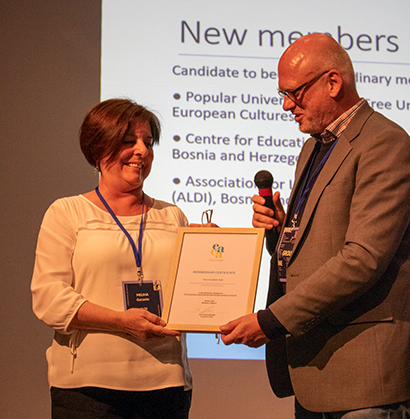
Association for Local Development Initiatives (ALDI) is established in 1996 in Gorazje, Bosnia Herzegovina and works in partnership with actors from both industry and education. ALDI also supports the empowerment of citizens so that they will participate equally in the political and social sphere.
“We are focusing in private sector development, policy, advocacy, and capacity building. For the past 10 years, the organisation has been working in the field of adult education, labor skills development with aim to adapt to the challenges brought by digital age,” explains Meliha Gačanin from ALDI.
Odyssea is a Greek non-profit organisation which specializes in the field of employment and lifelong learning. Through personalized vocational and digital training, they seek to offer equal opportunities for personal and professional development.
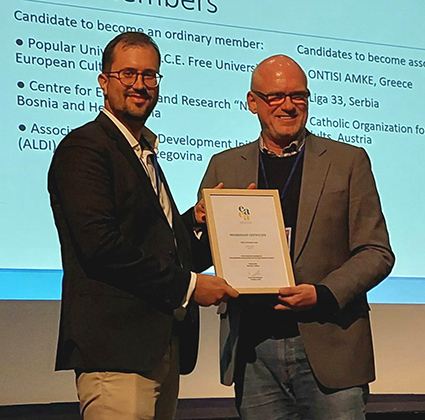
I am happy to meet you all and work together on European level.
Loukas Oikonomakis
“We are a non-profit organisation working with vulnerable populations, mainly migrants, unemployed people, and returning citizens. We provide training on hard and soft skills, digital training and also employability support through our network of companies. Last year we had more than 600 participants”, said Loukas Oikonomakis from Odyssea. “I am happy to meet you all and work together on European level”.
New Ordinary Members of EAEA
Association Popular University “LUCE”, Italy
Association for Local Development Initiatives “ALDI”, Bosnia and Herzegovina
Centre for Education and Research “NAHLA”, Bosnia and Herzegovina
New Associate Members of EAEA
Odyssea, Greece
Liga 33, Serbia
Catholic Organisation for the Education of Adults, Austria
Didaxe, Italy