
Read EAEA’s full response to the public consultation on Reinforcing Social Europe (pdf)
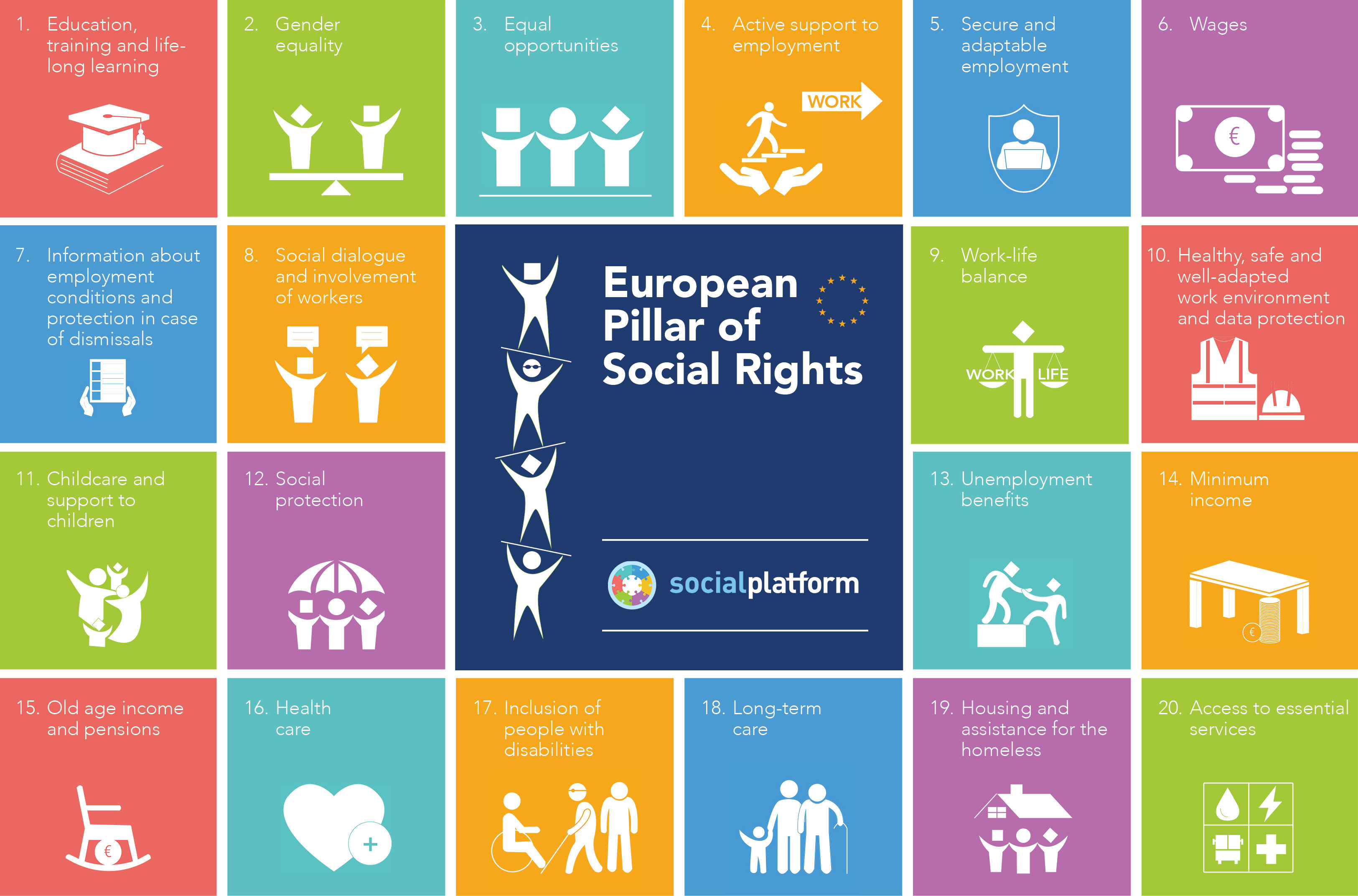
EAEA’s infographic: European Pillar of Social Rights and what has it achieved for adult learning and education? (pdf)
Everyone has the right to quality and inclusive education, training and life-long learning.
EAEA advocates for this right to (lifelong) learning and wants to reiterate the centrality of education, training and lifelong learning, as the first principle of the Pillar. Education does not only support citizens to maintain and acquire skills, but also enables them to participate fully in society, managing challenges in the labour market and their personal life. The social strategy, outlined by the European Pillar of Social Rights, requires a strong adult education sector that can ensure that the transitions of digitalisation, demographic change, climate neutrality and the recovery from the COVID-19 pandemic are socially fair and just. Moreover, adult learning and education is a key contributor for creating equal opportunities as well as enabling access to society, providing social protection and inclusion.
EAEA urges the European Commission:
- To ensure stronger coherence between the European Pillar of Social Rights and strategies and policies on adult education and lifelong learning
- To increase its efforts in promoting European policies and strategies to increase adult participation in lifelong learning
- To promote the implementation of European policies such as the European Pillar of Social Rights at the national and regional level
EAEA urges the EU Member States:
- To recognise the right to (lifelong) learning, as proclaimed in the European Pillar of Social Rights, in national education and lifelong learning systems
- To involve civil society in the implementation of the European Pillar of Social Rights at the national and regional level
- To support adult learning and education both structurally and financially and enable civil society in this sector to create national umbrella platforms that can help with the implementation of the objectives of the Pillar
Text: EAEA, Jana Ahlers, Raffaela Kihrer