
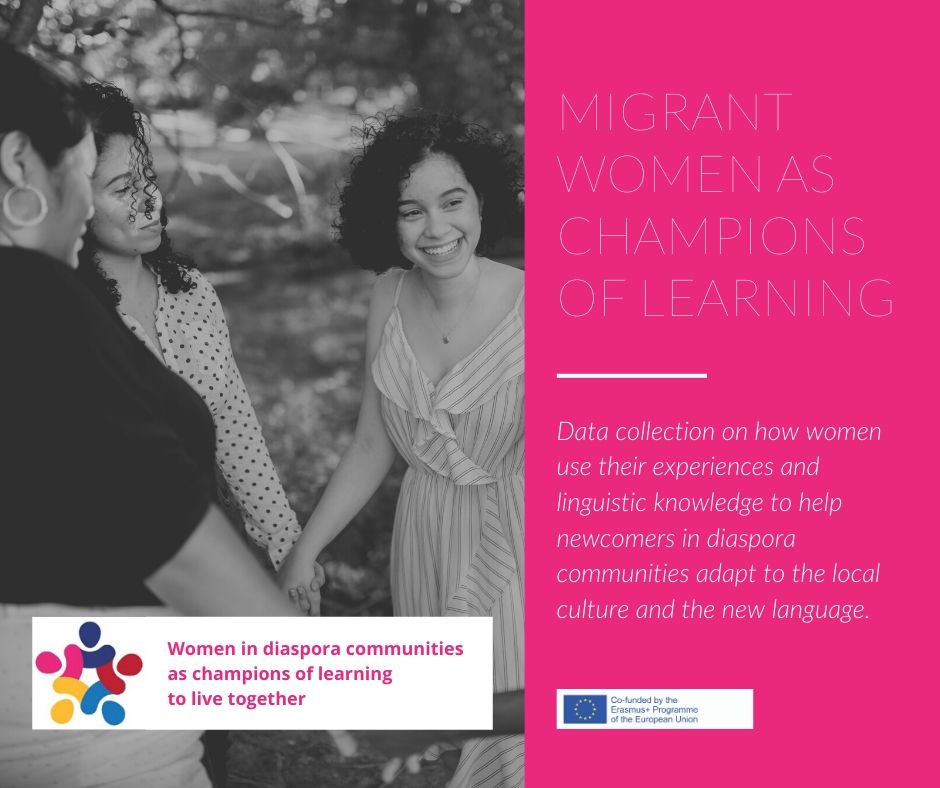
The report, published by the WIDHT consortium, analysed community development through migrant women in five European countries.
13.03.2020

New data collection on how migrant women can become champions of learning to live together

As a reaction to the existing challenges in the inclusion of migrants in their new host countries, organisations from several European countries decided to come together to shed light on the contributions of migrant women to their diaspora communities, and to reflect on how their activities could be encouraged and further supported. The project WIDHT (Women In Diaspora communities as champions of learning to live TogetHer) unites organisations from Italy, Spain, Greece, Romania, Finland, and Belgium.

The project is rooted in several principles: 1) creation of networks; 2) outreach; 3) capacity-building; 4) learner-centred approach and 5) gender dimension. The five principles were derived from research on existing inclusion projects in the involved countries that were considered successful.

The consortium is happy to share the first product of the project: a data collection on how women use their experiences and linguistic knowledge to help newcomers in diaspora communities adapt to the local culture and the new language.

Download the publication.

Text: WIDHTPhotos: Canva

07.05.2026 advocacy

A story of empowerment and resilience: Sem Terra in Brazil

On May 5, EAEA, through the support of the Erasmus+ project "ENHANCE: Enhancing Learners Voices", and MEP Cristina Guarda from the Greens, introduced Raizes Sem Terra at the European Parliament.

07.05.2026 Erasmus+

Erasmus+ for everyone: keep adult learning broad, inclusive and future-focused

EAEA calls for a strong, holistic and inclusive understanding of adult learning and education to be at the heart of the next Erasmus+ programme.

24.04.2026 Democracy

Digitalisation, skills, and community learning: what’s at stake for adult education in Europe

Europe’s digital transition is reshaping how people work, participate in society, and access services. Yet many adults still lack the basic digital skills needed to benefit from these changes, raising urgent questions for policymakers and adult learning providers alike: how can ALE systems become more inclusive, better funded, and more responsive to learners’ realities?