
11.02.2019

EAEA Grundtvig Award call 2019

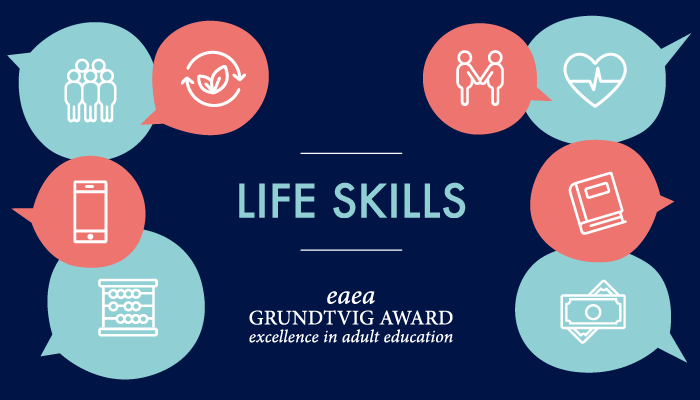
The 2019 EAEA Grundtvig Award celebrates life skills! This year, EAEA Grundtvig Awards will be given to organisations or project consortiums that present best examples of projects or initiatives promoting life skills.

With the EAEA Grundtvig Award 2019 EAEA aims to raise awareness, at a European level, for the importance of promoting life skills in adult education. Life skills are a set of different capabilities that make adults able to cope with problems of their independent life as individuals and participate in a collective life within society. Life skills contribute to social and civic engagement, self-efficacy and employability, but also to key challenges that adults have to face in the modern world, such as taking care of their physical and mental health, actively contributing to their wellbeing, mastering financial matters and coping with the digital environment.

The Grundtvig Award is given to organisations or project consortiums who present the best transnational projects in adult learning, promoting new ideas, new partnerships, new methodologies and a new understanding of how we can work in adult learning.

More on Grundtvig Award

Grundtvig Award 2019 Call on Life Skills


11.12.2025 adult educators

EAEA's celebratory event: 30 years of Adult Learning in Europe - from legacy to responsibility

On December 10, EAEA and GO! hosted the 30-year anniversary event of adult learning and education in Europe as part of the Lifelong Learning Week. The event brought together several high-level speakers. Their key message was that adult learning is a living, evolving field that must stay high on Europe’s agenda.

10.12.2025 country reports

EAEA Country Reports 2024/25 - adult education trends across Europe

EAEA Country Reports provide a civil society view on the latest developments in adult learning and education (ALE) across Europe.

09.12.2025 advocacy

Micro-credentials and non-formal short programmes as instruments of equity and access for adult learners with migrant background

How can we co-design accessible, inclusive and flexible learning pathways, also as micro-credential for non-formal education, to foster key competences for learners with migration background?