
What was the main purpose of this project?
“The main goal of the initiative was to train a group of 30- 35 Master trainers in youth and adult education in Lao PDR, a country, where no pre- or in-service training is available for the sector. At the moment, youth and adult education is mainly implemented by teachers. The project wanted to provide capacity building for staff at non-formal sectors, especially for the trainers. It was very important to provide capacity building for the non-formal adult education staff in the country. We also wanted to raise awareness about adult education in Laos.”
How did the project foster cooperations and partnerships?
“DVV International Regional Office Southeast Asiainitiated the project with the Department of Non-Formal Education of the Ministry for Education and Sports. There was a deliberate selection and cooperation of partners at the beginning of the project in order to make use of various resources, skills and people. These partnerships enabled the project to secure a wide range of expertise and offer high quality trainings, coaching and mentoring to the participants. The partners also included big organisations such as RMIT University Melbourne, UNESCO Regional Office Bangkok, Australian Volunteers and ASPBAE.
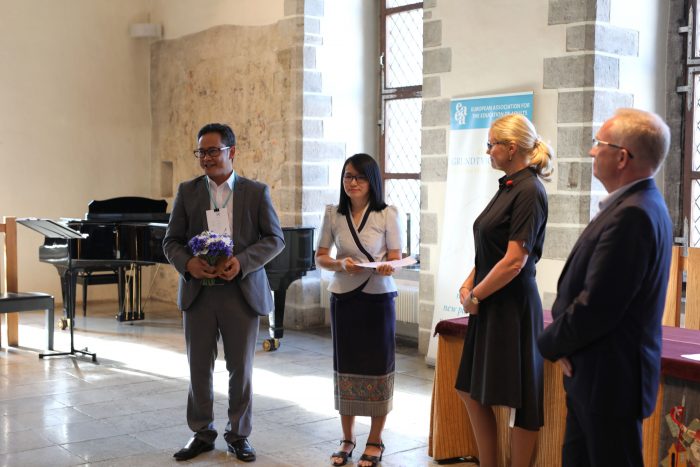
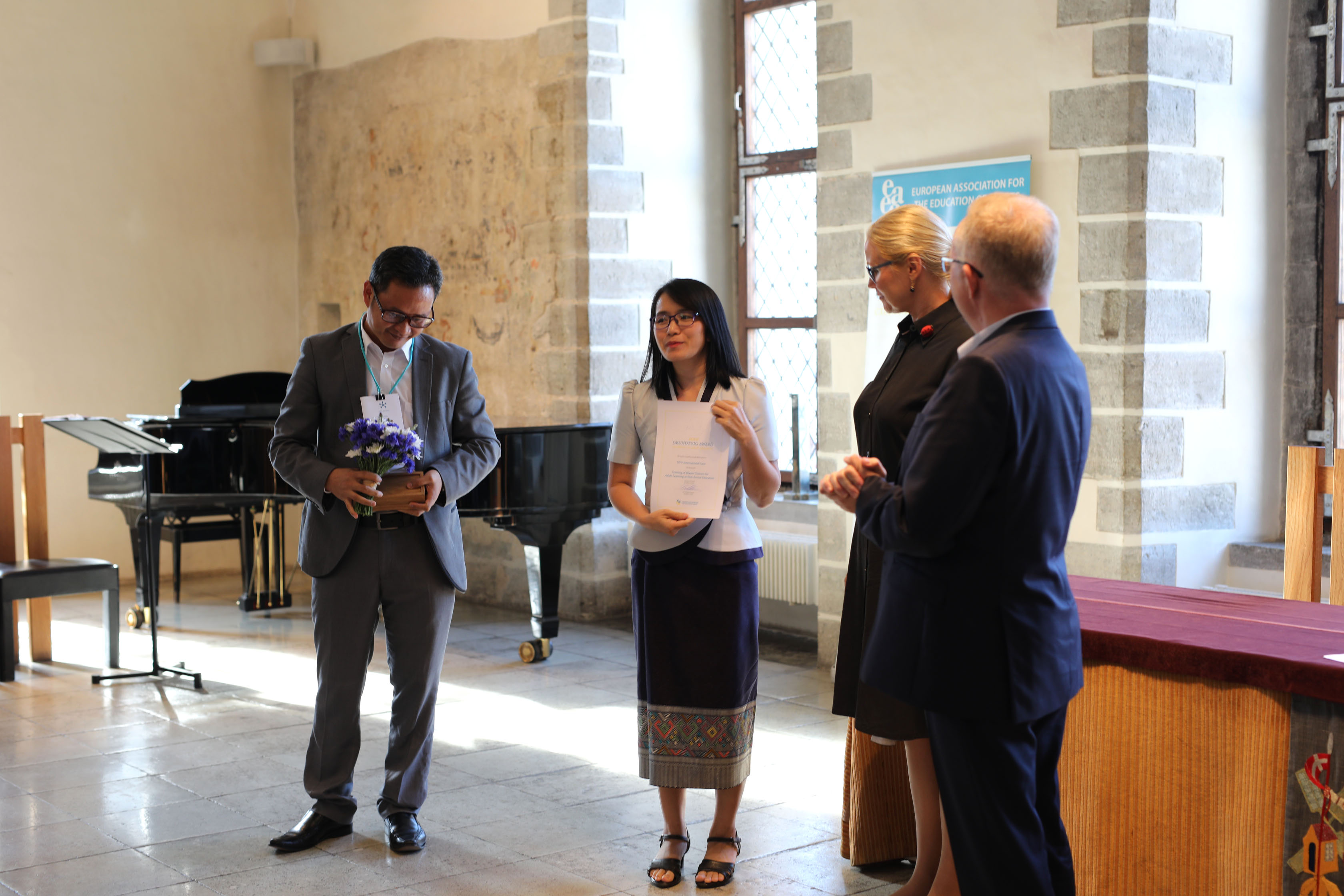
Souphap Khounvixay from Non Formal Education Development Center in Laos (left) talks about the project.
The project was conducted over the course of one and a half years, and this allowed time for the relationships between all partners to develop and for understanding between partners to be reached.
As the project went on, there was a sharing and growing of partnerships, with additional partnerships being added and the existing partnerships being deepened.
The project was conducted over the course of one and a half years, and this allowed time for the relationships between all partners to develop and for understanding between partners to be reached.
The idea is also mutual learning: for example when a non-formal adult education centre attends a training in India, they bring their ideas back to Laos. That is how the expertise grows.”
What was the best practice learnt from this project that you want to share?
“The importance of educating the trainers, as well as the importance of networks. It is also important to understand the bigger picture of adult education. There is still a lot that needs to be done to fully broaden the understanding about adult education in Laos.”
Master ToT / DVV International Regional Office Southeast Asia
- Category: Winner of international projects
- Coordinator: DVV International Regional Office Southeast Asia
- Country: Laos
- Focus: trainers of non-formal adult education
- Innovative cooperation: local ministries, UNESCO Regional Office in Bangkok, ASPBAE, the Royal Melbourne Institute of Technology (RMIT University), many local organisations
- Resources: organisation’s website