
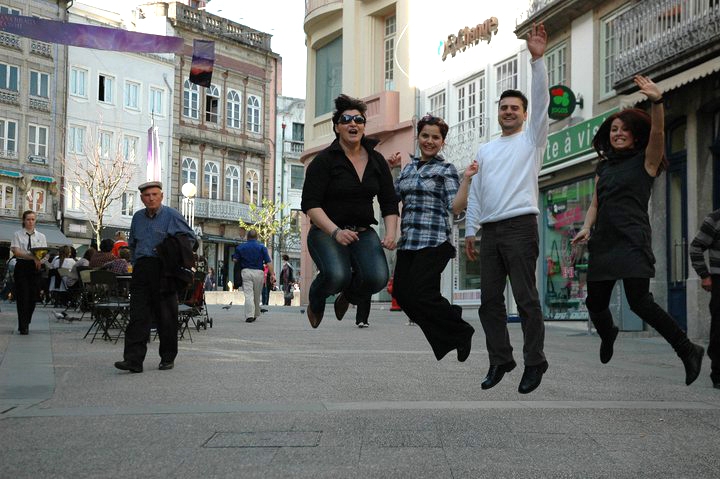
Much of the programme focused on ‘soft-skills’ in order to give the target group the confidence and skills to progress and develop personally, and offer opportunities to move into further learning, training, volunteering or the workplace.
The project sets out to be accessible and inclusive for all learners. The main objective is to enable the personal development of learners.
“Whatever their own ambitions, the learning experience will contribute significantly in reducing isolation,” says Gabriella Russo, Project manager.
The aim was to find the most effective way of delivery and the most appropriate content for learners. To do so, different methods for retaining the learners were tried, and the content was adapted to the specific issues faced by trainers and facilitators.
Games as tools for learner engagement
The project consortium studied best practices in engaging learners and found that the use of games works well in informal education.
“An environment of games and play helps create the right learning conditions,” Gabriella Russo explains.
The overall approach of the project was to enable collaboration between partners, identify gaps in content or delivery methods and ensure best practice. Thus, an on-going evaluation was realised so that the programme can evolve effectively and successfully and the learners can gauge their on-going needs and levels of response to the programme.
Engaging the learner also offered mobility opportunities to learners whose opportunities in life are below average. Thus, this learning experience significantly contributes to reducing isolation.
The project: Engaging the learner
- Award category: European projects (Italy)
- Learner target group: Disadvantaged people over 50 without work and with low education
- Innovative practice: Using the method of game (gamification)
Project coordinator
- Organisation: Adriatica Consulting SRL
- Contact: Gabriella Russo
Project partners
- Bumps, DPMC, Kaunas, Epralima, Ordu University, Utravalo
The article series shares good practices on engaging new learners by introducing the nominees of the EAEA Grundtvig Award 2017.
Text: Lou-Andréa PinsonPhotos: Engaging the Learner project