
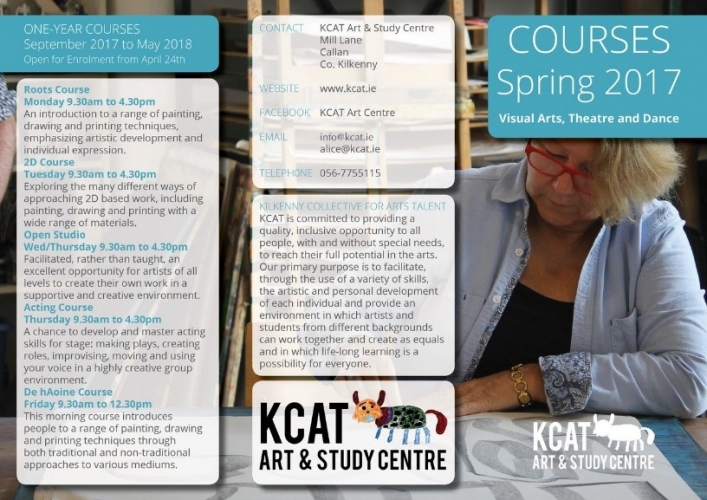
Having grown from an EU project to a vibrant school, KCAT Art Centre offers quality inclusive opportunities to learners with and without special needs. The primary purpose is to facilitate the artistic and personal development of each individual and provide an environment in which artists and students from different backgrounds can work together.
KCAT studio is made up of 14 artists with support needs, Equinox Theatre Company, made up of 8 artists with support needs. There are currently 131 students attending visual and performance art courses. Learners come from diverse backgrounds and include migrants, early school leavers, retired professionals and people in care as well as living in mainstream community. The approximate ratio is 40/60 of people with and without special needs. Learners are supported by experienced community facilitators, who are also professional artists.
Blurring boundaries between ability and disability
The relationship between the facilitator and learner is key to supporting the particular needs of each learner. A co-worker also attends the classes whenever necessary – when a learner needs their physical, behavioral or emotional needs to be supported. Thanks to this learner-centered approach to all activities, the school blurs boundaries between ability and disability.
The centre provides the learners with several opportunities to present their work, for example during the End of Year Show and Certification Ceremony, and progress to employment or further study. While KCAT has recently been forced to step back from accredited certification, since 2002 over 60 KCAT students have been awarded over 200 certificates at FETAC Level 5, with a breakdown of 96 Distinctions, 73 Merits and 39 Passes. Some of the learners have found employment with the KCAT Studio.
The centre also uses European mobilities to improve teaching methodologies and exchange practices.
The project: KCAT Art Centre – Ireland
- Award category: European projects (Ireland)
- Learner target group: Learners with and without special needs
- Innovative practice: Learner-centered approach
Project coordinator
- Organisation: KCAT Art Centre
- Contact: Alice Bennett
Resources
The article series shares good practices on engaging new learners by introducing the nominees of the EAEA Grundtvig Award 2017.
Text: Lou-Andréa PinsonPhotos: KCAT