
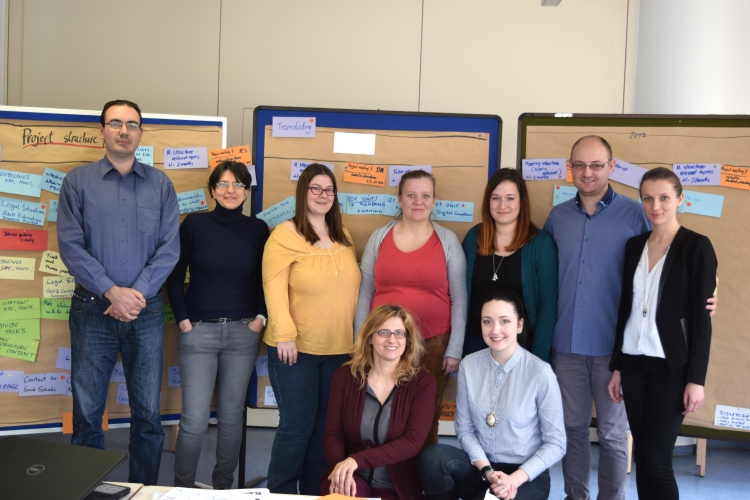
The “BERA – Basic Education for Roma Adults” project wants to raise awareness of the situation of the Roma people, especially in the areas of politics as well as pedagogic and social studies, increase the self-esteem of the Roma and develop concepts that can be applied and implemented easily.
Besides focusing on the Roma community, the project targets NGOs and Roma organisations, students and teachers in social and pedagogical facilities and political and adult education institutions. This diverse target group was chosen in order to get in-depth knowledge about the situation of Roma in other countries, in addition to becoming more aware of the situation of Roma in each project country.
The recognition of factors that lead to discrimination of Roma was also a key aspect of the project, in order to enable a higher level of involvement for Roma in future project development.
Introducing a new target group: families
As a long term result, the project desires to achieve better chances for the Roma in the future and to raise awareness on the importance of education in the Roma community.
As the main outcome, two manuals will be produced and published at the end of the project. The manuals highlight the specific living and social situation of Roma people as well as to attract the public’s attention to this ethnic minority and raise awareness of how they are discriminated against. The first manual focuses on Roma adults and the second one on families.
Until now, families have rarely been considered as a learning group in basic education, but family is a very important institution for Roma which is why the project tends to focus on this crucial institution.
The impacts of the project will be measured through surveys – for steering group, participants and partner organisations – and through interviews with the Roma people.
The project: BERA – Basic Education for Roma Adults
- Award category: European projects (Austria)
- Learner target group: Roma adults and families
- Innovative practice: Choosing families as a target group
Project coordinator
- Organisation: Caritas für Menschen in Not
- Contact: Michaela Haunold
- Partners: Caritas Viseu (Portugal), Caritas Bosne i Hercegovine (Bosnia Herzegovina), Caritas Subotica (Serbia), Caritas Alba Iulia (Romania), Caritas Ambrosiana (Italy)
Resources
The article series shares good practices on engaging new learners by introducing the nominees of the EAEA Grundtvig Award 2017.
Text: Lou-Andréa PinsonPhotos: BERA project