
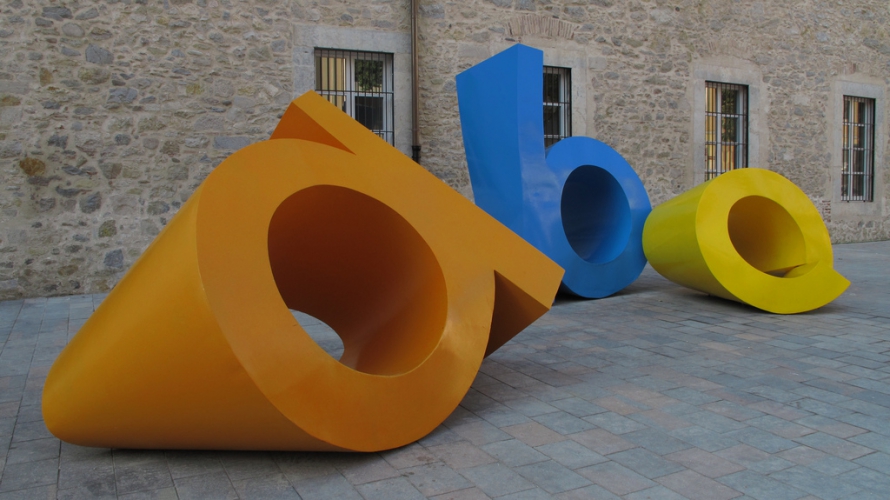
Besides fame and fortune, the EAEA Grundtvig Award winners receive a piece of art or handicraft. This year’s winners will receive scaled reproductions of the famous sculpture, located in the city center of Girona, Catalunya, and made by Catalan artist Francesc Torres Monsó, called “A, B, C, Q” and representing four letters of the alphabet.
The sculpture is a set of four iron letters each painted in a different color. The A letter is orange, B is blue, C is yellow and Q is red. The original sculpture is located in front of the building of the provincial government of Catalunya, and it is one of the most popular public sculptures of the center of Girona.
Created in 1980, the art piece is called “A,B,C,Q” or sometimes “Lletres toves”, and is described by the mayor of the town as a “symbol of the city”. Originally held to mark the International Year of the Child in 1980, Francesc Torres Monsó wanted to pay tribute to the letters and colors of Joan Miró. The sculpture should be in principle the first four letters of the alphabet (a, b, c, d) but the shape of the letter D turned it accidentally into a Q, which brought a new game sculpture: A, B, C, Q.
This year’s EAEA Grundtvig Award ceremony will be held in Girona, Spain on June 27th. Organised by EAEA, the Grundtvig award aims to reward projects that have been successful in engaging new learners. Those joining the event will have the opportunity to admire the original version of the sculpture, as it is located near the event venue. The award ceremonys organized by one of EAEA members, ACEFIR – a Catalan Association for Education, Training and Research.
The call for the EAEA Grundtvig Award 2017 is now open. The awards will be given to projects successful in engaging new learners.
The EAEA Grundtvig Award 2017 ceremony will be organised in connection to the EAEA General Assembly and the Annual Conference themed “Engaging New learners” on June 27th-28th.
Text: Lou-Andréa PinsonPhotos: Enric (Wikimedia Commons), Jofre Ferrer