
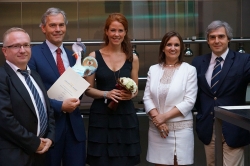
Among several candidates from all over Europe, the AEMA consortium decided to award an EAEA member, the Retzhof Castle, for its remarkable work to increase participation of disabled people into the centre’s activities. The Retzhof Castle was celebrated last week in Porto, in the framework of the EAEA annual conference and during the Grundtvig award ceremony. “We believe EAEA’s participation in this project is very important: adult education providers and organisations should give more relevance to the issue of accessibility” said the EAEA President at the ceremony.
The AEMA Award winner
The Retzhof Castle (Bildungshaus Schloss Retzhof) is an education provider for adults funded in 1948 and located in region of Styria. They plan and organise seminars, symposia, conferences, congresses, workshops and cultural events on topical themes, as well as stage active days and project weeks for schools.
For the last six years the centre became a pioneer in the field of inclusive adult education in Austria as it strives to make education for adults accessible to everybody – especially for people with physical and mental disabilities. Barrier-free education is perceived as a cross-section task at the Retzhof for the conception of all educational measures.
Find out more about the Bildungshaus Schloss Retzhof at http://www.retzhof.at/
Concrete steps to improve accessibility
The project consortium seized the occasion of the Grundtvig and AEMA award ceremony to meet and discuss the last project developments as well as challenges for the next months.
The two last project’s results are: the Accessibility Criteria for adult education providers and the Competency Catalogue for experts on Accessibility.
The first was developed to provide the basis for the creation of a maturity matrix, an assessment tool which identifies ascending levels of achievements for adult education providers; whereas the second defines the knowledge, skills and competencies experts on accessibility need to support adult education providers to progress on the issue.
More information at http://aemanet.eu/en
Text: Francesca OpertiPhotos: Aura Vuorenrinne