
Among various activities in this field, EAEA is involved in the Q-ALE initiative – Quality assurance in non-formal Adult Learning and Education, an initiative developed in collaboration with sTOP (national network of trainers from Poland), POU Varaždin (public ALE institution in Croatia) and the umbrella Association of the Finnish Study Centers (a network of 11 local adult education centres).
Q-ALE model for QA in ALE organisations
The Q-ALE model is formulated to support non-formal adult learning organisations to improve their quality assurance processes, to structure and formalise them, make them regular and coherent, and prepare the organisation to comply with current and potentially new QA standards in their countries, etc., also to respond to the current and future challenges the ALE sector is facing across Europe.
The model promotes an organic, mindset-based approach to quality assurance. It is based on shared understanding of core values and definition of commitments specifically related to QA criteria and processes and it also considers QA approach by three key roles in non-formal ALE organisations: manager, course designer, educator.
The model includes three main components: underlining values of quality in education (in general), statements related to specific QA aspects, examples of existing good practices and finally a self-assessment tool.
Who is afraid of quality assurance?
The Q-ALE initiative also aims to support ALE providers in understanding the core aspects of Quality Assurance within the adult education sector, and in particular non-formal education providers and smaller providers, focusing on two main questions:
- What does Quality Assurance mean in non-formal ALE?
- What do we really need for ALE organisations to build a strong culture of Quality Assurance?
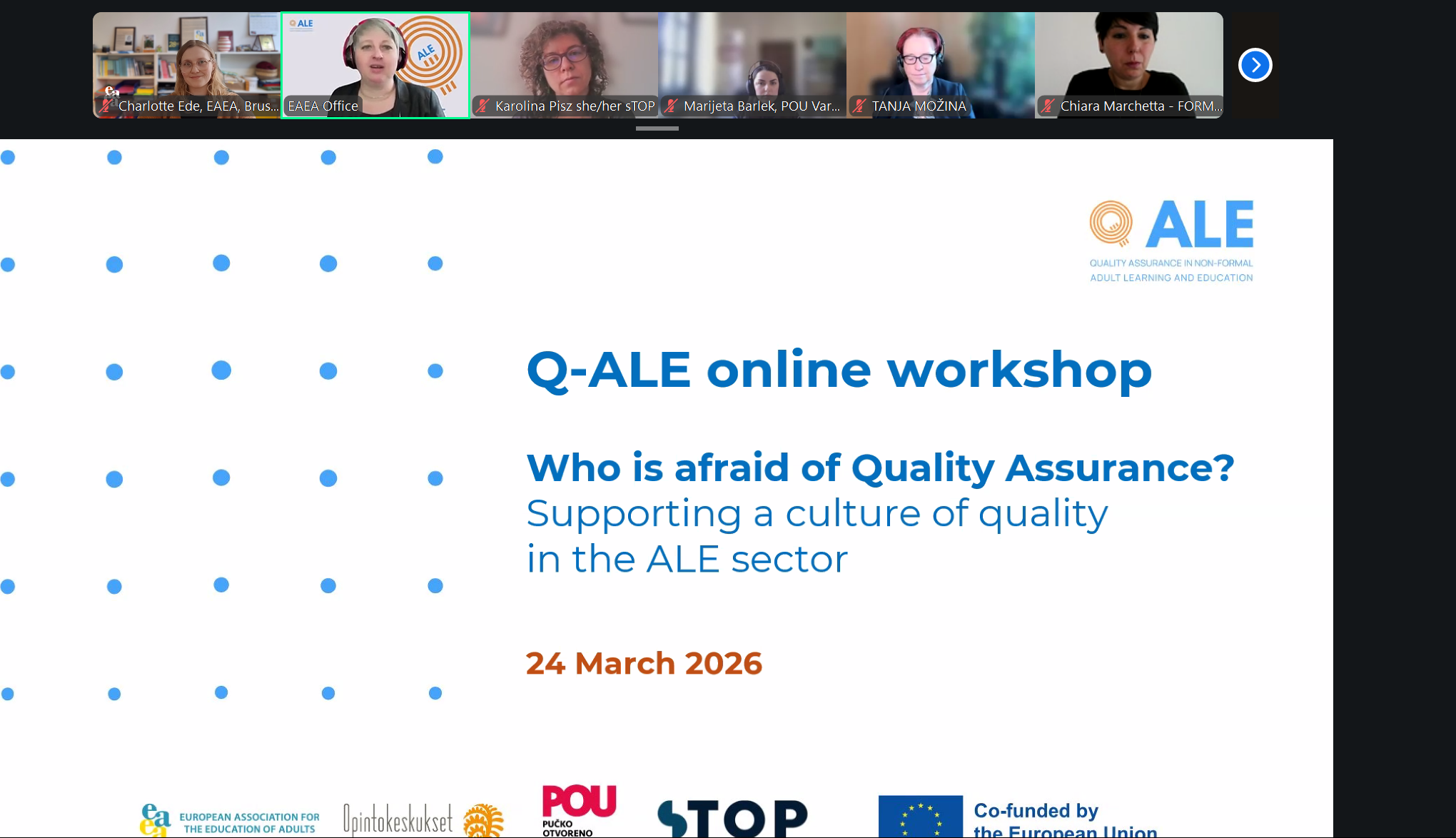
On 24 March 2026, EAEA, with the support of Q-ALE partners, organised an online workshop titled ‘’Who is afraid of quality assurance?’’, to explore these core questions with experts and practitioners and to present the first version of the Q-ALE model and self-assessment tool.
The online seminar explored how quality assurance (QA) can be developed and embedded in Adult Learning and Education (ALE), particularly within non-formal organisations. Speakers and panellist’s highlighted practical approaches, challenges, and strategies for fostering a culture of continuous improvement.
Quality Assurance in ALE is possible: methods and perspectives
During the Q-ALE workshop, two core methods for QA in education were introduced: Self-assessment as internal evaluation method by Tanja Mozina, Head of the department for Quality and Training of Adult Educators, Slovenian Institute for Adult Education, and The European Peer Review Methodology by Chiara Marchetta, QA expert at FORMA.Azione in Italy.
Building a Culture of Quality
Tanja Možina emphasised that quality must be actively developed and discussed within organisations.
The Slovenian approach for QA in ALE combines ongoing monitoring, using regular learner feedback to respond quickly to challenges, and in-depth self-evaluation, conducted every three years and focused on key improvement areas. A strong focus is placed on making self-assessment part of daily practice, involving both staff and learners. When implemented effectively, self-assessment processes can help building trust and open dialogue, encourages reflection at individual and team levels and supports the overall development of learning organisations.
Support structures are also important for such instrument to be effective and impactful, such as quality counsellors and dedicated training.
Rethinking Quality Assurance
Chiara Marchetta highlighted the need to shift perceptions of QA from complex and administrative to practical and supportive process, as well as from the idea of QA as control to the concept of continuous improvement and reflection process. Marchetta introduced then a specific approach of external evaluation for QA in adult education: the European Peer Review methodology
This approach builds on self-evaluation, while expanding to the contribution of the external evaluators which are ‘’peers’’, therefore experts with similar roles and expertise (ALE managers, educators etc.). The approach itself focuses on constructive feedback and aims to support, rather than judge, the organisations to grow and improve.
Results of Q-ALE pilots
The preliminary result of the piloting of the Q-ALE model and insight from the participants in the Q-ALE focus groups in the three national contexts involved in the initiative (Croatia, Finland, and Poland) were discussed by the national experts of the project: Karolina Pisz from sTOP, Poland, Sunčica Stanić-Gluhinić and Marijeta Barlek from POU Varaždin, Croatia, and Anna Kirstinä from the association of Finnish Study Centers.
The panellists shared a quick overview of the state of play of quality assurance in adult education in their country, discussed national contexts, key challenges, and how to foster a culture of quality assurance, also highlighting several shared challenges across countries:
- Limited system-level support for QA in non-formal ALE
- Time constraints, making it difficult to integrate QA into daily work
- Sustainability, especially for project-based initiatives
- Recognition of learning outcomes, particularly in non-formal settings
- Administrative burden, with a need to simplify processes
In the second part of the panel, they also focused on key insights that emerged from the Q-ALE national focus groups on quality assurance in ALE and on the potential of models and approaches like Q-ALE. General interest was expressed by participants, both on the topic and also on the proposal of the Q-ALE initiative and models. Participants also recognised the fundamental role of QA in adult education.
In Poland, practitioners discussed the central question of who is responsible for QA in ALE, as well as what effective QA requires, in the sector. They considered commitment, leadership, and trust as the most important factors to develop such a system.
In Croatia, participants highlighted training providers operate under diverse conditions, and also about roles, how, currently, quality assurance processes are largely ensured through self-regulation and project-based activities.
As for the Finnish groups, the participants highlighted some of the core benefits of structured and more systemic QA strategies in ALE, such as articulating the value of learning activities and building bridges between everyday practice and administrative process and policy discourse.
Conclusions and key messages
Across discussions, several success factors for effective quality assurance emerged:
- Strong leadership and organisational commitment
- A focus on embedding QA into regular practice, rather than treating it as a one-off activity
- Clear roles and responsibilities within organisations
- Communication of QA as a positive and empowering process
- Use of QA to bridge practice and policy, providing evidence of impact
- Towards a QA Mindset
The proposed QA model promotes an organic, values-based approach, built around:
- Shared commitments to quality
- Defined roles (manager, course designer, educator)
- Practical tools, including self-assessment and good practice examples
Overall, the online seminar underlined that building a culture of quality in ALE requires time, trust, and continuity, but offers significant benefits for learners, staff, and organisations alike.
The key messages of the event can be summarised as follows.
- Quality assurance should not be seen as a bureaucratic obligation, but as a continuous, reflective process that supports everyday practice.
- Effective QA is based on trust, participation, and shared responsibility among staff and learners.
- The goal of QA is improvement, not control, helping organisations better understand and enhance their work.
How can you contribute to this work?
We are inviting any organisation and practitioner in the field of adult education and related services to support this work.
- Join the online validation process open till 12 June 2026!
Read and review the Q-ALE – Code of conduct – Read now the Q-ALE Model – Quality Assurance for ALE (beta version) - Try out the interactive Q-ALE Self-assessment tool
- Provide your feedback in the online validation questionnaire
—-
Q-ALE initiative – Quality assurance in non-formal Adult Learning and Education is an initiative co-funded by the European Union and developed in collaboration with sTOP (national network of trainers from Poland), POU Varaždin (public ALE institution in Croatia) and the umbrella Association of the Finnish Study Centers (a network of 11 local adult education centres).
Text: Viola PinziPhotos: EAEA