
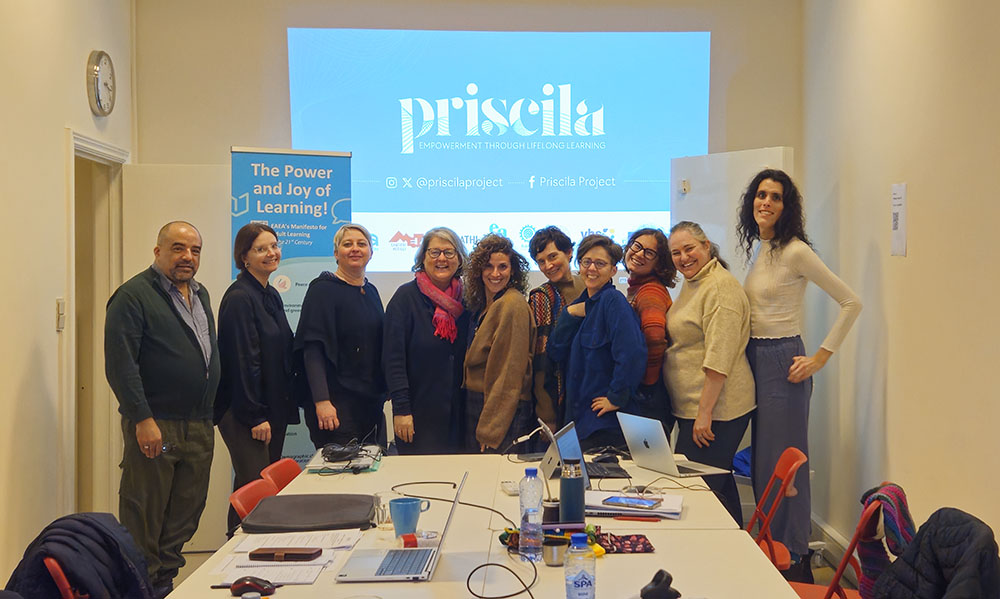
The PRISCILA initiative (Fostering Personal, Intercultural, Social, and Citizenship Competences for Lifelong Learning to Empower Adult Migrant Learners) addresses the complex challenges faced by adult migrants, refugees, and asylum seekers to facilitate their inclusion into host societies and labour markets.
PRISCILA answers this call by creating educational pathways that enhance employability, promote active citizenship, and foster social inclusion through personalized, learner-centred approaches, in the form of workshops in four countries (Germany, Italy, Spain and Turkey).
The PRISCILA Approach
The PRISCILA training programmes for learners and trainers/practitioners were designed in the form of a ‘micro-credential’, following as close as possible the European micro-credential model proposed by the Council Recommendation on a European approach to micro-credentials for lifelong learning and employability. The digital credentials for learners are delivered through the European Digital Credential infrastructure and using the European Learning Model as main data model.
The PRISCILA Approach for learning pathways for adult learners is designed based on learner-centred methodologies (such as Theatre of the Oppressed, Spatial Assemblage, Deep Democracy, and Critical Incident) and includes a custom assessment method based on self-assessment, both developed based on competences and learning outcomes and with two European competences frameworks as reference (EntreComp and LifeComp).
The PRISCILA Approach includes also custom quality assurance activities focusing on learners’ feedback and peer review, specifically design to support non-formal education organisations and their educators and learners needs.
Finally, a fundamental component was the capacity building programme for ALE organisations to support them in understanding and designing micro-credentials using the European model and standards.
Key resources for ALE organisations
The PRISCILA Guide presents the PRISCILA method for designing flexible learning pathways for adult learners, in the form of micro-credentials, including learning design, methodologies, credential building and issuing and implementing basic quality assurance processes at learning programme level. The Guide aims to support the effective adoption and recognition of the PRISCILA method in diverse educational contexts.
The PRISCILA Handbook is designed to complement the PRISCILA Guide and offer all the needed tools to effectively use the PRISCILA method. The Handbook is a comprehensive resource for adult trainers, available in multiple languages, providing an overview of the PRISCILA method, practical guidance to apply it complemented with structured learning paths and activity sheets and, finally, actionable recommendations for adult education providers to integrate the PRISCILA method within their training programs and organizations.
The PRISCILA – Handbook for Adult Trainers and PRISCILA Guide for Quality Provision and Recognition through Micro-credentials are now available under CC license!
Text: Viola PinziPhotos: EAEA