
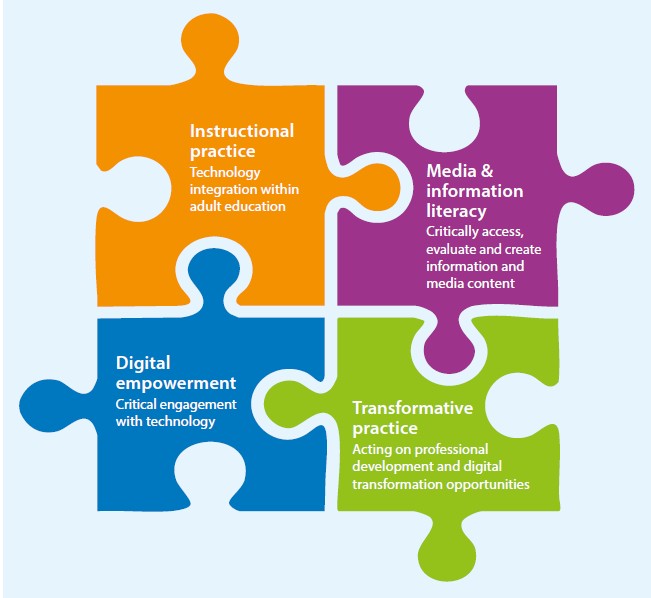
In a landscape of digital transformation opportunities for adult education, the DELTA Framework was developed to support adult educators to enhance learning experiences, while also tackling the risk of increasing inequalities by focusing the experiences on learners needs and using technology to create positive change in learning environments and communities.
What is the DELTA Framework in practice?
The DELTA Framework – Digital Empowerment for Lifelong Learning and Transformative Andragogy for adult educators includes various conceptual aspects (core principles, growth stages and domains of practice), a detailed list of competencies and additional resources – including capacity building units mapped to the DELTA competencies and readiness indicators for each growth stage.
The Framework main objective is to support the development of initiatives for adult educators to empower them and to enhance their digital competence across for core domains: instructional practice, digital empowerment, media and information literacy, and transformative practice.
How was it developed?
The DELTA framework was developed through an extensive review of digital competency frameworks, followed by iterative refinement through multiple forms of collaborative evaluation.
The instrument was developed collaboratively with a group of international experts from nine countries and across two years of work, including the contribution of Uwe Gartenschlaeger (Director and Chief Executive, Institute for the International Cooperation of the Deutscher Volkshochschul-Verband e.V and EAEA former President) and Viola Pinzi (EAEA Technical Advisor), as well as Katarina Popović (Secretary General, International Council for Adult Education).
DELTA also promotes flexible, inclusive learning and offers Open Educational Resources to support digital capacity-building worldwide. In the course of 2024 and 2025, a series of hybrid capacity-building workshops were organized by SOU and UIL with technical working groups from China (two teams), Egypt, Kenya, Kazakhstan, Nepal, the Philippines, Uganda and Zimbabwe, which provided extensive review and feedback on the framework and suggestions for contextualization in national settings.
Start learning now
Based on the DELTA, UIL have launched an online learning experience: the self-paced online course ‘’Digital Empowerment for Adult Educators in the Age of AI and Emerging Technologies’’.
The course is designed for adult educators, teachers and trainers working in formal, non-formal and informal learning spaces to help build digital skills and confidence needed to thrive in today’s educational landscape.
What happens next?
This version of the framework will be then presented to Member States for adaption and contextualization in line with national contexts, policy priorities and the diverse needs of adult educators.
Download the DELTA publication
Digital empowerment for lifelong learning and transformative andragogy (DELTA) for adult educators: introduction to the DELTA framework and resources
Text: Viola PinziPhotos: UNESCO UIL - Authors of the DELTA Framework