Emerging Technologies for Holistic Literacy in Adult Education
Emerging Technologies for Holistic Literacy in Adult Education (ETHLAE) aims to analyse, adapt, and test methods and practices to embed emerging technologies in the adult education sector and in holistic literacy programmes, especially targeting adult learners in vulnerable situations.
Emerging technologies such as AI, IoT, AR/VR, and robotics offer a wide range of potential applications across all sectors of learning and education, and society at large, shaping how we perceive the world around us and establishing new grounds for critical engagement. The inquiry into whether technology can facilitate learning and change for adult workers in vocational and adult education has been a subject of extensive examination by researchers and educators alike. Still, although these technologies have been mapped and explored in various projects and initiatives, there is an identified gap in the pedagogical approaches to embed them effectively in adult learning and education contexts, especially in the provision of inclusive and accessible holistic literacy and life skills programmes, as hinted at in the “On the Futures of Technology in Education: Emerging Trends and Policy Implications” report of the European Commission.
In this context, to better understand and tackle this pedagogical gap, the project ETHLAE: Emerging Technologies for Holistic Literacy in Adult Education comes to life! It aims to support systemic change for Adult Learning and Education (ALE) organisations in embedding technologies in the delivery of holistic literacy programmes for adults, supporting peer-learning and capacity-building activities among organisations and individuals of different countries and contexts.
In particular, the project aims at supporting ALE educators in designing and delivering a holistic literacy education programme for adult learners in vulnerable situations, that embeds these emerging technologies, when beneficial, in a meaningful and accessible way, and developing new custom approaches, with a focus on considering social, contextual, economic, and personal needs of educators and learners, their potential challenges and benefits.
Main objectives
Support systemic change for ALE organisations in embedding technologies in the delivery of literacy programmes for adults.
Identify and analyse good practices and methods for embedding emerging technologies in ALE literacy programmes in a meaningful way.
Adapt existing holistic literacy and life skills programme learning scenarios to meaningfully embed emerging technologies, considering the specific needs of ALE organisations and adults in vulnerable situations.
Develop and run a capacity-building programme involving ALE learning designers, educators, and learners and that supports the views of both technological experts and ALE literacy experts.
Test the ETHLAE Toolbox and pilot the new learning scenario in at least 5 countries and with European communities of educators, with different audiences and contexts, to support mainstreaming and potential exploitation.
News & Articles
During this two years, the partnership will provide you with the news from the project and interesting articles on Emerging Technologies and how these technologies work, Holistic Literacy Programmes design, digitalisation in education and much more!
Join us in exploring emerging technologies and the future of education! During these 2 years, we will organise a great variety of events, both online and in-person, in the different countries of the consortium. We will organise capacity-building labs, dissemination activities and a final policy roundtable in Brussels.
Next events:
Next events will be added here. Follow EAEA’s social media for real-time updates.
Past events:
Implementarea scenariilor de învățare în educația adulților folosind tehnologii emergente
Participați la atelierul dedicat implementării scenariilor ETHLAE în contexte educaționale reale, inclusiv în lucrul cu adulți vulnerabili și în medii cu acces digital limitat.
Webinaarissa perehdyttiin perehdyttiin tekoälytyökalujen käyttöön aikuisten perustaito-opetuksen suunnittelussa. Sari Pohjola kertoi ETHLAE-hankkeen suunnittelemista oppimistilanteista ja erityisopettaja Vilma Kosonen esitteli Oppimisen taloa, joka tukee maahan muuttaneiden luku- ja kirjoitustaidon oppimista. Kososen esittelemä materiaali on kehitetty Kvs-säätiön aiemmassa, opetus- ja kulttuuriministeriön tukemassa hankkeessa.
Tule webinaariimme 25.9. klo 14-15 kuulemaan, miten voit käyttää tekoälyä välineenä opetuksen suunnittelussa, opiskelijoiden tukemisessa tai osallisuuden lisäämisessä! Webinaarin alustajana toimii palkittu tekoälyn asiantuntija, Innovation Lead Tove Mylläri Yleisradiosta. Mylläri on innostunut oppimisesta sekä aliedustettujen sekä marginalisoitujen henkilöiden voimaannuttamisesta tekoälyn avulla. Keräämme myös osallistujilta palautetta siitä, millaiset resurssit ja työkalut palvelisivat parhaiten opettajia heidän päivittäisessä työssään.
🗓 29 syyskuuta 2025 | 🕙 14:00–15:00 EEST | 📍 Online
A Glimpse into the Tech-Driven Classrooms of the Future
Join us for a thought-provoking onlineCapacity-Building Lab that explores how emerging technologies like AI, VR, and adaptive learning are reshaping the future of education. We will count on the participation of Zoran Jančić, long-time e-learning expert and project leader and Maja Šarić, researcher and project coordinator, both from Algebra Bernays University, who will explore these technologies in the context of education and will showcase the work done so far in ETHLAE!
🗓 14 July 2025 | 🕙 10:00–11:00 CET | 📍 Online
Research and Methodological analysis
First, the consortium conducted a comprehensive mapping and analysis of existing methods, practices, and tools relevant to the integration of emerging technologies in adult learning and education and in holistic literacy programmes.
This research was done by involving interviews with ALE educators, organisation representatives, learners, decision-makers and digitalisation specialists; reviewing literature and desk research, and identifying useful case studies and best practices which will inform the development of the ETHLAE Toolbox, setting up its methodological framework.
This collection and analysis of relevant existing methods, good practices and tools is based on the existing work on emerging technologies in the education setting at large, also from other sectors, such as schools, Higher Education and Vocational Training and Education, which will support the development of learning scenarios for adult learning. Partners also conducted an exploration and scoping activity to contextualise the implementation of emerging technologies in literacy programmes for adults, identifying the main enablers and obstacles. By examining existing frameworks and practices, opportunities for learning improvements in adult education through emerging technologies can be identified, which will now be explored.
Interested in a specific country? Click on the images to read the key findings for each country!
Repository of resources
Here you can find a repository of external resources for educators on technical aspects (how do emerging technologies work) and transversal aspects (ethical and legal aspects) related to the implementation of such technologies in (adult) education.
The partnership collected 50 external resources, divided into articles, publications, online courses or MOOCs, webinars or videos, and online tests to support educators to learn more about the different types of emerging technologies, how they work, their benefits, main challenges (including ethical considerations) and how they can be used in educational contexts. The repository also features digital tools which can be used by educators and other education practitioners in their work with adult learning (for example, AI-based chatbots and AR apps).
The repository features the work of international organisations such as UNESCO, which published a recent course on AI titled “Digital Empowerment for Adult Educators in the Age of AI”, or the European Commission, in partnership with OECD, developed an AI Literacy Framework for Primary and Secondary Education focusing on “Empowering Learners for the Age of AI” (while the focus is young learners, much can be adapted to the context of adult education). Digital tools to support education, such as NotebookLM, Brisk Teaching or Magic School, are also included in the resources.
Simply click below to find all the external resources gathered by the consortium!
On this page, you can explore some learning scenarios and concrete ideas on how to meaningfully use emerging technologies in adult education programmes. The scenarios are adaptable to different contexts within adult learning.
These learning scenarios across five key areas demonstrate ways to include emerging technologies in adult education programmes. From managing personal finances with AI-powered budgeting tools to building connections in digital communities, these scenarios show a multitude of opportunities to consider emerging technologies in adult learning, focusing on pedagogy and not solely on the digital technology or resource. They are relevant for the specific needs of the adult education sector (with a focus on holistic literacy programmes and adults in vulnerable situations), from the perspective of organisations, learning activities designers, educators, and learners.
The consortium developed the scenarios to be adaptable to different contexts, lengths and resource levels and include the following areas:
Literacy and Numeracy
Personal, Social and Learning to Learn
Digital spaces and communities
Environment sustainability
Democracy and active engagement
These learning scenarios were influenced by the practical implications of the research elaborated previously, as well as the main insights gathered from educators and other adult learning stakeholders through three external events with 150+ participants.
Whether you’re working on literacy and numeracy, democracy and active engagement, sustainability, personal and social competences, or digital spaces and communities, these examples offer starting points that you can adapt, modify, and make your own with the help of the learners!
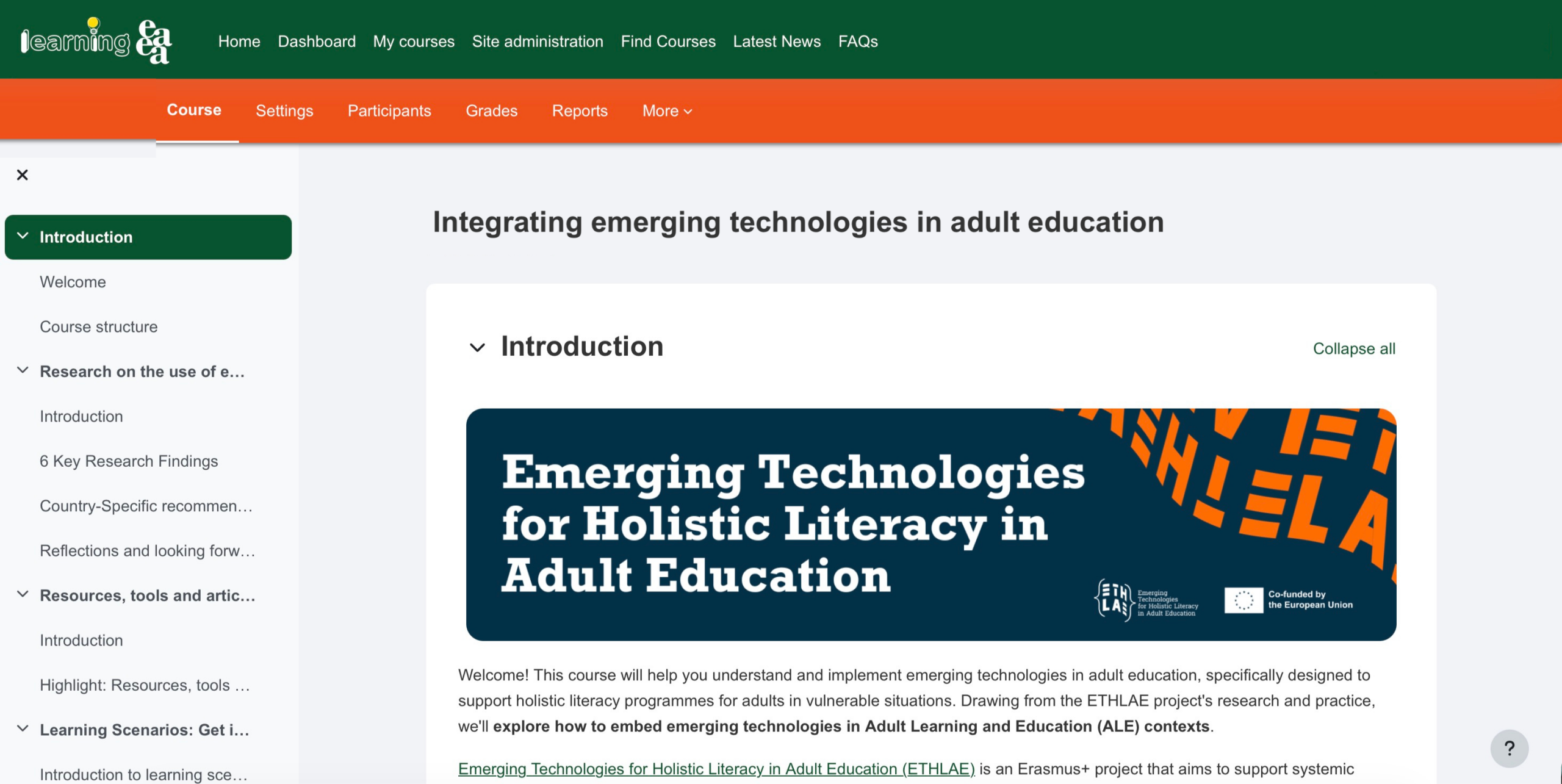
Join us in exploring all phases of the ETHLAE project in a fun and interactive way! ETHLAE partners worked on a MOOC (Massive Open Online Course) for educators and education stakeholders, which features the main research insights, the repository of external resources and learning scenarios to use emerging technologies in the adult education context!
The ETHLAE MOOC for educators and education stakeholders is hosted at the EAEA learning platform, EAEA’s one-stop platform, which offers a diverse range of courses tailored to meet the unique needs and aspirations of adult educators, adult education organisations, learners and policy makers.
This course addresses the critical need for pedagogical approaches and practical strategies to integrate emerging technologies into adult education. Emerging technologies can support learning, but only if they support adults’ diverse learning needs and styles and if the tools are specifically adapted to the educational setting and/or adaptable to the context in which adults are learning.
Throughout the course, educators can explore the main research insights from our research (Research tab here on the website) and discover the differences between countries in the context of emerging technologies and education. Participants can also scan through multiple external resources on how technologies work and how to use them in the context of education, and delve into learning scenarios especially targeting adult education. These scenarios present concrete ways to include emerging technologies as support for the development of basic skills in adult education: literacy and numeracy, personal, social and learning to learn competence, democracy and active engagement, digital spaces and environmental sustainability. With this MOOC, you can learn and hopefully share your knowledge and build capacity within your organisation for meaningful technology integration.
The ETHLAE MOOC is interactive, and educators can use the open forums to comment, give suggestions or advice to other educators across Europe. To access the MOOC, participants need to access the EAEA learning platform and create an account. With this account, participants just need to log in to the platform and can enroll to the course (as well as in other courses available, for example, on the just transition and sustainability).
Emerging Technologies for Holistic Literacy in Adult Education (ETHLAE) brings together seven partners from Austria, Croatia, Finland, Romania, UK and two European networks based in Belgium. The project is also supported by the Associated Partners.
The European Association for the Education of Adults (EAEA) is the voice of non-formal adult education in Europe. EAEA is a transnational, non-profit association, based in Brussels, with 120 member organisations in 43 countries and represents more than 60 million learners Europe-wide.
Algebra University (AU) stands as a premier private non-profit educational institution in Croatia, dedicated to providing undergraduate and graduate programs in digital technologies. Offering a diverse range of courses, AU is committed to equipping students with the skills and knowledge needed to excel in today’s digital landscape, serving a vast student body of more than 15,000 annually.
All Digital is a leading pan-European association based in Brussels working to enhance digital skills across Europe and support Europeans that have an insufficient level of digital skills. It represents 100+ member organisations across Europe that work with 25,000 digital competence centres providing training and support in digital skills to 1.5 million people every year.
Centrul Pentru Promovarea Invatarii Permanente is a Romanian non-profit organisation that works in Lifelong Learning since 2005. CPIP is committed to mainstreaming the principle of equal opportunities for all citizens in public policies and associated practices, as an integral part of democratization and the creation of an open society, to re-define the status of community co-production in all areas related to lifelong learning.
KVS Foundation is politically and religiously non-affiliated organisation established in 1874. It is an independent foundation on everyday learning. Its core expertise is in the fields of adult learning, innovations and communication, with innovative projects and open-access publications (European Lifelong Learning Magazine and Aikuiskasvatus, a peer-revied research journal).
Learning and Work expertise encompasses strong thematic knowledge of adult basic skills policy and practice, and a track record of undertaking robust research and evaluation in the adult learning and skills sector. With a heritage of over 100 years in adult education, L&W is nationally and internationally recognised and respected for its expertise in adult basic skills
Verband Österreichischer Volkshochschulen (VÖV), together with its Educational Work and Research Unit (Pädagogische Arbeits- und Forschungsstelle, PAF), regards itself as a co-ordination centre for activities relevant to educational policy and pedagogics in Austrian Adult Education Centres and also as a service centre for its member organisations, the regional associations.
Associated partners: Swiss Federation for Adult Learning (SVEB), VHS Vienna (Wiener Volkshochschulen), European Basic Skills Network (EBSN), DAFNI KEK, Finnish Adult Education Association – FAEA (Vapaa Sivistystyö ry (VST) – Fritt Bildningsarbete rf), Timisoara Prison, Arad Prison and Gherla Prison.
Manage Consent
To provide the best experiences, we use technologies like cookies to store and/or access device information. Consenting to these technologies will allow us to process data such as browsing behaviour or unique IDs on this site. Not consenting or withdrawing consent, may adversely affect certain features and functions.
Functional Always active
The technical storage or access is strictly necessary for the legitimate purpose of enabling the use of a specific service explicitly requested by the subscriber or user, or for the sole purpose of carrying out the transmission of a communication over an electronic communications network.
Preferences
The technical storage or access is necessary for the legitimate purpose of storing preferences that are not requested by the subscriber or user.
Statistics
The technical storage or access that is used exclusively for statistical purposes.The technical storage or access that is used exclusively for anonymous statistical purposes. Without a subpoena, voluntary compliance on the part of your Internet Service Provider, or additional records from a third party, information stored or retrieved for this purpose alone cannot usually be used to identify you.
Marketing
The technical storage or access is required to create user profiles to send advertising, or to track the user on a website or across several websites for similar marketing purposes.