
Lifelong Learning across borders – second appointment
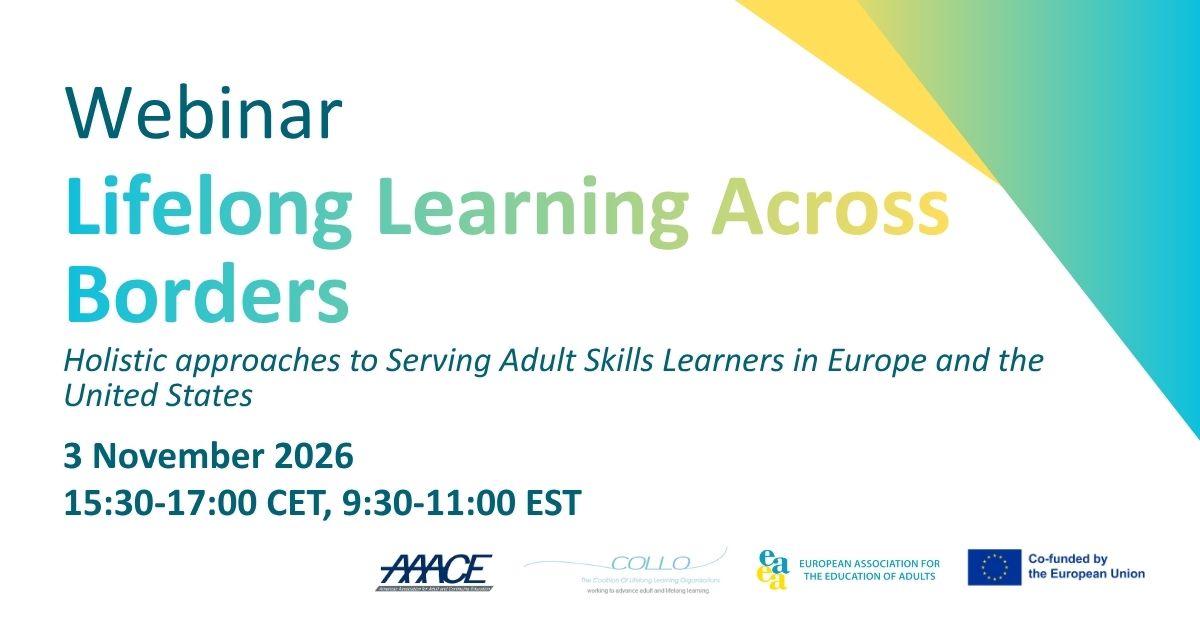
The European Association for the Education of Adults, the Coalition of Lifelong Learning Organizations, and the American Association for Adult and Continuing Education are delighted to host the second appointment of “Lifelong Learning Across Borders – Holistic Approaches to Serving Adult Skills Learners in Europe and the United States” on 3 November at 15.30 – 17.00 CET (9.30 – 11.00 EST).
As Europe and the United States navigate the digital and green transitions, labour market restructuring and growing concerns about democratic resilience, strengthening adults’ foundational skills is becoming increasingly important.
Literacy, numeracy and digital skills remain essential, particularly for vulnerable groups. Yet enabling adults to navigate periods of profound transformation requires a broader approach — one that also supports their social and personal well-being, ability to participate in society, and capacity to continue learning throughout their lives.
Both Europe and the United States have recognised the importance of strengthening adult skills through major policy initiatives. In Europe, the Union of Skills aims to support the development of skills for quality jobs and competitiveness while promoting lifelong learning. In the United States, the Workforce Innovation and Opportunity Act (WIOA) provides a framework for helping adults develop the skills and knowledge needed to progress in education, training and employment.
Moving towards a holistic approach
Adult educators across Europe and the United States are increasingly exploring holistic approaches to foundational skills education that respond to the multiple and interconnected needs adults may face.
Rather than addressing literacy, numeracy or digital skills in isolation, holistic adult education can combine foundational learning with digital competences, critical thinking, soft skills, citizenship education and other forms of support that enable adults to access and remain engaged in learning.
In Europe, adult education providers are increasingly emphasizing inclusive learning approaches that can address social isolation, strengthen active citizenship and equip learners to participate in the green and digital transitions. EAEA has highlighted the importance of keeping adult learning broad and inclusive, recognizing that its value extends beyond labour-market outcomes to individuals, communities and democratic societies.
In the United States, holistic approaches to adult foundational education similarly encompass a range of services supporting adults throughout their learning journey — from accessing and enrolling in adult education to developing skills, achieving learning goals and preparing for their next steps in education, training or employment.
Under WIOA, this includes developing a combination of basic academic skills, critical thinking, digital literacy and self-management skills, as well as competencies related to accessing information and resources, working with others and successfully transitioning into further education, training or employment.
Learning from both sides of the Atlantic
While the European and U.S. contexts differ, adult educators on both sides of the Atlantic face a common question: how can foundational skills education respond to adults as whole individuals, rather than addressing individual skills in isolation?
This webinar will bring together perspectives from Europe and the United States to explore how holistic approaches to adult foundational education are being designed and delivered in practice. We’ll hear insights and practices from: Judith Alamprese -board member at COLLO in the USA, Maria Gonçalves Ribeiro – Policy and Project Coordinator at EAEA in Belgium, Ginny Seltenright – Assistant Vice Chancellor for Adult Basic Education for College & Career (Acting) at Pima Community College, Ludwig Willaert – Coordinator at Ligo Brusseller in Belgium, Anja Kathrin Meierkord – Policy Officer at the OECD, and Alex Stevenson –Deputy Director at Learning & Work Institute in England.
By bringing these experiences into conversation, the webinar aims to identify opportunities for mutual learning and contribute to strengthening adult foundational skills education across both contexts — supporting adults not only to adapt to changing labour markets, but also to participate fully in lifelong learning, their communities and democratic life.