

International frameworks suggest that this shift is not only necessary but overdue. The OECD has consistently framed equity and diversity as strengths within education systems, even as such perspectives face increasing political contestation [1]. Through its Education for Inclusive Societies initiative, the OECD highlights that one of the most pressing challenges in Europe lies in the insufficient training and capacity of post-secondary educators to respond to diverse learning needs.
ALE frames inclusion as a societal responsibility – and provides the capacity-building educators need
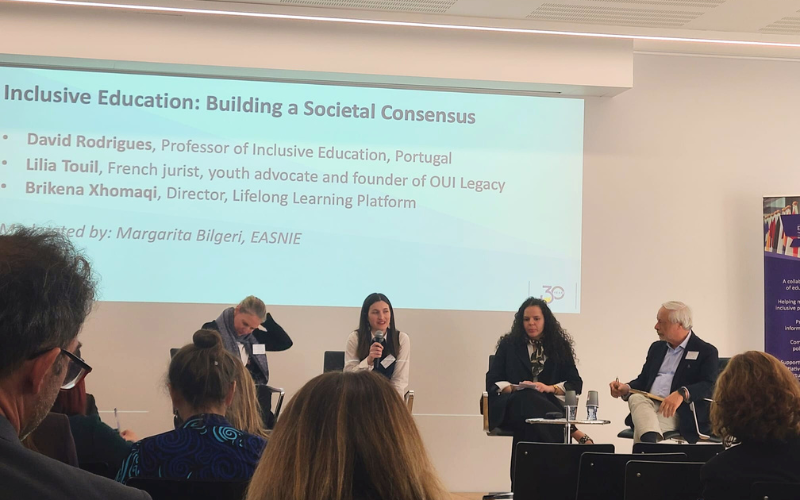
In the field of adult learning, inclusion has long been understood as extending beyond formal education systems. During the during EASNIE 30: Inclusive Education Shaping the Future High-Level Conference, May 19 2026, Brikena Xhamaqi, Director of the Lifelong Learning Platform highlighted that lifelong learning stakeholders increasingly advocate for a whole-of-society approach. In this model, inclusion is supported across formal, non-formal and informal learning environments, as well as within communities and families.
This perspective aligns closely with the rights-based framework established by the United Nations through the Convention on the Rights of Persons with Disabilities. Article 24 of the Convention clearly states that education must be inclusive, non-discriminatory and accessible to all. Inclusion, therefore, is not a matter of goodwill or targeted intervention – it is a legal and moral obligation. Importantly, a rights-based approach also invites a critical reflection: who defines inclusion? To speak of inclusion implies that exclusion has taken place, and exclusion is rarely accidental [2]. It is embedded in systems, structures and decisions. It is therefore the role of society – and here ALE supports at the community-level – to shift from reactive support for specific groups and to inclusive design in education and learning at all stages.
One of the practical implications of a rights-based approach is the need to rethink pedagogical approaches. Supporting educators is essential, particularly in equipping them to respond to diverse classrooms and learning contexts. The Universal Design for Learning supports this vision. Rather than waiting for learners to encounter barriers and then introducing compensatory measures, Universal Design for Learning promotes designing educational environments from the outset to be accessible to the widest possible range of learners. This proactive approach reduces the need for individual adaptations and fosters more inclusive learning experiences for all.
Inclusive Path – developing pedagogical tools for individuals with intellectual disabilities
The European Association for the Education of Adults is actively contributing to this effort through its involvement in the Inclusive Path initiative. The project focuses in particular on individuals with intellectual and developmental disabilities (IDDs), a group that continues to face significant barriers in accessing post-secondary education and lifelong learning opportunities.
INCLUSIVE-PATH adopts a needs-based, co-creation and rights-based approach, bringing together learners, families, educators and service providers to jointly design and test solutions. This collaborative model reflects the broader shift towards recognising learners not as passive recipients but as active agents in shaping their educational pathways [3].
The project’s outputs include a range of practical tools, such as a comprehensive handbook on inclusive transitions, targeted capacity-building workshops for secondary and post-secondary staff, and an accessible 3D interactive digital game. The latter uses gamified scenarios to support decision-making, strengthen self-advocacy and build digital skills among learners.
Crucially, the project also acknowledges that inclusion does not happen in isolation. By engaging families and wider support systems, it reflects a whole-society approach that is essential for sustainable change.
Join us as we explore the topic further
As international frameworks from UNESCO and the OECD make clear, inclusive education is central to achieving equitable and resilient societies. The challenge now lies in ensuring that these principles are fully realised in practice, across all levels of education, and throughout the lifespan of a learner.
In this sense, the future of adult learning and education will depend not on how well systems include some, but on how effectively they are designed for all.
___________________________________________________________________________________________________________
[1] Lucie Cerna, Senior Analyst in Equity, Inclusion and Transitions, Directorate for Education and Skills, OECD, during the panel ‘From Commitment to Implementation: Advancing Inclusive Education in Practice’, as part of the EASNIE 30: Inclusive Education Shaping the Future High-Level Conference, Brussels, May 19 2026
[2] Lilia Touil, French Jurist and Youth Advocate Bridging law, education and global development, during the panel ‘Inclusive Education: Building a Societal Consensus’ as part of the EASNIE 30: Inclusive Education Shaping the Future High-Level Conference, Brussels, May 19 2026
[3] Katholeik Onderwijs Vlaanderen, INCLUSIVE PATH Handbook, draft, March 2026