What do we really need for ALE organisations to build a strong culture of Quality Assurance, also to respond to the current and future challenges the ALE sector is facing across Europe?
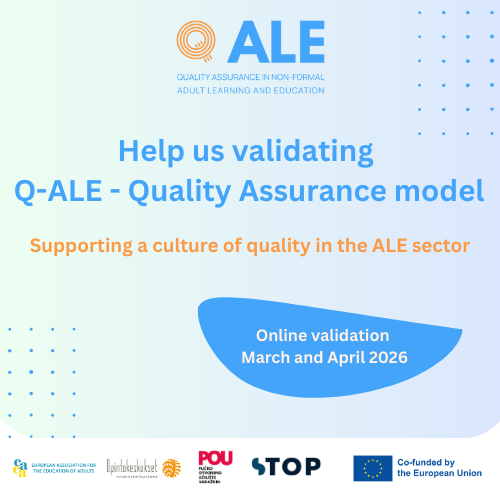
To support concrete solutions to this challenge, EAEA and three ALE national organisations (sTOP from Poland, POU Varaždin from Croatia and the Finnish Association of Study Centres) have joined forces to develop Q-ALE – Quality assurance in non-formal Adult Learning and Education. The initiative aims to contribute to quality assurance in education across countries, by proposing and start assessing a co-designed, feasible and context-based approach for quality assurance in the adult education sector.
What is the Q-ALE approach?
The partnerships started with analysing existing models of quality assurance in education (certification systems, methods and training programmes etc.) from the perspective of non-formal ALE organisations, in particular in terms of accessibility (can we use them?), applicability (does these methods/systems works also for the ALE sector?) and feasibility (do we have the technical capacity and resources to implement them?). One of the core questions of this research is finally, are the existing tools relevant for adult education and the specifics of non-formal learning environments?
The main output of the initiative is the Q-ALE Code of Conduct for Quality Assurance in ALE organisations. The Code is formulated to support non-formal adult learning organisations to improve their quality assurance processes, to structure and formalise them, make them regular and coherent, and prepare the organisation to comply with current and potentially new QA standards in their countries, etc. The Code also includes a Self-assessment tool (offline and interactive), to support the first steps of any ALE organisation toward a more structured and sustainable QA strategy.
- Discover more about the Q-ALE initiative
- Read now the Q-ALE Model – Quality Assurance for ALE (beta version)
What can you contribute to this work?
We are inviting any organisation and practitioner in the field of adult education and related services to support this work through:
- Online validation of the Q-ALE model and Code of conduct till 20 April 2026
- Online workshop on 24 March 2026
To join the online validation process
Timeline: from 10/03/2026 to 20/04/2026
- Read and review the Q-ALE – Code of conduct – Read now the Q-ALE Model – Quality Assurance for ALE (beta version)
- Try out the interactive Q-ALE Self-assessment tool – Access to self-assessment here
- Provide your feedback in the online validation questionnaire – Access the feedback form here
- If you want, you can also get in contact with us directly, for further feedback or ideas for collaboration at viola.pinzi(at)eaea.org
To join the online workshop
Who is afraid of Quality Assurance? Supporting a culture of quality in the ALE sector
Date: Tuesday 24 March 2026 – 10.00 AM – 12.00 PM CET
- Explore what we will do in the workshop – Check the full agenda here
- Join us for event – Register here
——————————————————–
Q-ALE – Quality Assurance in non-formal Adult Learning and Education is funded by the European Union.
Views and opinions expressed are however those of the author(s) only and do not necessarily reflect those of the European Union or the European Education and Culture Executive Agency (EACEA). Neither the European Union nor EACEA can be held responsible for them.
Text: Viola PinziPhotos: EAEA