

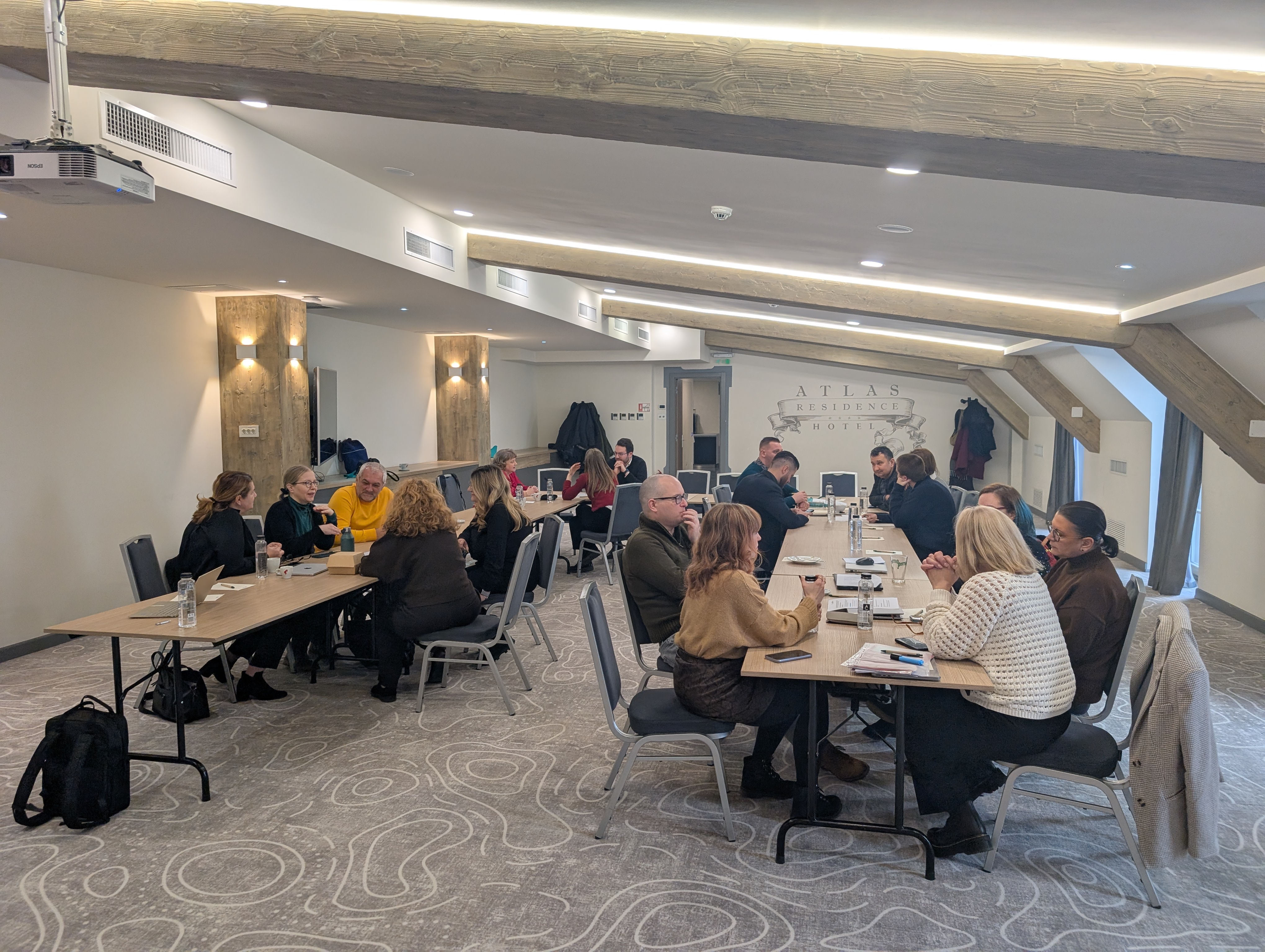
The session brought together a great mix of voices, educators working with vulnerable learners, psychologists in correctional facilities, and specialists from Romania’s second-chance education programme. Some work in well-resourced STEM schools where emerging technology is the norm. Others teach in prisons where internet access doesn’t exist. Yet all shared a common challenge: navigating how to embrace emerging technology while staying true to what education is really about.
Finding balance in a digital world
“Do we need to teach technology? We need a balance,” one educator insisted during the ethics discussion.
It’s a sentiment that resonated throughout the day. The conversation kept circling back to a crucial reality: many learners lack basic skills (literacy and digital) and are relying so heavily on autocorrect that fundamental skills are slipping away. As one participant pointed out, even the hand movements involved in writing develop patience and perseverance – skills that can’t be replicated by tapping on a screen. The pandemic accelerated this shift, pushing educators online overnight. Now, educators are reflecting on where and when technology belongs in the education process. The answer, they agreed, isn’t replacing everything – it’s choosing purposefully.
The reality check: barriers beyond technology
Perhaps the most sobering insight came when educators identified that technology barriers often mask deeper challenges.
“If you are not able to properly read or write, you cannot use emerging technology where you need to read and understand how to use it,” one participant explained.
In Romania, where basic literacy remains a priority, rushing to implement emerging technologies without addressing foundational skills risks leaving the most vulnerable learners even further behind. Geographic disparities worsen the problem. While urban schools push to incorporate emerging technology, rural areas lag far behind. Not every educator has the same level of digital skills or even access. Some older teachers may actively resist technology, preferring traditional methods they’ve refined over decades.
Unexpected applications, familiar concerns
The session revealed some creative uses of technology in unlikely places. In one prison,
Educators had the opportunity to pilot VR experiences for drug prevention, an engaging
approach that sparked ideas about using similar tools to help individuals overcome phobias
or build confidence. Yet even these possibilities come with caveats about funding limitations
and infrastructure challenges.
Smart boards in special needs schools? Transformative and engaging. Three-month training
courses on emerging technology for Romanian educators? Helpful, but requiring significant
time investment for teachers already juggling pedagogical shifts.
Digital well-being needs more attention
A recurring theme emerged around digital well-being. While some educators lead sessions
on online safety and digital balance for children, often drawing from their own master’s-level
training – these conversations rarely extend to adults. Adults need guidance too.
“Everything moves so fast that the most important messages are not addressed. We are all mostly connected 24/7,” one participant noted.
Organisations have adopted different approaches: some schools use phone collection boxes where students deposit devices for the day, helping students focus during lessons. In prisons, educators set up TV viewing sessions to keep learners connected to current events.
The big question
As the day’s discussions unfolded through world café rotations, covering access and digital inclusion, educator capacity and support, ethics and sustainability, and emerging technology in practice, one question kept surfacing: should technology be used for specific purposes, or will it fundamentally change how education exists? The educators’ answer was clear: the goal isn’t to delay the digital future or reject innovation, but to ensure technology serves educational goals rather than dictating them.
“We must learn and be able to control how we use it so that it doesn’t control us,” one educator summarised.
Technology should support people in living better lives, but only when it’s adaptable to context, accessible to everyone, and purposeful in application.
Looking forward
The Timișoara Capacity Building Lab made clear that successful technology integration in adult education requires honesty about limitations, respect for foundational skills, and commitment to digital well-being. The discussion showed participants aren’t rejecting emerging technology, but they’re insisting these tools earn their place by demonstrating clear educational value.
As colleagues from Romania, Belgium, Finland, the UK, and Croatia shared their perspectives, the exchange revealed both universal challenges and local realities. Whether teaching in a high-tech STEM school or a resource-constrained prison classroom, the principles remain the same: ethical implementation, proper educator support, genuine inclusion, and technology that enhances rather than replaces the human elements of education.
This Capacity Building Lab was part of the ETHLAE project’s ongoing work to support adult
educators in meaningfully integrating emerging technologies in the work with adults.
In accordance with the GDPR, we have obtained written consent from all participants for the use of their photos.
ETHLAE – Emerging Technologies for Holistic Literacy in Adult Education (Project: 101184061 — ERASMUS-EDU-2024-PCOOP-ENGO). Funded by the European Union. The views and opinions expressed are, however, those of the author(s) only and do not necessarily reflect those of the European Union or the European Education and Culture Executive Agency (EACEA). Neither the European Union nor EACEA can be held responsible for them.
Text: Gabriela Mucientes Lambert (All Digital)Photos: EAEA