
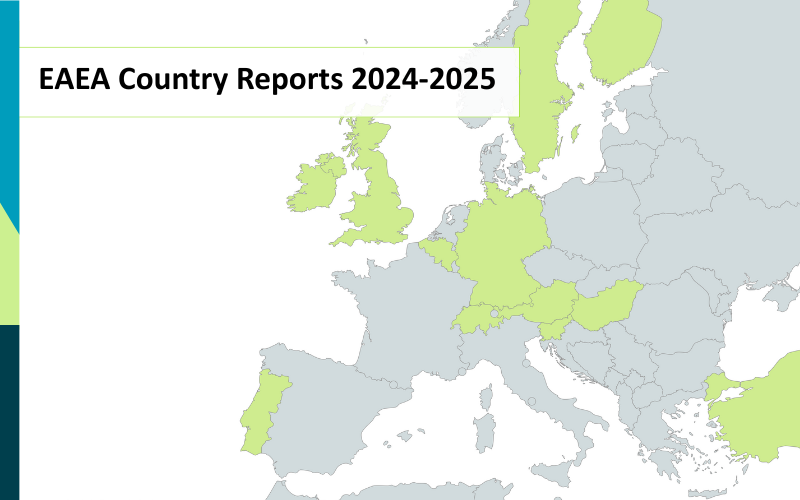
Based on a survey of 15 EAEA member organisations, this new edition of EAEA Country Reports presents policies, funding challenges, and adult education trends in 12 countries: Austria, Belgium, Finland, Germany, Hungary, Ireland, Portugal, Slovenia, Sweden, Switzerland, Turkey, and the United Kingdom.
The information gathered in the reports offers an in-depth grassroots analysis, aiming to complement official data such as the European Labour Survey 2023 and the European Adult Education Survey 2022.
The survey included questions such as members’ perspectives on the current focus on skills in European ALE policies, the use of Artificial Intelligence in adult learning and education, the participation of learners and civil society organisations in policy and decision-making, and the funding situation of adult learning.
Key highlights of the EAEA Country Reports 2024/25:
- National ALE policies follow the European trend, focusing mainly on employment and labour market needs.
- AI is being incorporated by 67% of the organisations in some capacity: as part of teaching and learning, as a valuable professional skill, or to support administrative tasks. The remaining 33% is still unsure due to the risks associated with the use of AI, such as ethical concerns.
- Civil society organisations in ALE continue to advocate for a seat at the table during policy-making processes, while adult learners generally lack opportunities to influence policy-making.
- Funding is a prevailing issue in ALE, both at the national and European levels, resulting in a myriad of problems, including a lack of access to learning opportunities for many adults. 50% of the respondents reported the funding situation in their country has deteriorated; 33.3% of the respondents stated the funding situation in their country has remained the same; 16.7% of the respondents indicated the funding situation in their country has slightly improved.
Take a look at the new EAEA Country Reports 2024/25 on our dedicated website countryreport.eaea.org, and explore this new edition searching by country, thematic tags, or through comparative graphs under Insights!
As part of the Country Reports, we would love to showcase good examples on how ALE has changed the lives of learners. If you’re interested in sharing learners’ stories to be featured on the website, reach out to Greta Pelucco, Senior EU Public Affairs Coordinator at greta.pelucco[at]eaea.org and Maria Gonçalves Ribeiro, Policy and Project Coordinator at maria.ribeiro[at]eaea.org.
Text: Beatriz Martin Pique