

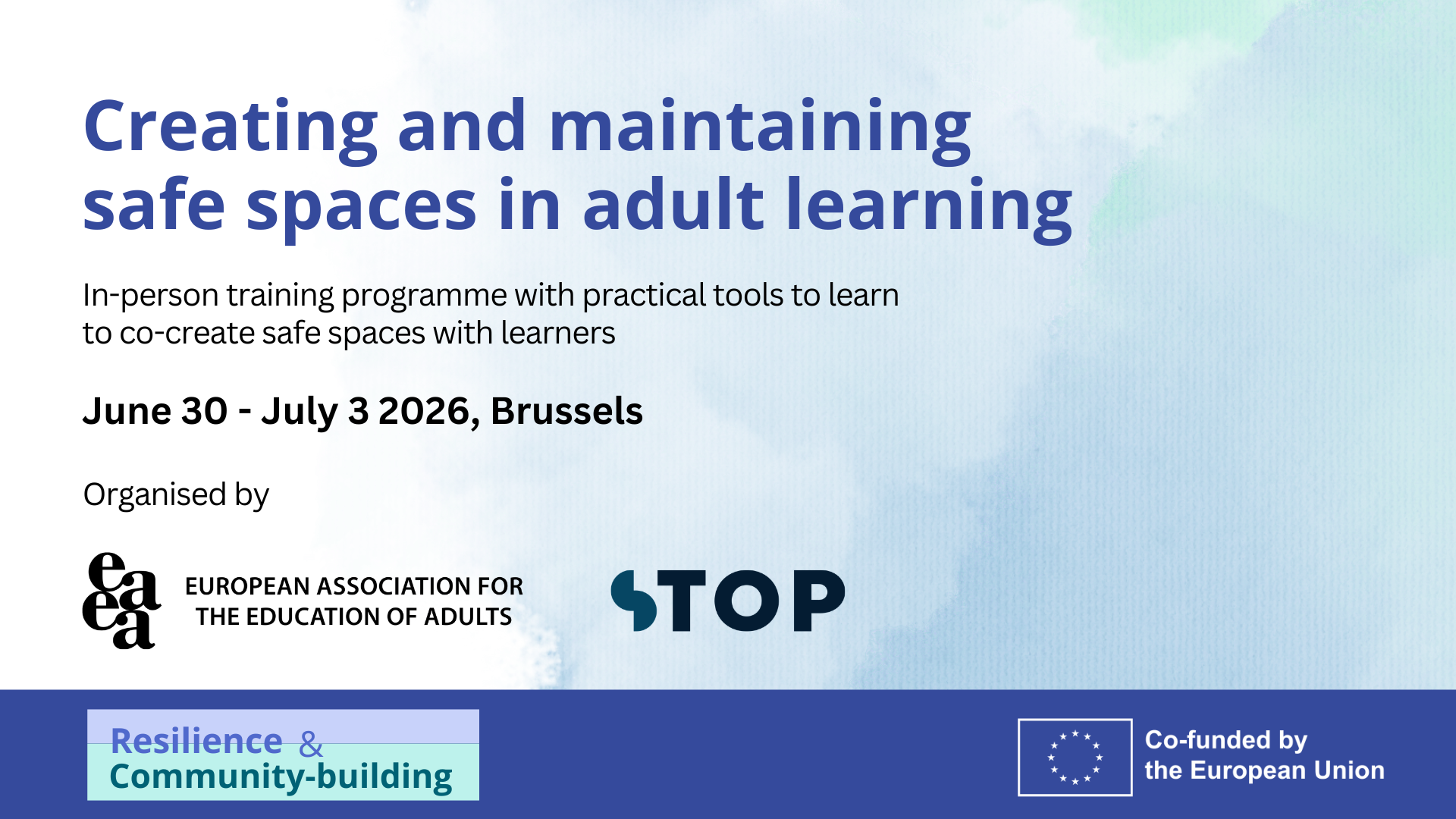
In summer 2026, we are hosting our second edition of the Safe Spaces in Adult Learning Training in cooperation with our member sTOP, Poland.
The concept of safe space is a complex one and can relate to different elements of educational practice, whether it is connected to the physical aspect of the space, the online environment, or the role of the trainers, organisers and/or learners in creating a safe learning setting. During the training, offered in a blended format, we will explore the power dynamics and decolonial approaches in adult learning and education, public pedagogy and the relationship between safety and space. We will also look at practical ways of co-creating a safe space together with learners.
By the end of the training, participants will be able to:
- Identify what creates a feeling of safety in ALE settings
- Position their learning experiences within the concept of safety
- Understand how privilege and struggle relate to the notion of safety in the learning environment
- Identify good practices of safe spaces in adult learning
- Understand how feelings of discomfort, triggers and challenging conversations can be had in sae spaces
- Relate theories of public pedagogies with safe spaces in ALE
- Experiment with co-creating a safe space
Learning Methods: Online mini-lecture and workshop; in-person workshops, historic decolonial walking tour around Brussels
Target group: The training targets adult educators and organisers of adult learning courses, as well as learners themselves
We kindly ask you to note that the programme below might be subject to minor changes.
Please register latest by the 12th of April 2026. EAEA will evaluate the registrations on a rolling basis so we encourage you to sign up early.
We welcome adult education staff and adult learners who have an interest in maintaining and developing safe spaces for learning!
Practical information
Dates: 30 June – 3 July, 2026
Online: June 1, 2026 (TBD)
Venue: Brussels, Belgium
Registration period until 12.04.2026
Participation fee
| Participation type | Fee |
|---|---|
| EAEA member organisations, adult learners, and university students | €450 |
| NGOs | €500 |
| For-profit organisations and public institutions | €900 |
Disclaimer: We reserve the right to cancel the training in case we are unable to reach the minimum number of participants. We will send out the confirmation to all the interested participants by 20.4.2026. We reserve the right to close registrations if the maximum participants have been met.
Programme
Online sessions
There will be one online session before the training takes place and one after. The online sessions will be an hour and a half long, and the time will be decided amongst the participants of the training.
Please note that the programme might undergo minor changes.
In-person sessions
13.30 – 14h Welcome with coffee
14 – 15.30h Getting to know each other and EAEA, practical information about the training.
15.30 – 17h What are safe spaces for the group? Why is it important to talk about safety, privilege and struggle in adult education? Guided exchange of experiences between participants.
09 – 09.30h Welcome with coffee
09.30 – 10h Check-in: getting started
Recap of the first day and introduction to the second day of the training
10 – 11.30h Power Dynamics in ALE. How privilege and struggle relate to the notion of safety in the learning environment. Input and discussion
11.30 – 12h Coffee break
12 – 13h Decolonial approaches in ALE. How does the concept of colonisation and decolonisation affect adult learning environments? Interactive practice
13 – 14h Lunch break
14 – 15h Decolonial walk around Brussels/ Decolonial visit in Brussels
15 – 16h Positioning our privilege. Immersive activity in the public space.
16 – 17h Check-out: self-reflection practice
Day wrapping and self and group reflection activity on the practices and main take aways.
09 – 09.30h Welcome with coffee
09.30 – 10h Check-in: getting started
Quick recap of the main take aways from the previous day, introduction to the third day of the training
10 – 11.30h What makes us willing to express, embrace and learn from differences
11.30 – 12h Coffee break
12 – 13h Triggers, uncomfortable feelings and points of resistance: creating safe space for it all
13 – 14h Lunch break
14 – 16h Leading people through challenging conversations
16 – 17h Check-out: self-reflection practice
Day wrapping and self and group reflection activity on the practices and main take aways.
19 – 21h Social dinner
09 – 09.30h Welcome with coffee
09.30 – 09.45 Check-in: getting started
Quick recap of the previous day and introduction to the fourth day of the training
09.45 – 10.15h Creating an informed safe space in the ALE setting. The Why, the what, the who and the How of SAFE spaces. Input and discussion based on the results of the SAFE project.
10.15 – 11.30h Using the SAFE Board Game- World Café edition.
Character Creation and discussion on safe spaces on a policy, organisational and classroom level using prompts of the SAFE Board Game.
11.30 – 12h Coffee break
12 – 13h Reflections and key takeaways from the world cafe
13 – 14h Lunch break
14 – 15h Tying all the loose ends
Interactive closing session on creating and maintaining safe spaces in adult learning
15 – 16h Evaluation and reflection on the training
Immersive activity to exchange on the training experience


Still have questions?
For questions about the training, please contact EAEA Learning and Project Coordinator Charlotte Ede, charlotte.ede(at)eaea.org.