

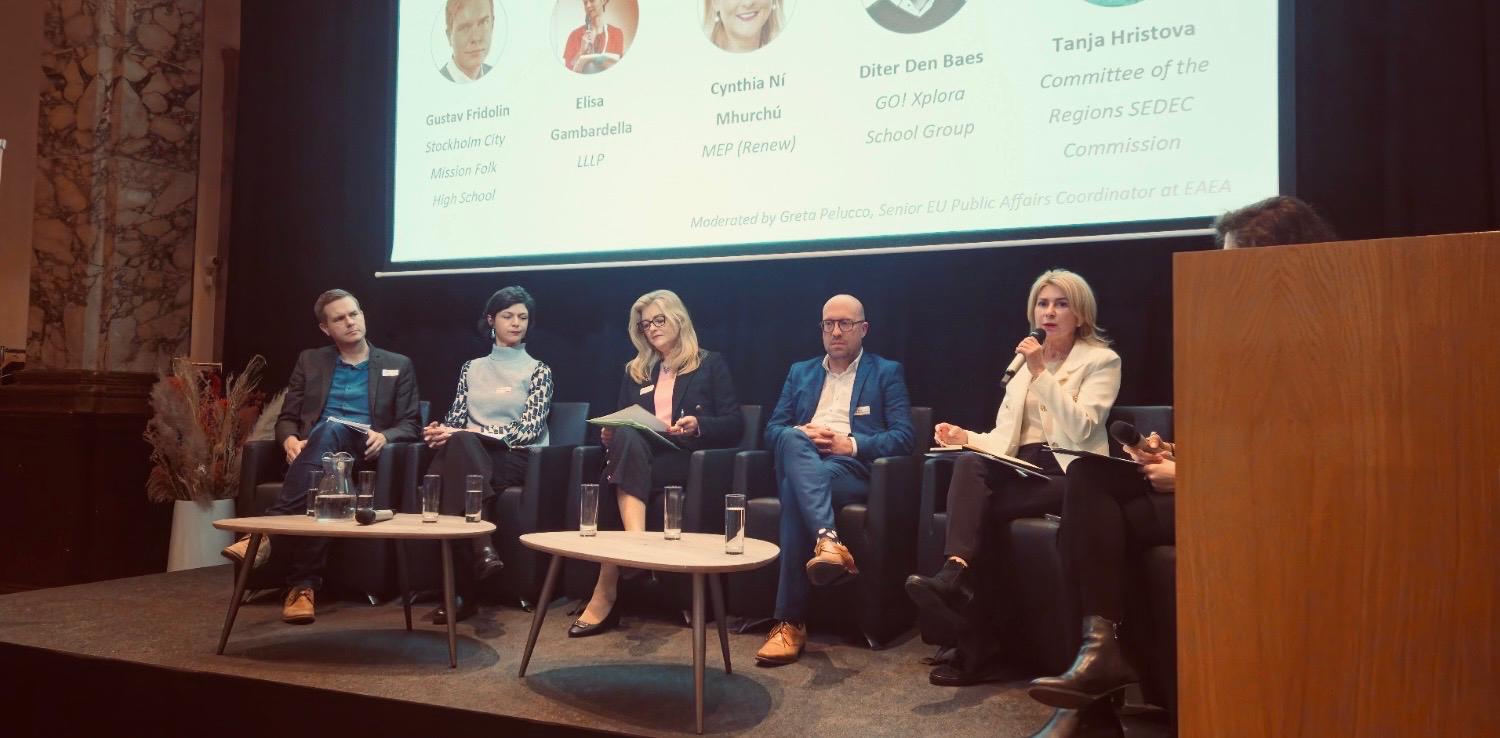
Among the speakers of the celebratory event were Alan Smith – former Director of the Erasmus Bureau, Vanessa Debais-Sainton – Executive Vice-President Minzatu’s Cabinet, MEP Brigitte van den Berg, MEP Cynthia Ní Mhurchú, Tanya Hristova – SEDEC Commission, Gustav Fridolin – Stockholm Stadmission Folk High School, Elisa Gambardella – Lifelong Learning Platform (LLLP), Diter den Baes – Xplora School Group, MEP Sirpa Pietikäinen, EAEA’s President Lauri Tuomi – Finnish Lifelong Learning Foundation. The event was part of the Lifelong Learning Week, which is organised by the Lifelong Learning Platform.
The discussions underscored an important point: Thirty years of adult learning and education (ALE) in Europe are not just a milestone to celebrate. They are a moment to reassess how learning can continue to serve people, democracy, and social cohesion in a rapidly changing Europe.
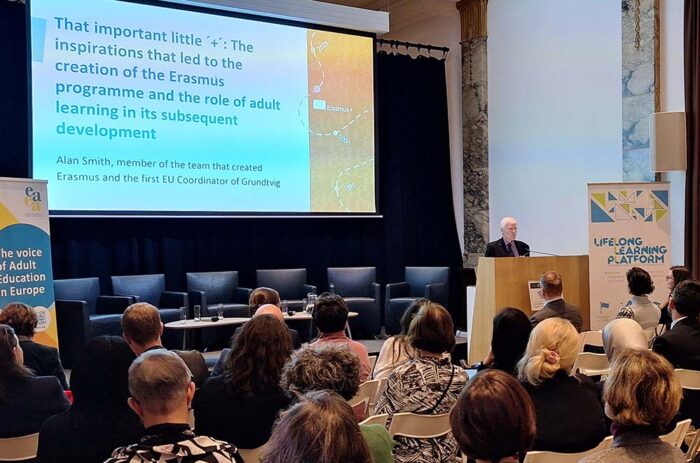
‘’Adult learning was not welcomed by default in EU programs – it had to be defended, negotiated, and structurally built over time.’’ Alan Smith
Opening the event, a strong message emerged immediately: lifelong learning matters not only at European level, but locally, in industrial regions, communities, workplaces, and families. From its early roots in the Grundtvig program to today’s Erasmus+, adult learning has consistently been about opening doors and crossing borders – geographical, social, and cultural. Yet progress does not exempt us from responsibility. On the contrary, it demands critical reflection.
Innovation in adult learning is not only technological. It is about design: designing learning opportunities that fit into people’s lives, rather than asking people to adapt to rigid systems. Not everyone thrives in traditional education settings, and not everyone experiences learning as something positive or stress-free. Adults have different needs, motivations, and constraints.
‘’Adult learning should not be taken for granted: access, outreach, validation and governance need to be actively supported by policy.’’ Elisa Gambardella
If Europe wants adults to keep learning, the first step must be easy. Accessible entry points, flexible formats, and welcoming environments are essential. Learning should meet people where they are – in workplaces, online spaces, communities, and family life – and build on practical skills gained in real contexts. This approach not only supports individual confidence and adaptability, but also strengthens Europe’s capacity to respond to technological change and economic transformation. Investment in adult learning, therefore, is not optional: it is a strategic necessity.
‘’We have to meet people where they are’’ MEP Brigitte van den Berg
Looking back at the last three decades, the European adult learning community has made remarkable progress. Erasmus+, policy frameworks, reference tools, and cooperation mechanisms have expanded opportunities and improved quality across countries. Yet one recurring challenge remains: adult learning is still too often reduced to a narrow labor-market function.
Speakers throughout the event stressed the need for a holistic understanding of ALE – one that includes formal, non-formal, and informal learning, and recognizes adult education as a fundamental right.
‘’We need to recognize adult education in the Multiannual Financial Framework (MFF). Keep fighting for the programs, so we don’t end up in a fragmented society, a breakdown of democracy, and lack of access to education. Health is the key component of the breakdown of democracy – that’s when people become disengaged from CSOs and community.’’ MEP Cynthia Ní Mhurchú
Civil society plays a crucial role in making this vision real. Policies do not implement themselves, and programs only work when they are shaped and delivered together with those closest to learners. Community organizations, adult educators, and local actors are essential partners in reaching people who are least comfortable with formal education and most at risk of being left behind. In times of demographic change, economic pressure, and geopolitical uncertainty, resilience depends on inclusion.
Data shared during the event highlighted both progress and urgency. Participation in adult learning remains far below Europe’s ambitions, with only 39.5% of adults engaged in training, against the EU target of 60%. 47.7 million adults are still low-qualified across Europe. Bridging this gap requires collective responsibility – involving not only education ministries, but also finance, economy, social affairs, and private actors. Lifelong learning must be treated as a shared investment in Europe’s human capital and social cohesion.
‘’Trust the alternative, trust the journey and change the politics’’ Gustav Fridolin
Beyond skills, adult learning also plays a fundamental democratic role. Critical thinking, media literacy, and community engagement are increasingly vital in an age of misinformation, acceleration, and polarisation. Several speakers emphasised that education cannot stop at childhood or youth if societies want to remain democratic and cohesive. Learning is communal by nature: people learn with and from others, in spaces that foster trust, belonging, and dialogue. When such spaces disappear, societies fragment.
The panel discussion reinforced a key insight: adult learning should no longer be treated as a collection of projects, but as a transformative, long-term policy. One-size-fits-all solutions do not work. Flexible, targeted approaches – especially for vulnerable groups – deliver the greatest impact when they respond to real-life challenges at local and regional level. Transitions, whether green, digital, or demographic, must be made with citizens, not imposed on them.
‘’Bring that mindset that we see with children.’’ Diter den Baes
Learning should not be framed solely as an obligation for employability or economic productivity, but as something inherently interesting, meaningful, and empowering. Reconnecting adults with the curiosity and motivation often seen in childhood may be one of the most important tasks ahead. Outreach, validation of learning outcomes, and recognition of informal learning are crucial to make participation visible, valued, and rewarding.
As discussions turned to the future, a recurring warning emerged: adult learning budgets and priorities are under pressure, particularly in the context of security and defense debates. Yet neglecting lifelong learning would ultimately cost more – socially, economically, and democratically. Maintaining access to affordable adult education is essential to prevent further disengagement and inequality.
‘’Adult learning is no longer a single project, it should be a transformative policy, sustainable, financially funded. The MFF is crucial this debate is important as a key component in the policies engaged with Europeans.’’ Tanya Hristova
Thirty years on, the message from the event was clear. Adult learning is not a marginal policy area, nor a legacy of the past. It is a living, evolving field that must remain high on the European agenda. Celebrating past achievements matters, but what matters more is learning from them – and acting on that knowledge.
Adult learning is about people at every age having the opportunity to grow, contribute, and feel included. It is about building communities, strengthening democracy, and ensuring that no one is pushed off a fast-moving society. The future of adult learning in Europe is not predetermined. It is, quite simply, in our hands.
Text: Greta PeluccoPhotos: EAEA