

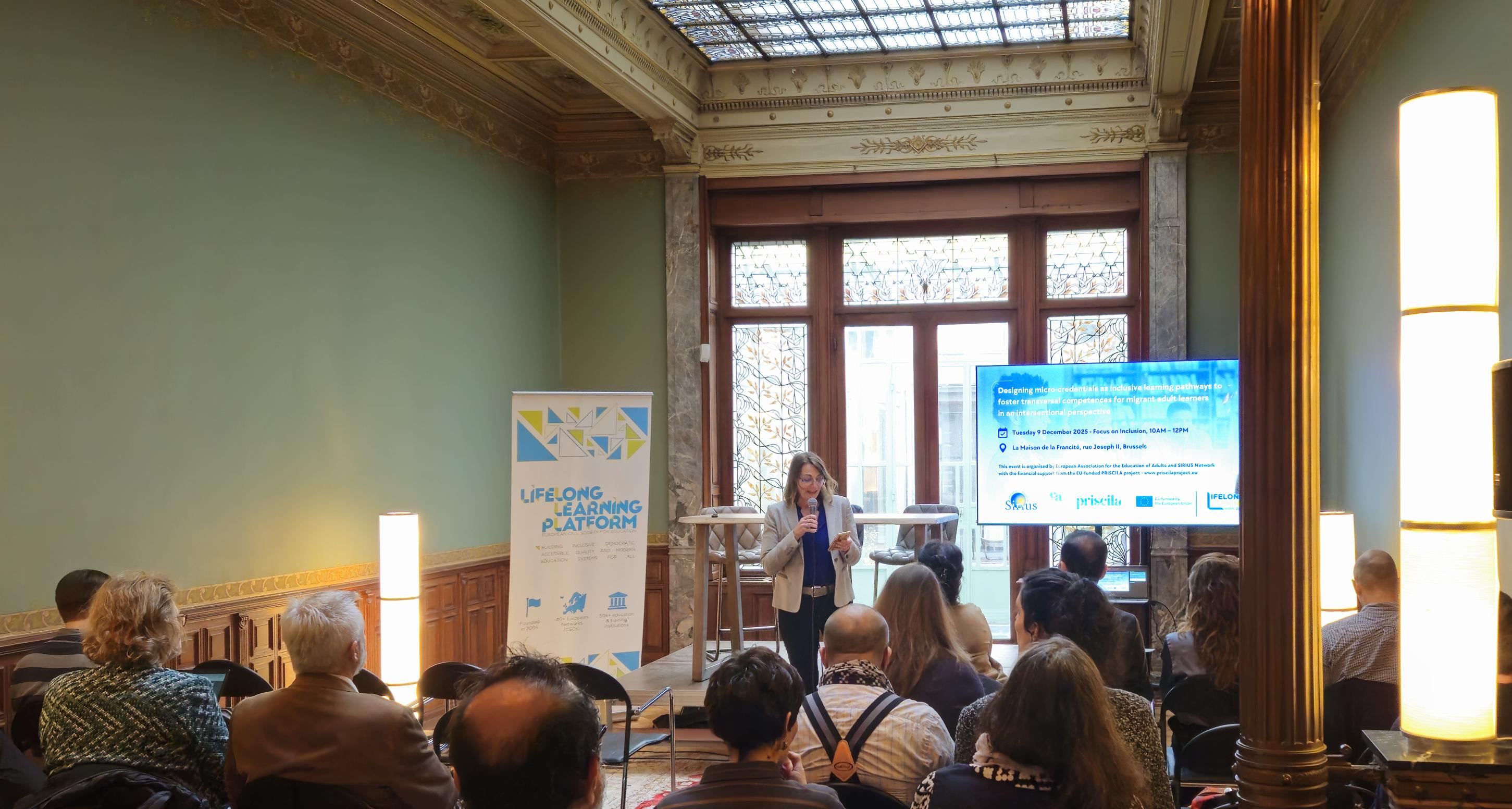
On 9 December, more than 40 experts in education, social innovation and migration policy, gathered in Brussels, for the first event of the Lifelong Learning Week 2025, ‘’Designing micro-credentials as inclusive learning pathways to foster transversal competences for migrant adult learners in an intersectional perspective’’ to explore and discuss the core question of how we can co-design accessible, inclusive and flexible learning pathways, also as micro-credential for non-formal education, to foster key competences for learners with migration background.
The event was co-organised by European Association for the Education of Adults and SIRIUS Network and the partners of the PRISCILA initiative – www.priscilaproject.eu
The event was opened by the welcoming words of the LLL Platform Vice-President Chiara Piccolo, followed by an introduction to the topics of the day by the moderator and host Viola Pinzi, European Association for the Education of Adults.
The introduction provided a brief overview of the meaning of micro-credentials for different kinds of education processes and sectors and their aim also to extend the opportunities for certification beyond qualification to skills and competences. Pinzi offered also a recap of the main landscape of policies and instruments at European level and introduced the idea of the integration of micro-credentials for non-formal adult education programmes, therefore, the design of Microcredentials as flexible learning pathways as a base.
Finally, the PRISCILA initiative was presented (Fostering Personal, Intercultural, Social and Citizenship Competences for Lifelong Learning to Empower Migrant Adult Learners), an European funded projects that aimed indeed at linking the valuable aspects of non-formal methods, which support adult learners motivation and participation, with the option to design a micro-credential following the principles of the EU model, for example embedding ‘’valid’’ assessment methods, applying quality assurance for the programmes and also issuing micro-credentials to learners in a digital format and though European infrastructure (in this case the European Digital Credentials Infrastructure).
Policy and practices to support equity and access for adult learners with migrant background
The Panel discussion ”The role of micro-credentials to support transversal competences and basic skills programmes for adult learners and vulnerable groups in an intersectionality perspective”, brought diverse perspectives from research, policy analysis and practice.
Mojib Atal, Policy analyst at the Migration Policy Group, shared key insights and concerns related to migrants’ experiences, skills recognition, and the systemic barriers that prevent meaningful inclusion. Migrants face limitations embedded in society, which directly shape how their skills are perceived, since they must navigate systems that are not coordinated and, while most migrant have already acquired competencies, these remain unrecognised and often difficult to ‘’trace’’ within existing systems, leading to “unseen labels” and barriers to empowerment. The core systemic concern remains then to ensure that employers can actually recognise migrants’ lived experience and competencies. Atal also shared some key aspects from the Migrant Education Policy Index 2025 (joint work with SIRIUS – Policy Network on Migrant Education) that looks at fifteen Member States and their national strategies and confirmed that most countries do not have specific strategies for migrants and education, coordination activities or standard forms of RPL in place or properly assisted.
Valentina Galli, Policy expert, SIRIUS Network, focused on the conceptual and ethical dimensions of inclusion and micro-credentials. She remarked how inclusion should be seen as a national and cross-sectoral priority, to be operationalised through cross-sectional interventions at national level. Inclusion should be both fundamental and tangible—not abstract rhetoric. Galli also questioned the common assumption that Microcredentials inherently increase labour market relevance, while she encouraged a clearer understanding of which skills are actually needed and how they are communicated through national skills frameworks and whether microcredentials genuinely reflect real labour shortages or simply reproduce narrow policy agendas.
In the last contribution, Francesca Torlone, Professor, University of Florence and representing also the SALAM initiative, provided the audience with a good overview of the recent data on participation on adult learning and how this is a useful insight to talk about equity and access to education and employment for vulnerable groups. Torlone remarked how the AES 2022 data shows that the participation level is increasing, while this is related to only specific demographics (young, highly educated and employed people are the most likely to participate in adult learning) and for specific type of learning activities (the participation in non-formal adult learning prevails). These data seem to suggest therefore that Short-term learning activities are attractive and this already the reality for most of adult learners in Europe.
In the second round of discussions, the panellist shared insights on effective and potential solutions to these needs and challenges, at policy and implementation level.
Atal remarked once again the need for structured national strategies as well as improving the data-driven policy making processes as well as the collection of granular data around education and migration.
Furthermore, Galli outlined how advocacy and inclusion are also as ‘’human practices’’ and that meaningful inclusion requires addressing our own stereotypes. educating ourselves first, understanding inclusion as more than coexistence, supporting self-advocacy among migrants, enabling both personal and collective advocacy, seen as essential to prevent further layers of exclusion.
Finally, Torlone looked at policies and good practices put in place by regional and local authorities, in particular some members of EARLALL (European Association of Regional and Local Authorities for Lifelong Learning), which are also working together on the SALAM initiative, focusing in particular on instruments supporting Recognition of Learning for Adult Migrants for their fast integration in employment. Among these regional and local examples of good practices, Torlone presented the examples of SOC-Catalonia Regional Government (Spain), with the ‘’integration window’’ approach (helping migrants enter systems quickly), the Mark Municipality (Sweden) fostering a strong role of the community in assessment, recognition, and integration procedures (learners, employers included), the Tuscany Region (Italy) current policy measures for training migrant with propension in self-entrepreneurship (high entrepreneurial activity of migrant people in the region), and finally Baden-Württemberg (Germany) with their Regional Alliance for Lifelong Learning aimed at developing a “regional Pact” to provide migrants with different pathways – guidance, training, counselling, etc.
The panellists concluded also addressing the question whether micro-credentials can be a potential solution to some of these challenges.
Torlone outlined how micro-credentials might work if they are short-term, focused on granular skills, meet expectations of both learners and employers, come from high-quality ACE (Adult and Continuing Education) provision and are integrated within expanding ACE systems. Galli also pointed out that micro-credentials can support providers, but they must not create additional administrative complexities and introducing new layers of exclusion, especially for migrants.
The second part of the morning was dedicated to an interactive activity focusing on the concept of intersectionality and its complexity. The workshop on ‘’Integrating inclusive learning and assessment methods in flexible learning pathways in an intersectionality perspective’’, was led by Eleonora Bonvini, University of Bologna (Italy), and Cihan Koral, inclusion expert and founder of HASAT (Turkey).
After an introduction to the concept of intersectionality (Crenshaw, 1989), the participants were invited to join an interactive group work based on cards presenting diverse persona of adult learner profiles and their characteristics and situations. Each group was invited to discussed the two questions ‘’What structural and assessment barriers emerge?’’ and ‘’What design or assessment adaptations could address these barriers?’’ considering a variety of aspects such as access, language requirements, evidence of competence, timing, tools, support. Each group came up with one or two key points and high impact idea, which were then briefly presented in plenary.
The key takeaways from the groups were much in line with the good practices brought by the pannelists.
- The involvement of institutions and the broader community is considered essential to support the integration process, through concrete and coordinated assistance.
- Support to address language-related difficulties and to correctly obtain the required documents is also fundamental.
- A structured employment orientation pathway is recommended.
- Especially for younger adults, the focus should be placed also on identifying future aspirations in order to define interest in studying, working, or both, level of motivation, and the construction of a coherent educational and professional pathway.
- An ecosystem approach is recommended, involving multiple stakeholders (institutions, schools, community actors, third sector organizations) to ensure continuous and integrated support.
- The focus should be also on strengthening non-formal and transversal competences, including learning to learn, leadership and team management skills and enhancement of soft skills already possessed.
- A cooperative system could be the base, one that recognizes and supports individual competences and enables collaborative learning dynamics.
- Activation of community-based learning is recommended, through the involvement of the local community based on specific needs, to support integration and inclusion.
If you want to know more about these topics and the related work, you can check:
• PRISCILA initiative and core guidelines – https://www.priscilaproject.eu/results
• SIRIUS Migrant Education Policy Index – https://www.migpolgroup.com/wp-content/uploads/2025/07/2025-Sirus-Watch_Migrant-Education-Policy-Index_fin_040725.pdf
• Migration Policy Group work – https://www.migpolgroup.com/index.php/portfolio-2/
• SALAM initiative – https://www.interregeurope.eu/salam
Text: Viola Pinzi