

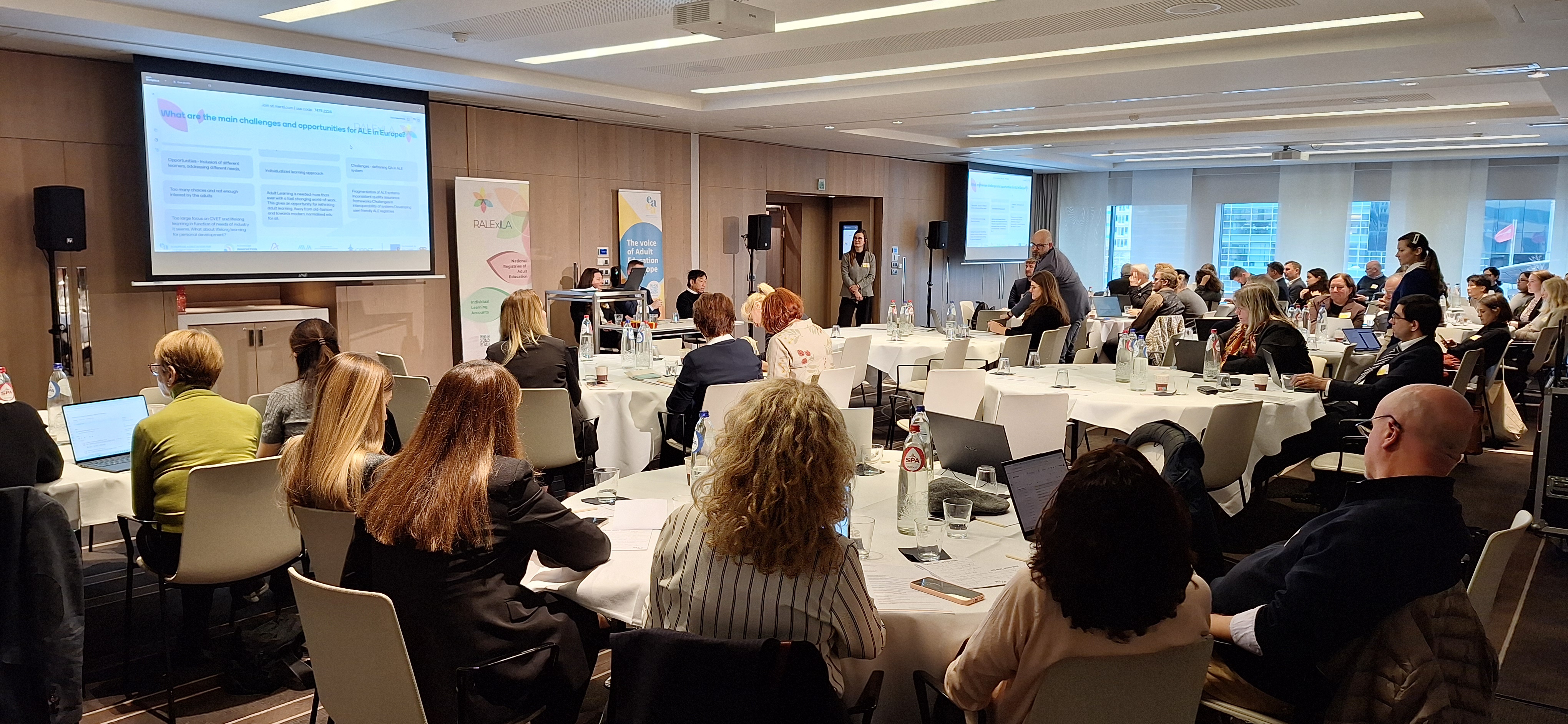
The ‘One Europe, Many Learners Building Foundations for ALE Registries and ILAs’’ conference was organised by the European Association for the Education of Adults (EAEA), on 3rd December 2025, in collaboration with the partners of the RALExILA initiative, to explore the future of Adult Learning and Education (ALE) in Europe, with a specific focus on the development of national registries and their integration into Individual Learning Account (ILA) systems.
RALExILA is an initiative co-funded by the European Union born to develop a model for national registries for adult education to support the implementation of individual learning accounts in European countries. The RALExILA approach proposes a foundational model that is scalable at national level across Europe, promoting knowledge exchange among countries and stakeholders.
The event included contributions and participations of representatives from European Commission, OECD, CEDEFOP, Lifelong Learning Platform, national ALE associations, public authorities at national and regional level, European networks involved in education and quality assurance, and academia.
ALE ecosystems in Europe
The opening by Raffaela Kiher, Secretary general of EAEA, focused on the main challenges and needs for ALE in Europe. Kihrer remarked that lifelong learning is a human right, not just a slogan: it is an approach to make it real. While the conversation on national registries, individual learning accounts and such instruments may sound very technical, it is in reality related to visibility of ALE, fairness and real opportunities for learners. Europe needs integrated learning systems, not fragmented structures, and the event was an excellent opportunity to explore core aspects to design and improve this ecosystem further. The RALExILA initiative, coordinated by EAEA, has shown that system innovation is possible when it is created together with learners and with wide collaboration of different stakeholders.
After the opening, keynote speakers provided an overview of the state of play for individual learning accounts and registries in Europe.
Johnny Sung (University of Oxford and Thematic Expert on Individual Learning Accounts for DG EMPL, European Commission) guided the participants on a journey through the learner’s perspective, related to accessing and using such instruments. Sung remarked how these instruments are very attractive to promote adult learning and how they have the potential to make public funding portable across jobs, professions and needs. From the learner’s perspective, access and information is still fragmented though and matching individual needs to what already exists is not always obvious. ILAs on their own – as personal learning budgets – are not enough, they need quality registries and the wider ecosystem in place. Registries are powerful foundations, also to reach out: they are not glamorous because they are backroom work, but they provide legitimacy. Ultimately, success in this sense is about every potential learner being able to find what they need.
In the following, Patrycja Lipinska and Mantas Sekmokas from CEDEFOP offered an overview on the implementation of individual learning account and other funding instruments for adult education in Europe, based the recent studies on ILAs and training funds and the event ‘’Financing adult learning’’. Lipinska and Sekmokas presented the approach to identify ‘’spaces’’ for ILA development in the countries involved in the study (Estonia, Ireland, The Netherland, Germany, Austria) and the factors can be considered enabling such schema, based on the existing financing arrangements and on type of training provision to be supported (demand side instruments). The approach was also looking at proposing potential way forwards for development, based on the specific contextual situation. The results of the study also supported the development of a step-by-step roadmap for designing and implementing ILAs, from preparatory work (such as ALE ecosystem analysis), to identification of which type of ILA should be designed (fully fledged, smaller ILA-type instruments), to creating the core governance structures and monitoring systems.
RALExILA: a model and approach to develop ALE and ILA systems
The morning was concluded with a Demo session on the prototyping process to establish national adult learning registries applying the RALExILA approach, led by Stefan Jahnke and Domen Bevec from Knowledge Innovation Center. Participants had the occasion to dive into the RALExILA approach, its system model, and methodology for the development of adult learning registries (data backbone) and individual learning accounts (portal). The approach is based on various core design principles: start small, focus on clear user value, build in phases, consider realistic context in various countries. The core messages of this approach? Capabilities before complexity!
Deep diving into the core aspects of ALE integrated ecosystems
In the second part of the day, participants were able to join deep dive workshops on integrating quality assurance across education sectors, information systems for ALE, and governance and stakeholders’ collaboration for a strong ALE ecosystem.
The workshop ‘’Quality assurance across sectors: toward an integrated approach for adult education between formal and non-formal systems’’ explored how quality assurance (QA) in adult education can be designed as an integrated approach across formal and non-formal sectors, balancing learner trust and protection with feasible requirements for providers. Through a structured discussion from the perspectives of public authorities, small training providers, and adult learners, participants compared what QA should achieve, examined which mechanisms work (or fail) in their contexts, and identified enabling conditions, effective tools, and incentives that lead to real quality improvement rather than just compliance. The discussions spanned from policy to implementation aspects. Participants discussed what is QA in education today and which key components and mechanisms should be included, which body should be responsible and which organisations should be the service providers; and, finally, how to define the scope of assessment and support the costs of these processes. Related to policy development, core aspects to consider are the level of ‘’formality’’ these processes should have, especially in the ALE sector, how to ensure that QA processes support trust from learners (in the quality of the learning offer), while avoiding for them to become a burden or just a bureaucratic procedure for providers, which mechanisms of QA also support improvements of the learning offers, and, finally, which incentives and conditions can make an integrated QA system works.
The second workshop ‘’Interoperable information systems for education: quality of information and data-driven policy developments’’ was organised as a participatory policy lab, where participants explored how data from interoperable ALE/ILA systems, like those shown in the RALExILA prototype, can inform smarter, fairer, and more transparent policy and funding decisions in Adult Learning across Europe. Participants discussed extensively the concept of interoperability for policy, which must be ‘’interoperability by design’’. They also discussed which are the main differences between more established systems (for example in higher education) and more diverse/fragmented ecosystems (for example ALE), in terms of interoperability challenges and design requirements, also considering existing frameworks like Higher Education Interoperability Framework (HEIF), EHESO Microdata (European Higher Education Sector Observatory) and DEQAR approach (Database of External Quality Assurance Results).
The last workshop on ‘’Governance and policy coherence: whole system approach and multi stakeholders’ collaboration’’ proposed working groups and discussion tables from three main different perspectives: EU Institutions & Policy Frameworks; Civil Society, Education Providers & Learner Participation; Local & National Sectoral Initiatives. Each table was prompted to share key insights, challenges and barriers, opportunities and enabling factors and, finally, concrete actionable recommendations. From the perspective of CSO and education providers, the core recommendation was to ensure by law the involvement of learners and providers in the system and provide funding for them to organise. From the point of view of national and local initiatives, participants endorsed the idea of an extensive needs and gaps analysis across different levels and stakeholders. Finally, the most actionable recommendations related to the EU institutions regarded the meaningful involvement of a wide set of stakeholders into the development and governance of registries and new policies, the support to MS stakeholders for funding and enabling continuous development of policies (upward spiral), and, finally, encouragement to a wider use of ESCO (European Skills, Competences, and Occupations).
The event closed with an experts panel to summarize the main take aways of the day and of the work conducted so far.
The panel was moderated by Zvonka Pangerc-Pahernik (Head of Awareness Raising and Information Unit – Andragoški center Republike Slovenije – ACS), with contribution by Eva Farkas (Professor Szeged University and ILA expert for Hungary), Ricardo Espinoza (Head of Vocational Education and Training, OECD Centre for Skills), Klara Engels-Perenyi (Policy officer – European Commission, DG Employment) and Colin Tuck (Higher Education Policy Consultant – Knowledge and Innovation Centre).
The closing panel focused on the insights generated throughout the event and explore concrete pathways toward an integrated, equitable, and future-ready European system for Adult Learning and Education (ALE), connecting the discussions on quality assurance, interoperable information systems, governance, and the role of Individual Learning Accounts (ILAs) with broader questions of system transformation and shared responsibility across sectors. The panel tried provocatively to answer the most relevant question: Why do we need well designed ALE registries when we have online search engines?
From the perspective of systems and interoperability, legacies for existing systems (for example for higher education) are a value to leverage, while, in developing these systems for ALE, there is now the great opportunity to design for interoperability. Interoperability among learning opportunities registries is a strong base for decision making and policy making. And, ultimately, we need to ensure that the requirements (for registries, portals ec.) match the learner needs and demands. Interoperability is not always the easiest route, but it will pay off.
As for quality assurance, these processes have different meaning for different people, from the point of view of governance, funding, learners and employers. A useful way to think about QA, could be from the point of view of risk and how much risk are institutions willing to take: there is a risk of underperforming and providing low quality education and training and there is a cost to be more comprehensive. Finding this balance between risk and cost is fundamental.
Finally, in terms of governance, multi stakeholders’ collaboration is fundamental and possibly unavoidable for instruments like ILA to function and have an impact, which include learners. Providing legal systems to ensure a role for learners and educators in policy making processes is an option that was discussed, including for example consulting citizens directly with citizen panels, as well as bringing forward their voice by other stakeholders involved in registries or other adult learning measures. Cross countries peer learning programmes are also fundamental to support these processes.
The main take away of the event is about the perspective and interpretation of ILAs, registries and related portals as broad policy and implementation instruments.
ILA concept can go beyond the funding instrument as such. ILA can be seen as a core centralized ecosystem and tool (independent and aggregating information from various services), as a management instrument of funding and programmes and, more importantly of all, as a driver of change of systems but also of culture and mindsets and as systems for learners to drive their own learning processes.
It is time for innovation, innovation and not reform. Reform is repairing an old model, while innovation is transforming something completely, and ILA could be a tool for this innovation.
Our new slogan is now: ‘’ILA as a movement’’!
The results of the RALExILA initiative will be fully available in March 2026!
For now, you can read our extensive research report ‘’Building National Registries for ALE in Europe’’
If you are interested in exploring the RALExILA methodology, system model and prototype for ALE registries and ILA platforms, you can get in contact with us to organise a dedicated free of charge online demo for your staff and partners!
Contact Viola Pinzi – viola.pinzi@eaea.org
Text: Viola PinziPhotos: EAEA