

According to the International Telecommunications Union (2024), only 68% of the world population has internet access. Access to education is a human right, yet for many people in detention, that right remains uneven and limited. The integration of digital education in detention settings is even more complex due to security concerns, restricted internet access or limited digital infrastructure. According to the United Nations Digital Rehabilitation in Prisons Report (2024), access to digital technologies and the internet for incarcerated people remains limited and unequal across large parts of the world. Such constraints undermine opportunities to build digital competences that are crucial for meaningful engagement in modern society and for current labour market integration. Without strategic and targeted initiatives, the digital gap risks deepening the social exclusion of those leaving prisons.
Lessons from Practice: integrating digital education in prisons
Across Europe, educators and institutions offer solutions to introduce safe, meaningful digital inclusion in prisons. Let’s explore some of these practices together:
- In the United Kingdom, the Prisoner’s Education Trust and the Ministry of Justice have collaborated on digital learning pilots using secure tablets and closed intranet systems. These enable incarcerated learners to access approved educational content, complete vocational qualifications, and develop transferable digital skills.
- Finland’s Smart Prison model is among the most advanced systems in Europe. Every cell is equipped with a laptop connected to a whitelisted Moodle environment that includes coursework, dictionaries, and access to Studyinfo, Finland’s national education portal.
- In Catalonia, the Open University of Catalonia has partnered with the regional justice department to provide limited yet structured internet access. Findings indicate that this controlled connectivity improves mental well-being, engagement, and self-efficacy among participants (Romero, 2025).
- Norway enshrines the right to education for all people in detention under national law, aligning prison learning policies with the broader Norwegian model of rehabilitation and reintegration. The government funds digital networks that enable controlled e-learning in most correctional facilities, ensuring parity with external education systems.
Examples across Europe demonstrate that progress is possible. Across these practices, a shared principle emerges: digital inclusion in prison education is not only a technological choice but a governance and strategic decision. In today’s digital world, learning in detention contexts needs to include digital components, and not solely traditional methods.
DigiFusE: improving digital education environments
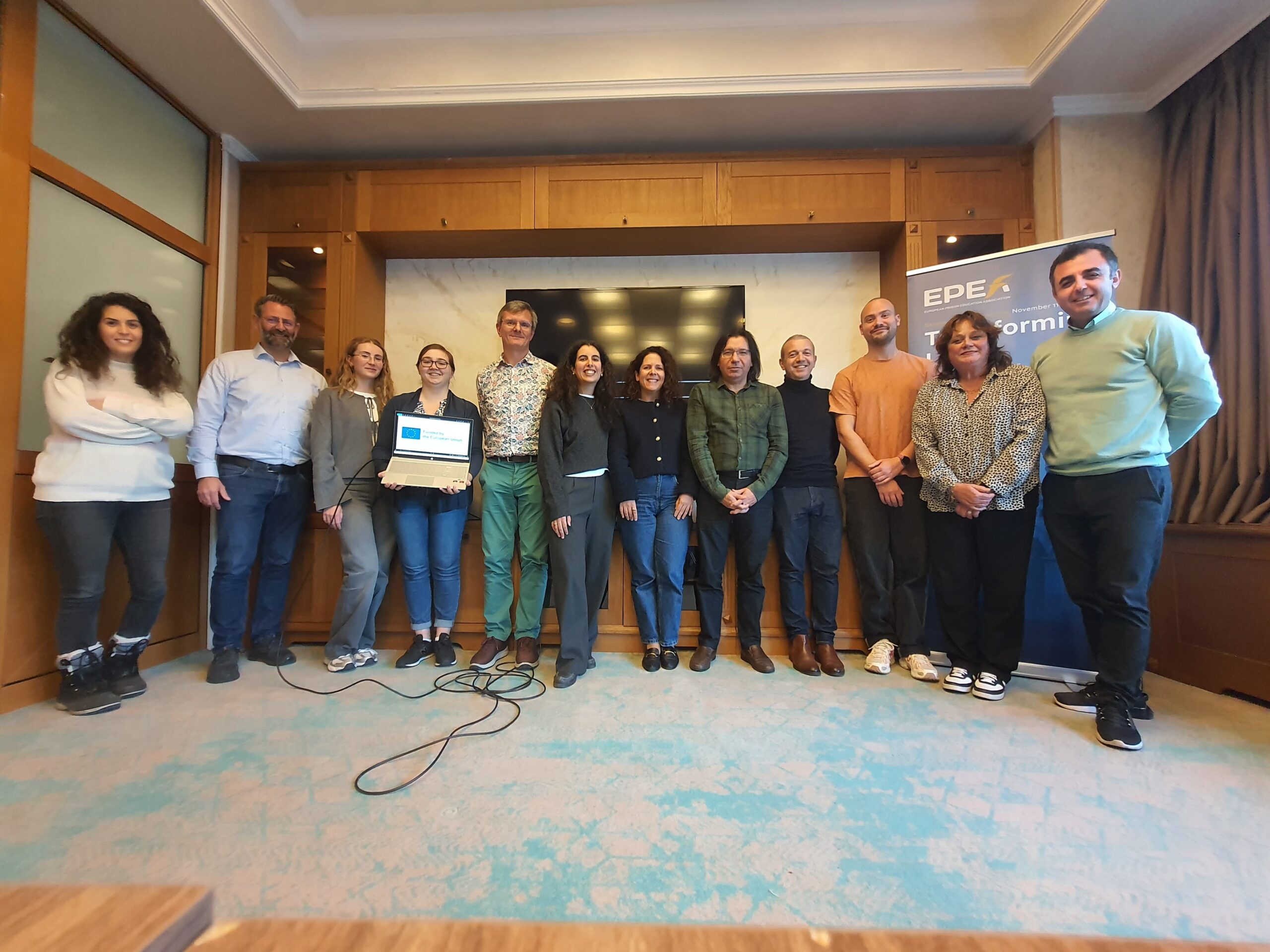
EAEA has been working on these themes for more than a year, thanks to the Erasmus+ KA2 project DigiFusE: Digital Fusion Environments. In November, partners met in Skopje, North Macedonia, to participate in and organise a few sessions at the European Prison Education Association (EPEA) conference: Transforming Lives Through Prison Education. The partners also held the third in-person meeting to discuss the work progress and start the work on the EU-level model, which will act as a toolkit for organisations, educators, and decision-makers who want to start or deepen their work in integrating digital education in detention contexts.
 |  |
For further information on the project, its methodology and partners, please visit the DigiFusE website and read the second project newsletter.
Read more on the good practices of this article at:
- Ministry of Justice, UK. (2016). Unlocking potential: A review of education in prison. GOV.UK. https://assets.publishing.service.gov.uk/media/5a7f537eed915d74e33f5bf5/education-review-report.pdf
- Prisoners’ Education Trust. (2020). Written evidence submitted by Prisoners’ Education Trust (PET) (DEO0018). UK Parliament Committees. https://committees.parliament.uk/writtenevidence/5695/default/
- Puolakka, P. (2023). Smart Prison: Digital Environment for Rehabilitation. Criminal Sanctions Agency (RISE). https://www.communityjusticecoalition.org/wp-content/uploads/2023/04/Smart-Prison_2023_edited_FJ_2.pdf
- Tranquil Earth Alliance. (2024). Finland – Normalcy in prison. https://tranquilearthalliance.com/normalcy/finland/
- Järveläinen, Eeva & Rantanen, Teemu (2025). Incarcerated people’s limitations of digital agency and re-entry into digitalised society: A qualitative study in a women’s prison in Finland. Criminology & Criminal Justice. (Advance online publication). 10.5204/ijcjsd.3774.
- Universitat Oberta de Catalunya (UOC). (2025). Internet use in prisons improves inmates’ well-being and social reintegration. https://www.uoc.edu/en/news/2025/internet-in-prisons-improves-well-being
- Romero, P. (2025). The use of online tools and Internet access in prisons: insights from Catalonia. Current Issues in Criminal Justice. https://www.tandfonline.com/doi/abs/10.1080/10345329.2025.2502886
- Klasbak. (2025). Good practices – Norway. https://www.klasbak.net/nl/english/good-practices
- Universitas. (2025). Education Behind the Prison Walls. https://www.universitas.no/education-behind-the-prison-walls/391942
Text: Gimar Reyes, Maria Gonçalves RibeiroPhotos: Maria Gonçalves Ribeiro