

AI in education raises many expectations as well as questions about its appropriate and ethical use.
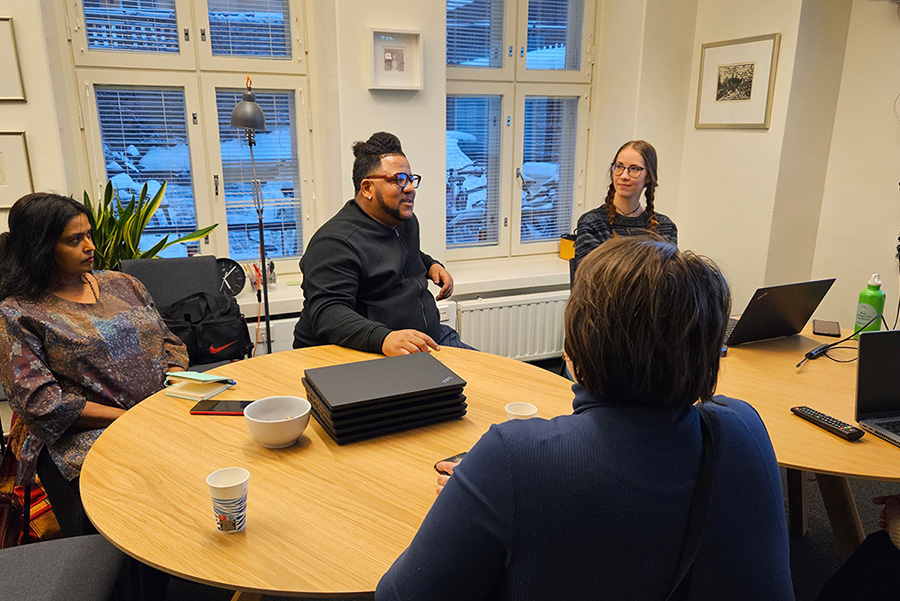
How could generative AI support the learning of Finnish writing skills? This question was the starting point of a pilot course organised by the Finnish Lifelong Learning Foundation. The training was part of the ETHLAE project, which seeks effective ways to use new technologies in adult education.
The course programme was based on a model developed in the project on how technologies can be used in teaching literacy. The Foundation’s partner, personnel service company Seure, helped find participants for the four-session course. The participants work as school assistants and daycare assistants through Seure, and they all had immigration background.
Writing begins with one’s own thinking
One of the course teachers, Nina Hjelt, who works as a lifelong learning specialist at the Foundation, familiarised herself with the tools and resources compiled in the project when preparing the course.
“I had never taught AI use before, so I had to think about how to approach the topic,” Hjelt explains. “For me, Faktabaari’s AI Guide for Teachers and Enorssi’s information package were good sources for getting introduction to the topic.”
Ella Hyvönen was the second teacher on the course. While teaching, she completed her teaching practice as part of her pedagogical studies.
“Our starting point was that AI does not replace one’s own thinking. We emphasised that on this course, students don’t ask AI to write on their behalf – they always write the first version themselves. Otherwise, you won’t learn, and your own voice won’t come through in the text,” says Hyvönen, who holds a Master’s degree in Finnish language.
Flexibility and learner-centred approach as guiding principles
At the beginning of the course, it became clear that the students had joined primarily because they were interested in using AI. Many, however, had only used it in traditional ways such as translating text, and were not familiar with its wider possibilities.
“The students had different skill levels, and some had used AI quite a lot. We realised that to make the course sufficiently challenging and useful, it needed to be differentiated,” Hjelt notes.
Flexibility and putting the learners’ needs to the centre were essential on the course. The content of the lessons was continuously adapted based on learners’ needs and wishes. This worked well because the group was small, with six students. Hjelt points out that with a larger group, the approach would have been different.
AI was both a topic and a tool in the course. Everything started from the basics.
“We went through the key concepts of generative AI: what services are currently available, how they work, how to create prompts, and what safe use entails,” Hjelt explains.
Hjelt points out that basic skills teachers must always consider how new tools fit into learners’ everyday lives. Once you learn to use a tool, you can continue using it independently.
“I see this as extremely useful for the learners. As the course progressed, we saw moments of insight and excitement in their eyes. We also repeated activities with small variations to support learning.”
Examples of how AI was used
The course mainly used Google’s Gemini and especially its Writing Assistant agent, which, as the name suggests, specialises in writing skills.
According to Ella Hyvönen, generative AI was very helpful for proofreading students’ own texts and giving feedback for them.
For example, the students practised writing job applications. They looked for an interesting job advertisement and wrote an application, or part of it. Finally, they showed both the advertisement and their application to the AI tool and asked for feedback.
“AI might say: ‘You didn’t answer this question, add these points.’ It worked as a good guide,” Hyvönen explains. “It surprised me how much it helped the students, and in a way also me as a teacher.”
AI was also used for text analysis and vocabulary practice. Students were given a homework to bring a text they found difficult to the course. First, they analysed it themselves, and then asked AI to identify five essential words for understanding the text. This helped in learning vocabulary.
AI use motivated the students
Course participants Elena Nikula and Anna Tervo Briceno, both working as school assistants, found the course highly useful and timely.
“AI was extremely helpful in developing my writing skills,” Nikula says. “I had already learned to use AI in Russian, but I had hoped I could use it in Finnish too. Thanks to this course, this dream has now come true.”
Tervo Briceno needs strong writing skills in her work at schools, which motivated her to join the course. She says she learned to use AI to summarise long texts and convert them into plain language.
“With its help, I can also edit text and find mistakes. AI helps me notice things I wouldn’t see myself.”
The participants appreciated that the course included a lot of writing, discussion, and interaction. In addition to AI, other digital tools such as Miro and Padlet were also used.
A side effect of AI: decreased tolerance of uncertainty
Both Nina Hjelt and Ella Hyvönen see challenges in using AI, one of which is a reduced tolerance for discomfort and uncertainty. Students may begin to rely too heavily on AI and translation tools, losing confidence in their own abilities.
“It can become a life jacket. In the worst case, you won’t learn the language or writing skills if you always rely on AI. It’s important to discuss where the uncertainty comes from and what concrete steps can help build more confidence,” Hyvönen notes.
Pedagogical competence is always at the core
“The power of face-to-face conversation should not be underestimated. And it’s important to be able to write bad texts – no one produces a good result on the first try,” Hyvönen stresses.
Using technology always comes with surprises, so the teacher must prepare carefully in advance, Hjelt notes. You need to prepare the learning environment, create links, and test them. The teacher also needs a backup plan in case something goes wrong.
From the learner’s perspective, a tool may seem easy to use, but the teacher should have deeper understanding.
“Pedagogical competence is always at the core. You need to consider whether these tools are actually helpful, or whether something else could work better.”
Both teachers were left with a positive impression of the writing skills course and felt that the students gained a lot from it.
“Many employers in expert roles teach their staff how to use AI,” Hjelt says. “But there are many jobs where people receive no support at all. Nobody actually shows the possibilities AI offers or how it works. Reading and writing will change significantly in the age of AI. It was important to address this topic, and learners benefit from it in any context. I believe the same applies in other countries too.”
***
Put the technology toolkit into use!
The ETHLAE Erasmus+ project has published a toolkit that includes 10 descriptions of different adult learning situations where new technologies are used. The learning situations are divided into five themes:
1. literacy and numeracy
2. sustainability
3. digital spaces and communities
4. democracy and active engagement
5. personal, social, and learning to learn skills
Some of the learning situations will be tested during spring in the project partner countries. The toolkit also contains a resource collection, including tools as well as articles, publications, and online courses on using technologies in education and learning.

Text: Sari PohjolaPhotos: Sari Pohjola